
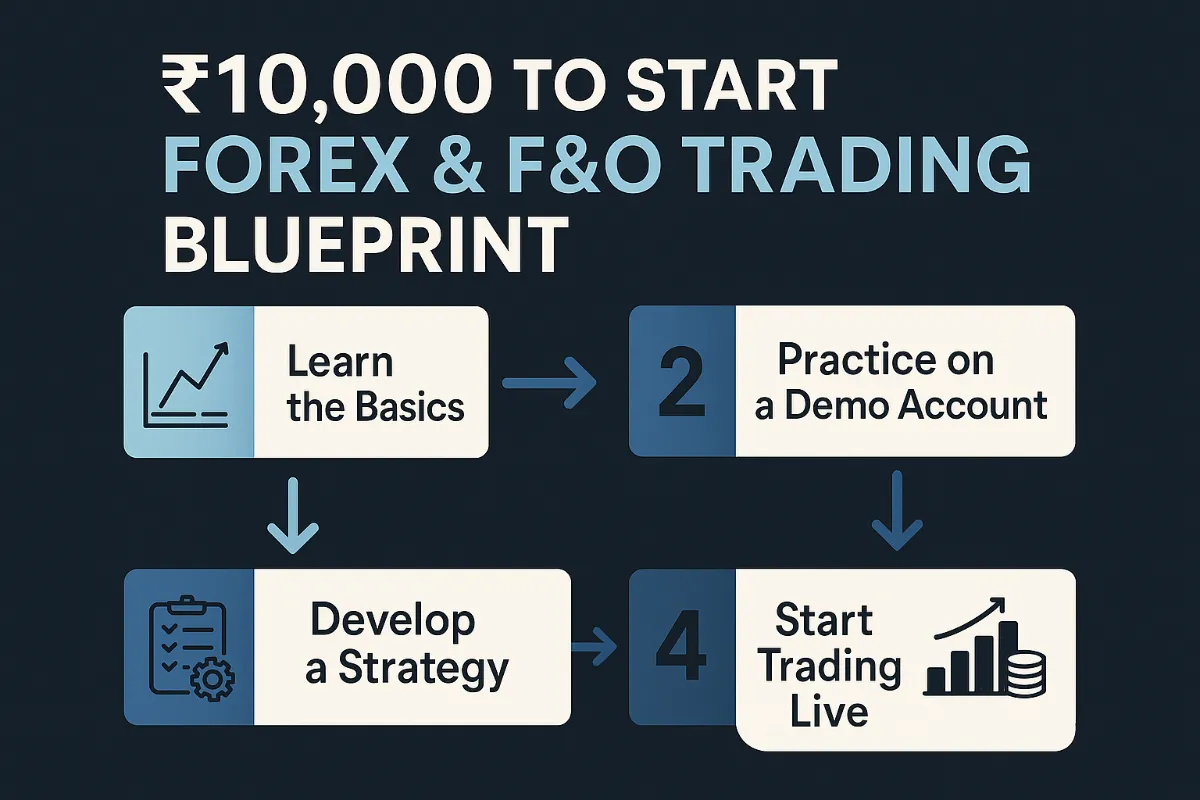
Hook Introduction: A Small Beginning, A Big Transformation
Every successful trader you see today—whether on YouTube, LinkedIn, or financial forums—started from a small amount, a small dream, and a small spark of curiosity.
Most people assume that Forex and F&O trading require big capital, advanced setups, or premium strategies. But the truth is simple:
Table of Contents
You can start your trading journey with just ₹10,000—IF you follow the right blueprint.
In the past two years (2023–2025), retail trading participation in India has jumped by more than 42%, proving that people now treat trading as a serious skill, not a quick-money gamble.
But here’s the real problem:
A ₹10,000 account can survive months with discipline…
Or disappear in minutes with poor decisions.
This guide is not about making you rich quickly.
It’s about helping you become a trader who survives and succeeds, step by step.
You’re not just learning trading today—you’re learning a lifelong skill.
TABLE 1 — Forex & F&O Market Growth (2024–2030 Projections)
| Year | Forex Avg Daily Volume (USD Trillion) | India F&O Volume Growth | Retail Participation % | 2030 Outlook |
|---|---|---|---|---|
| 2024 | 7.5 | 18% | 42% | – |
| 2025 | 7.8 | 21% | 45% | – |
| 2027 | 8.3 | 26% | 50% | Strong global liquidity |
| 2030 | 9.0 | 32% | 56% | AI-powered trading era |
What Exactly Are Forex & F&O Trading? (Beginner-Friendly Explanation)
Forex (Foreign Exchange) is the world’s largest financial market, where currencies like USD/INR, EUR/USD, GBP/JPY are traded.
With a daily turnover of $7.5 trillion in 2024, it offers unmatched liquidity, flexible timings, and opportunities for global traders.
F&O (Futures & Options) trading takes place in India’s derivatives market, where you trade Nifty, Bank Nifty, stocks, commodities, and currency contracts.
F&O allows you to hedge, speculate, or manage risk—but only if you understand its structure.
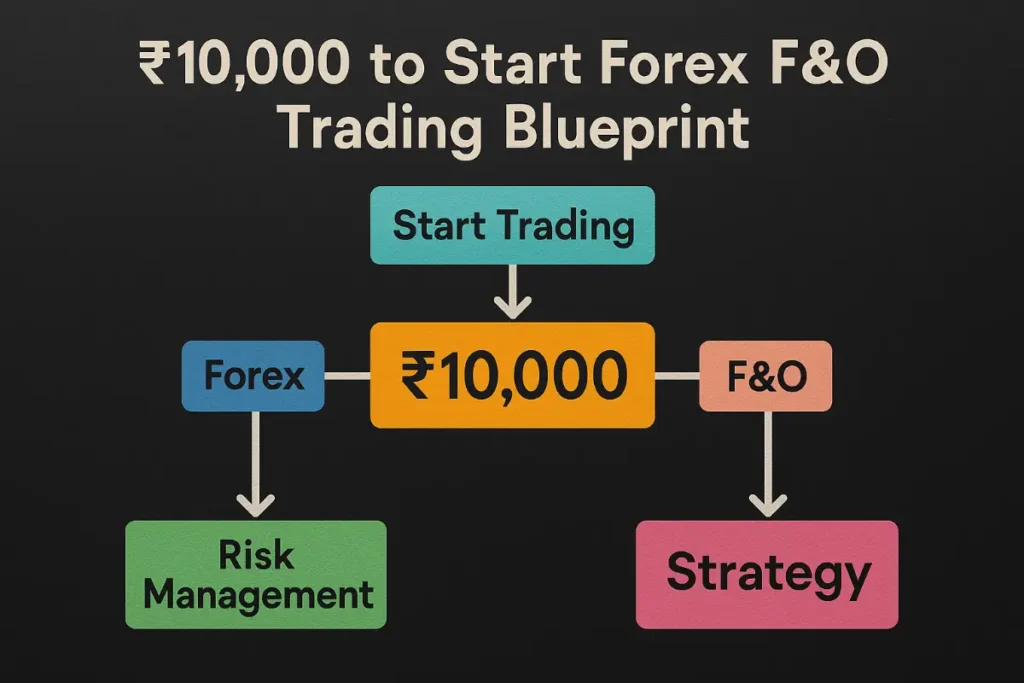
Both markets offer leverage—a double-edged sword.
It lets you control big positions with small capital, but also magnifies losses if misused.
That’s why this blueprint exists:
to teach safe, structured, and beginner-friendly trading with ₹10,000.
Also Read: Gold Futures: Trading at 3,362.52 with +0.13% Gain
How Can You Start Trading with Just ₹10,000? The Real Logic
Most beginners think small capital cannot survive.
But trading doesn’t depend on money—it depends on mindset, skill, and risk management.
If you’re willing to:
- Take small risks
- Accept slow, steady growth
- Build skills instead of chasing jackpots
…then ₹10,000 is enough to start a powerful journey.
The purpose of ₹10,000 is not to build wealth instantly—
it’s to build discipline and experience.
That discipline eventually scales to ₹1 lakh, ₹5 lakhs, and more.
TABLE 2 — Beginner Trading Journey Timeline (2025–2030)
| Stage | Duration | Key Focus Area | Expected Capital | Success Indicator |
|---|---|---|---|---|
| Demo Phase | 15–20 days | Chart basics | ₹0 | Consistent paper profits |
| Live Start | 1–2 months | Risk & SL discipline | ₹10,000 | Small wins + small losses |
| Skill Growth | 3–6 months | Strategy execution | ₹15k–₹25k | Reduced emotional errors |
| Consistency | 6–12 months | Psychology control | ₹25k–₹50k | Discipline above profit |
The Step-by-Step Blueprint to Start Forex & F&O Trading with ₹10,000
Step 1 — Build the Right Trading Mindset
Before strategies, charts, or profits—mindset comes first.
Most beginners fail because they approach trading like a lottery.
Professionals win because they treat trading like a business.
A strong mindset means:
- You focus on process, not profit
- You understand that losses are normal
- You avoid emotional decisions
- You value discipline more than prediction
74% of beginners lose money (2024 data) not because of bad strategies,
but because of lack of structure.
This blueprint will give you that structure.
Step 2 — Choose Your Market: Forex or F&O?
Here’s the simple breakdown:
Forex Advantages:
- 24-hour market
- Small capital-friendly
- Global liquidity
- Micro-lot trading available
F&O Advantages:
- Indian market familiarity
- High intraday movement
- Excellent for short-term opportunities
Beginners should ideally start with:
✔ Forex micro-lots
✔ Nifty/Bank Nifty options (1 small lot)
These offer the safest learning environment.
Step 3 — Account Setup (100% Legal and Safe Methods)
Forex (SEBI-compliant route):
Trade only INR currency pairs (USD/INR, EUR/INR, GBP/INR, JPY/INR).
F&O Trading:
Brokers like Zerodha, Upstox, ICICI Direct, Angel One are perfect.
Required documents:
- PAN
- Aadhaar
- Bank Account
- Selfie Verification
Account opening takes 10 minutes.
Step 4 — Start with Demo Trading (Your No-Risk Training Ground)
A demo account is your safest teacher.
Trade 15–20 days on demo before going live.
Demo helps you learn:
- Market structure
- Entry & exit timing
- Risk management
- Real emotions without real loss
Smart traders practice first.
Overconfident traders lose first.
TABLE 3 — Demo vs Real Trading Skills Comparison
| Skill Area | Demo Trading Impact | Real Trading Impact | Why It Matters |
|---|---|---|---|
| Strategy Practice | High | Moderate | Builds confidence |
| Emotion Control | Low | High | Real money triggers fear/greed |
| Risk Discipline | Medium | High | Critical for survival |
| Execution Speed | High | High | Same in both |
Risk Management — The Heart of Surviving ₹10,000 Trading
If strategy is the engine,
risk management is the seatbelt.
Your small capital survives only when you follow strict risk rules.
Golden Risk Formula for ₹10,000 Capital:
- Risk per trade: 1% = ₹100
- Daily max loss: 3% = ₹300
- Weekly max loss: 6% = ₹600
- Monthly drawdown limit: 12%
- Always use Stop-Loss (SL)
- Never revenge-trade
The goal of small capital is not big profits—
it is avoiding big losses.
Stop-Loss Placement: The Science Behind Safety
Beginners place SL randomly.
Professionals place SL scientifically.
Correct SL depends on:
- Support/resistance zones
- ATR (volatility measure)
- Candle structure
- Market trend
In Forex → SL should be ATR-based
In F&O → SL should be structure-based (swing high/low)
Position Sizing: The Formula That Saves Accounts
Example:
- Capital = ₹10,000
- Risk per trade = ₹100
- SL distance = 15 points
- Value per point = ₹5
Loss per lot = 15 × 5 = ₹75
So you can safely trade 1 lot.
This single formula prevents 70% account blowups.
Why Most ₹10,000 Accounts Get Destroyed?
Because beginners:
- Use high leverage
- Trade too frequently
- Skip stop-loss
- Enter based on emotions
- Expect jackpot profits
Trading rewards discipline—not impulsiveness.
TABLE 4 — Beginner Mistakes vs Professional Trading Approach
| Beginner Mistake | Immediate Result | Pro Trader Approach | Long-Term Outcome |
|---|---|---|---|
| Over-leveraging | Quick blow-up | Controlled lot sizing | Steady growth |
| No Stop-Loss | Huge loss | Pre-defined SL | Small manageable losses |
| Emotional entries | Revenge trades | Rule-based entries | Consistency |
| Overtrading | Burnout | Selective trades | Higher win quality |
Technical Analysis Blueprint (Beginner to Intermediate)
Most beginners complicate technical analysis.
You only need five tools to understand 80% of the market:
- Support & Resistance
- Trendlines
- Moving Averages (20, 50, 200)
- RSI
- Price Action Candles
Master these → You can trade any market confidently.
Price Action Strategy — Perfect for Small Accounts
Steps:
- Identify trend
- Wait for pullback
- Enter on rejection candle
- SL below previous candle
- Target 1:1 or 1:1.5
Price action works in both Forex and F&O and is extremely beginner-friendly.
The 20–50 EMA Strategy (Super Simple & Effective)
Rules:
- 20 EMA above 50 EMA → Buy
- 20 EMA below 50 EMA → Sell
- Enter on pullback
- SL = candle structure
This keeps trading clean and helps avoid noise.
RSI 40–60 Strategy (The Secret of Consistent Traders)
In trending markets, RSI is not very useful.
In ranging markets, it is a gem.
Rules:
- Buy near RSI 40
- Sell near RSI 60
- Confirm with EMA trend
Helps reduce false signals.
TABLE 5 — Strategy Performance Comparison (2025–2030 Projections)
| Strategy | Win Rate | Difficulty | Best Market Type | 2030 Projection |
|---|---|---|---|---|
| Price Action | 55–60% | Medium | All | Still dominant |
| EMA 20–50 | 50–55% | Easy | Trending | More algo-friendly |
| RSI 40–60 | 45–50% | Easy | Ranging | Stable |
Case Study — Rohan’s Journey from ₹10,000 to Consistency
Rohan, a 23-year-old student, began trading because he saw influencers making big money.
He deposited ₹10,000 and traded without SL or rules.
Within three days—he lost ₹7,200.
He didn’t quit.
Instead, he rebuilt himself:
- Month 1 → Demo trading
- Month 2 → Started using SL + lot sizing
- Month 3–6 → Practiced price action
- Month 7 onward → Averaged 4–6% monthly returns
He didn’t turn ₹10k into lakhs.
But he turned confusion into clarity, fear into confidence, chaos into discipline.
That’s the REAL success.
What Is a Realistic Monthly Return for ₹10,000?
Professional traders aim for 4–8%.
Example:
- 4% = ₹400
- 6% = ₹600
- 8% = ₹800
Realistic. Achievable. Sustainable.
Anything above this is gambling, not trading.
The TRUE Purpose of Trading with ₹10,000
Your purpose is to:
✔ Build skills
✔ Build discipline
✔ Build consistency
✔ Avoid big mistakes
✔ Learn market behavior
Once you achieve these → scaling capital becomes easy.
When Should You Increase Your Trading Capital?
Increase only after:
- 3 months of consistent profitable trading
- No emotional revenge trades
- High SL discipline
- Stable psychology
Then you can move from:
₹10,000 → ₹25,000 → ₹50,000 → ₹1,00,000+
TABLE 6 — Capital Scaling Forecast (2025–2030)
| Year | Ideal Capital | Skill Level | Expected Returns | Outcome |
|---|---|---|---|---|
| 2025 | ₹10,000 | Beginner | 3–5% monthly | Learning |
| 2026 | ₹25,000 | Early Intermediate | 4–6% monthly | Stability |
| 2027 | ₹50,000 | Intermediate | 5–7% monthly | Scaling |
| 2030 | ₹1,00,000+ | Advanced | 6–8% monthly | Consistency |
Forex vs F&O — Which Is Better for Beginners?
Forex
✔ Smooth charts
✔ Low capital needed
✔ Micro-lots
✔ Easy to learn
F&O
✔ High movement
✔ Fast profits + fast losses
✔ Requires psychology strength
Beginners should start with Forex + Index Options for safest learning.
2025–2030 Market Outlook
Forex Outlook:
- Strong USD volatility
- AI-based signal systems emerging
- Higher global liquidity
F&O Outlook:
- Retail participation increasing
- Algo dominance rising
- India becoming a derivative powerhouse
Trading will grow—but only disciplined traders will benefit.
Psychology — The Hidden Skill Behind All Trading Success
Most traders don’t fail because of bad strategies.
They fail because of:
- Fear
- Greed
- Impulsiveness
- Overconfidence
- Revenge trading
Master psychology →
You master trading.
The 5 Psychology Rules That Protect Every ₹10,000 Account
- Never trade angry, tired, or emotional
- Stop after 2 consecutive losses
- Never increase lot size after a loss
- Journal every trade
- Follow SL without exception
These rules separate winners from losers.
TABLE 7 — Psychological Factors vs Trading Performance (2024–2030 Study)
| Factor | Impact on Beginners | Improvement Time | 2030 Prediction |
|---|---|---|---|
| Impulse Trades | 60% losses | 3 months | Lower via AI alerts |
| Greed | 40% losses | 6 months | Improved awareness |
| Fear | Missed entries | 4 months | More confidence |
| Ego | Revenge trades | 8 months | Reduced with rules |
FAQs — Experts Answer the Most Common Beginner Questions
Q1. Can I really start trading with ₹10,000?
Yes. With micro-lots, risk control, and structured learning, ₹10,000 is enough.
Q2. Is Forex safe for beginners?
Trading is risky, but regulation + risk management make it educational and manageable.
Q3. Which is better to start—Forex or F&O?
Start with Forex for learning, then move to F&O for confidence.
Q4. What’s a realistic monthly return?
4–8%, not 40–80%. Sustainable growth matters.
Q5. When should I scale capital?
After 3–4 months of stable, rule-based trading.
Conclusion — Your ₹10,000 Is Not Small. Your Mindset Is Powerful.
Trading is not about the size of your money.
It’s about the size of your discipline.
Your ₹10,000 is a seed.
If used wisely, it will grow—not just into money,
but into:
- Skill
- Confidence
- Consistency
- A trader’s mindset
You have just taken the first step of a long, beautiful trading journey.