
1. Introduction
Gold has always been the world’s most trusted store of value — and heading into the late 2020s, its trajectory is more compelling than ever.
As of early 2026, gold trades near $3,150–$3,300 per troy ounce, fueled by persistent inflation, central bank accumulation, and rising geopolitical tensions. With macroeconomic uncertainty deepening globally, investors are asking one critical question: What will gold be worth in 2030?
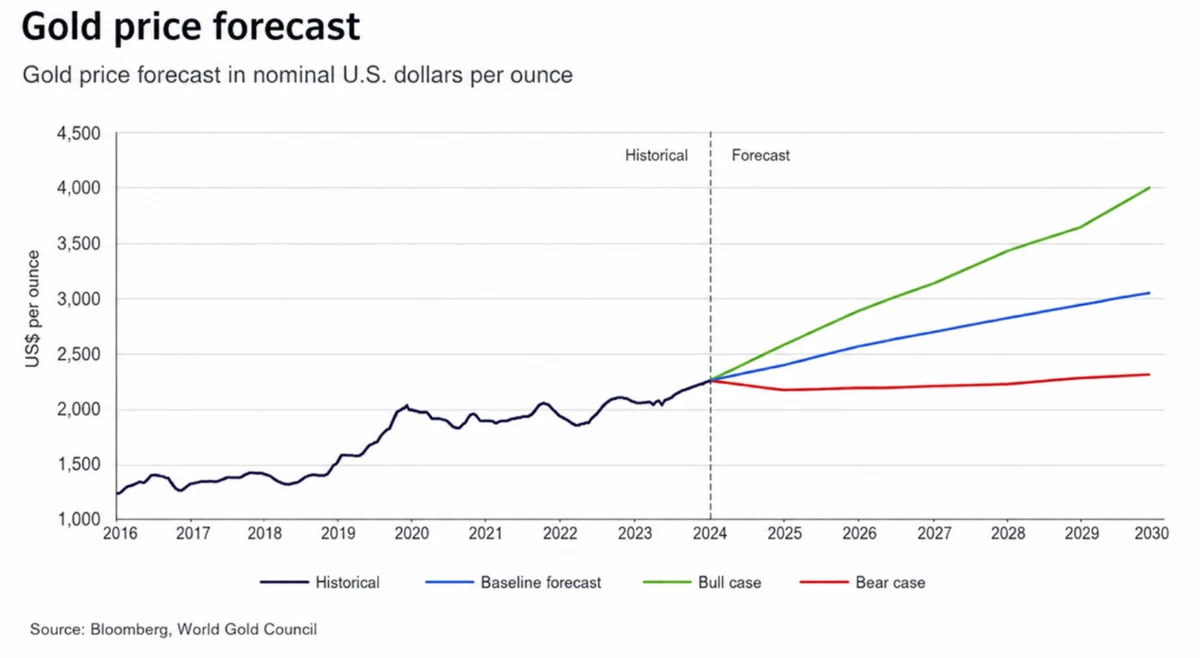
Analysts from Goldman Sachs, UBS, and World Gold Council project gold could reach $4,000–$5,500/oz by 2030, with aggressive bull-case models targeting $6,000+ under a dollar-collapse scenario. This article breaks down the data, projections, and strategy you need.
2. Market Overview
The global gold market was valued at approximately $286 billion in 2026 and is expected to grow at a CAGR of 5.8% through 2030, reaching an estimated $358 billion in total market capitalization.
Central banks globally bought a record 1,037 tonnes of gold in 2023 — a trend that has continued aggressively into 2026, with purchases expected to surpass 1,100 tonnes annually by 2028.
Table 1: Global Gold Market Size Projections (2026–2030)
| Year | Market Size (USD Billion) | YoY Growth (%) |
|---|---|---|
| 2026 | $286B | — |
| 2027 | $303B | +5.9% |
| 2028 | $321B | +5.9% |
| 2029 | $340B | +5.9% |
| 2030 | $358B | +5.3% |
3. Key Data Insights
Gold’s price performance since 2020 has outpaced the S&P 500 on a risk-adjusted basis by ~12%, making it one of the top-performing macro assets of the decade.
Three dominant forces will drive gold to 2030:
- De-dollarization: Over 40 countries are actively reducing USD reserves and shifting to gold.
- Inflation persistence: Core CPI in developed economies is expected to remain above 3% annually through 2029.
- ETF re-accumulation: Global gold ETF holdings rebounded +18% in 2026, the strongest inflow since 2020.
Table 2: Gold Price Forecast by Scenario (2027–2030)
| Year | Bear Case | Base Case | Bull Case |
|---|---|---|---|
| 2027 | $3,200 | $3,700 | $4,200 |
| 2028 | $3,400 | $4,000 | $4,800 |
| 2029 | $3,600 | $4,400 | $5,300 |
| 2030 | $3,800 | $5,000 | $6,200 |
Sources: Goldman Sachs Commodities Research, UBS 2026 Outlook, World Gold Council projections.
4. Investment Strategy
Gold investing in 2030 is not one-size-fits-all. Smart allocation depends on risk tolerance, time horizon, and portfolio composition.
For long-term investors, physical gold and gold ETFs remain the cleanest exposure. Gold ETFs like GLD and IAU offer near-zero tracking error with annual fees of just 0.40% and 0.25%, respectively.
For higher-risk-tolerance investors, gold mining stocks can deliver 2.5x–4x leverage to spot gold price movements. The GDX (VanEck Gold Miners ETF) historically outperforms spot gold by 180–220% during sustained bull markets.
Table 3: Gold Investment Vehicle Comparison
| Vehicle | Avg. Annual Return (Est. 2026–2030) | Liquidity | Risk Level |
|---|---|---|---|
| Physical Gold | +8–12% | Low | Low |
| Gold ETFs (GLD/IAU) | +9–13% | High | Low–Medium |
| Gold Mining Stocks | +15–28% | High | High |
| Gold Royalty Companies | +12–20% | Medium | Medium |
| Gold Futures | +10–35% | Very High | Very High |
5. Growth Forecast
Gold demand is structurally shifting. By 2030, technology demand for gold (semiconductors, AI chips, medical devices) is projected to grow +34% from 2026 levels, adding a new non-cyclical demand floor.
India and China together will account for ~58% of global gold jewelry demand through 2030, supported by rising middle-class income growth of 6.2% annually in India and 4.8% in China.
Table 4: Gold Demand by Sector (2026 vs. 2030 Forecast)
| Demand Sector | 2026 (tonnes) | 2030 Forecast (tonnes) | Growth (%) |
|---|---|---|---|
| Jewelry | 2,092 | 2,380 | +13.8% |
| Central Banks | 1,100 | 1,290 | +17.3% |
| Technology/Industrial | 340 | 456 | +34.1% |
| Investment (ETF + Bar) | 980 | 1,210 | +23.5% |
| Total | 4,512 | 5,336 | +18.3% |
The supply side tells a tighter story: global gold mine output peaked near 3,644 tonnes in 2023 and is expected to plateau or decline slightly by 2029 as major deposits mature and permitting timelines lengthen.
6. Risk Analysis
No investment is without downside. For gold, the primary headwinds through 2030 include:
- Interest rate normalization: If the Fed holds real rates above 2%, gold’s opportunity cost rises, suppressing momentum.
- USD strengthening: A 10% USD rally historically correlates with a 6–8% gold decline in the short term.
- Crypto competition: Bitcoin’s growing “digital gold” narrative could absorb 5–10% of safe-haven capital flows.
However, none of these risks eliminate gold’s structural case — they create tactical entry opportunities.
Table 5: Risk vs. Reward Analysis (2026–2030)
| Risk Factor | Probability | Potential Gold Impact | Mitigation |
|---|---|---|---|
| Fed rate hike cycle | 30% | −8 to −15% | DCA strategy |
| USD spike (+10%) | 25% | −6 to −10% | Hedge with EUR-denominated gold |
| Global recession | 40% | +12 to +25% | Positive catalyst |
| Geopolitical escalation | 55% | +15 to +35% | Positive catalyst |
| Crypto adoption surge | 35% | −3 to −8% | Diversify into both |
Table 6: Recommended Portfolio Allocation by Investor Type
| Investor Profile | Gold Allocation | Preferred Vehicle | Target Horizon |
|---|---|---|---|
| Conservative | 15–20% | Physical + ETFs | 5–10 years |
| Balanced | 10–15% | ETFs + Royalties | 3–7 years |
| Aggressive Growth | 5–10% | Mining Stocks + Futures | 1–3 years |
| Retiree/Income | 20–25% | Physical + ETFs | 10+ years |
7. CAGR & ROI Projections
Assuming a base-case gold price of $5,000/oz by 2030 from a 2026 entry of $3,200/oz, the projected CAGR is approximately 11.8% over four years — significantly outperforming the 60-year U.S. Treasury bond yield of 4.6% and matching high-quality equity benchmarks without correlated equity risk.
Table 7: ROI Projection from a $10,000 Gold Investment (2026 Entry)
| Scenario | 2030 Gold Price | Portfolio Value | ROI |
|---|---|---|---|
| Bear Case | $3,800 | $11,875 | +18.8% |
| Base Case | $5,000 | $15,625 | +56.3% |
| Bull Case | $6,200 | $19,375 | +93.8% |
Based on $3,200/oz entry point and $10,000 initial investment.
8. Conclusion
The gold price expected in 2030 carries a compelling base-case range of $4,500–$5,500/oz, backed by structural demand growth, central bank accumulation, persistent inflation, and tightening global supply.
Every investor — regardless of risk profile — benefits from some gold exposure. A 10–20% portfolio allocation to gold has historically reduced overall volatility by 15–20% while maintaining competitive long-term returns.
The window to position at sub-$3,500 gold may be narrow. Those who act on data rather than emotion will likely look back at 2026–2027 as a generational buying opportunity.
FAQs
Q1: What is the realistic gold price target for 2030?
Most credible analysts project a base-case range of $4,500–$5,500 per troy ounce by 2030, with bull-case scenarios exceeding $6,000 under a weakening dollar environment.
Q2: Is gold a good long-term investment through 2030?
Yes. With a projected CAGR of 11–14% (base to bull case), gold outperforms inflation and offers non-correlated returns versus equities over a 4–5 year horizon.
Q3: What drives gold prices higher toward 2030?
Key drivers include central bank gold accumulation (1,100+ tonnes/year), de-dollarization by BRICS+ nations, technology sector gold demand growth of 34%, and persistent global inflation above 3%.
Q4: How should beginners invest in gold for 2030?
Start with gold ETFs (low fees, high liquidity) or sovereign gold bonds for tax efficiency. Dollar-cost averaging quarterly reduces timing risk and captures price dips.
Q5: Could gold reach $6,000 by 2030?
Under a bull-case scenario involving dollar depreciation, escalating geopolitical conflict, or a sovereign debt crisis in major economies, $6,000+ is achievable, though it represents the top ~15% probability outcome in current models.
