
The honest answer is anywhere between ₹40 lakh and ₹1.91 crore. Here is the complete SWP calculation — every formula, every year, and the tax nobody accounts for.
If you want ₹30,000 a month to land in your bank account without touching your salary, the honest answer is: anywhere between ₹40 lakh and ₹1.91 crore. That is a wide gap, and it is exactly why most people get this calculation wrong. The corpus does not depend on the monthly amount alone. It depends on four other things — the return you earn, how fast you raise your withdrawal, how long you need the money, and how much tax you pay on the way out.
This guide does the full calculation for ₹30,000 per month, line by line, with the actual formulas, a year-by-year projection, the tax you will pay, and the number that matters most: ₹80 lakh is the corpus that gives a 30-year, inflation-proof ₹30,000 income at 8% returns.
Quick answer
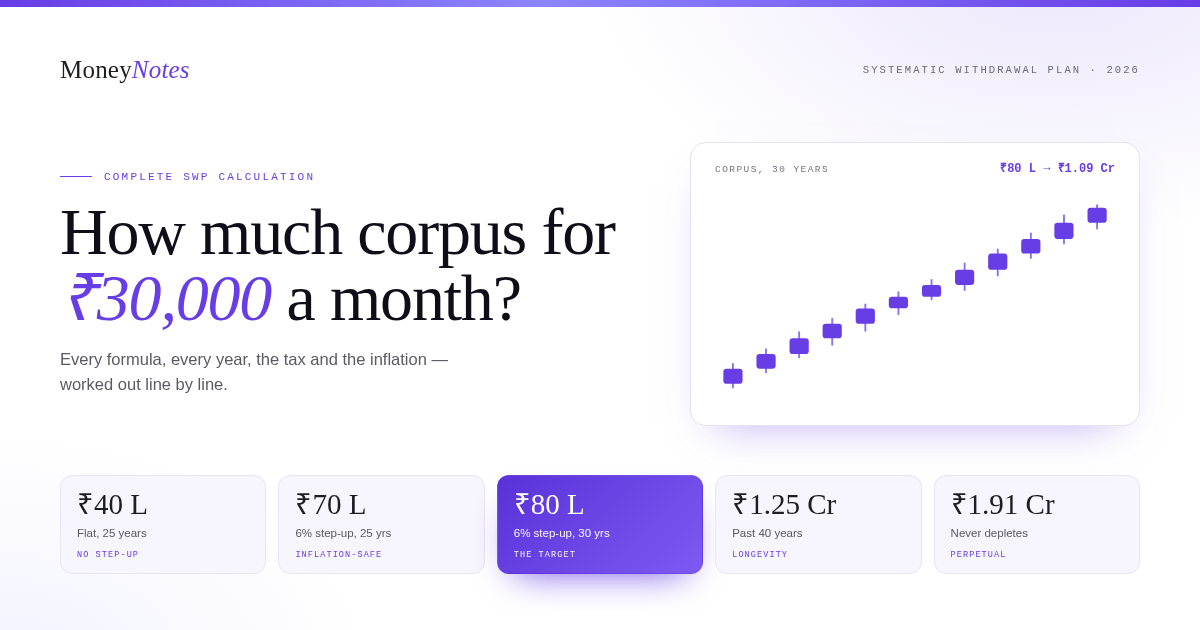
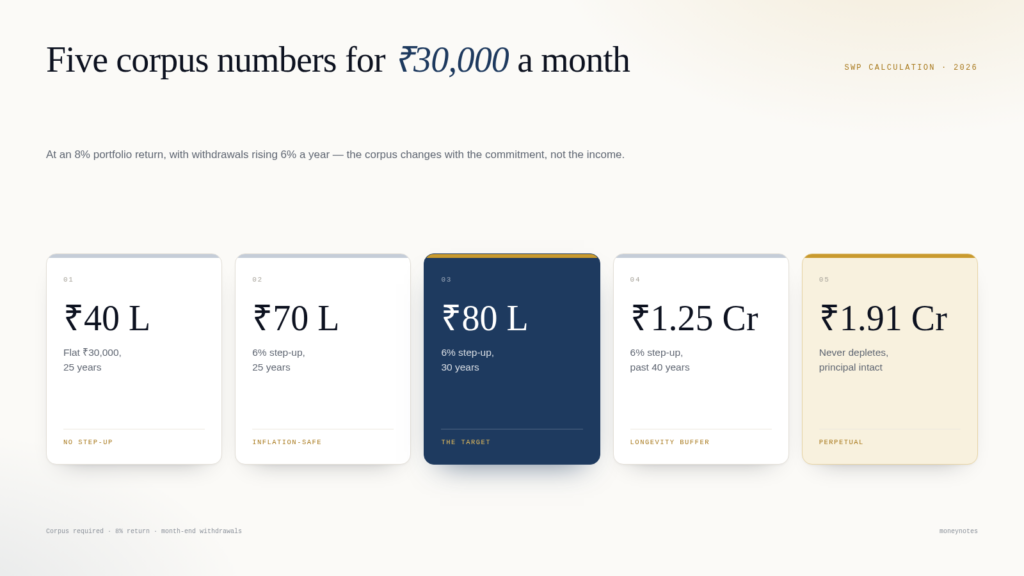
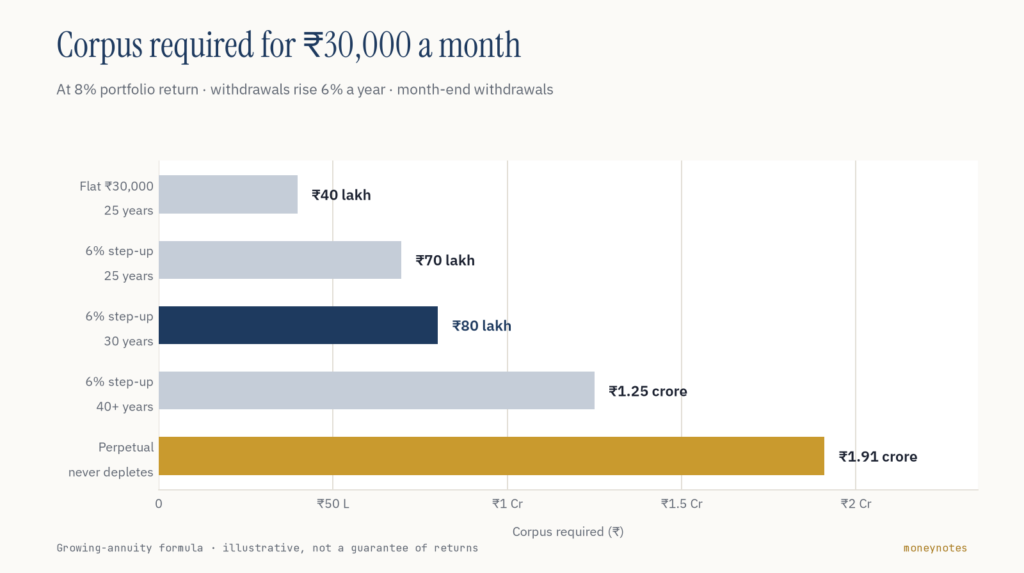
For ₹30,000 per month from an SWP at an 8% portfolio return — ₹40 lakh lasts 25 years if the withdrawal never increases; ₹70 lakh lasts 25 years if you raise it 6% every year; ₹80 lakh lasts 30 years with the same 6% step-up; ₹1.25 crore stretches past 40 years; and ₹1.91 crore keeps paying forever without ever touching your principal.
The short answer: corpus needed for ₹30,000/month
Five numbers, five different goals. Pick the row that matches your situation, not the row that feels comfortable.
| What you want | Corpus needed | How long it lasts |
|---|---|---|
| ₹30,000 fixed, no increase | ₹40 lakh | 25 years, then zero |
| ₹30,000 rising 6% a year | ₹70 lakh | 25 years, then zero |
| ₹30,000 rising 6% a year | ₹80 lakh | 30 years, then zero |
| ₹30,000 rising 6% a year | ₹1.25 crore | Past 40 years |
| ₹30,000 rising 6% a year | ₹1.91 crore | Forever — principal intact |
Assumes 8% annual portfolio return, 6% annual step-up in the withdrawal, withdrawals at month-end. Figures rounded.
Notice something uncomfortable: the difference between “25 years” and “forever” is ₹1.2 crore. Longevity is expensive. That single insight is what separates a plan that works from one that quietly runs dry at age 78.
What is an SWP, and why its math is different from FD interest
A Systematic Withdrawal Plan is a standing instruction to your mutual fund: redeem a fixed amount from my folio on this date every month, and send it to my bank account. You are not living off interest or dividends. You are selling units — a small slice of your own capital — and the remaining units keep compounding.
This creates two opposing forces working on your corpus at the same time:
- Your return pushes the balance up, compounding every month.
- Your withdrawal pulls it down, and when you increase the withdrawal with inflation, that drag compounds too.
In an FD, the corpus never moves and the interest is fixed. In an SWP, both sides of the equation move. That is why you cannot simply divide ₹3,60,000 — your annual need — by an interest rate and call it done. The withdrawal is not constant, and the balance is not constant.
The practical consequence: an SWP needs a bigger corpus than an FD for the same income, but it also grows your money while paying you. An FD gives certainty of amount. An SWP gives certainty of income plus a fighting chance against inflation.
The four inputs that decide your corpus
The monthly amount
₹30,000 a month is ₹3,60,000 a year. Every figure here is a multiple of that, so you can scale it — double the withdrawal and you roughly double the corpus.
The return you actually earn
Not the brochure number. After expense ratios, after the drag of holding cash, averaged across good and bad years. 8% is fair, 9–10% is optimistic, 12% is marketing.
Whether you raise the withdrawal
The biggest lever, and the one people ignore. ₹30,000 today costs ₹53,725 in ten years at 6% inflation. A flat withdrawal is a shrinking lifestyle.
How long it must last
25 years from 60, 35 from 55, 45 from 45. Use your age and family history, then add a five-year buffer. You cannot borrow against longevity risk.
Tax on every redemption
Each instalment carries a capital gain, and that gain is taxed. Your ₹30,000 is not really ₹30,000 unless you gross it up. Section 7 does the arithmetic.
Result One number, not four
Change any one input and the answer moves by lakhs. That is why a single “₹1 crore is enough” claim is always wrong for somebody.
The SWP formula, explained without jargon
You do not need to memorise these to use them, but you should recognise them, because every SWP calculator on the internet is running exactly these lines.
Formula 1 — Where your corpus ends up after n months
Balance = P × (1 + i)n − W × [ ((1 + i)n − 1) / i ]
P is your starting corpus, W is the monthly withdrawal, i is the monthly return, and n is the number of months. The first term is your money growing. The second term is every withdrawal, plus the growth you gave up on it.
Formula 2 — The corpus you need for a fixed withdrawal
Corpus = W × [ 1 − (1 + i)−n ] / i
The same equation solved for P instead of the balance. Set the balance to zero at the end of your horizon, and this tells you the starting corpus that runs out exactly on schedule.
Formula 3 — Adding the inflation step-up
Real monthly rate j = (1 + i) / (1 + s) − 1 → use j in place of i
Here s is the monthly rate of your annual step-up. If your return is 8% and your step-up is 6%, your real monthly rate is about 0.157% instead of 0.643% — and that small-looking change roughly doubles the corpus you need. This is the inflation penalty, in one line of arithmetic.
Formula 4 — The perpetual corpus that never runs out
Corpus = Annual withdrawal / real return
Real return is (1 + nominal) / (1 + inflation) − 1. For ₹3,60,000 a year at 8% return and 6% inflation, the real return is 1.887%, so the corpus is ₹3,60,000 ÷ 0.01887 = ₹1.91 crore. This is the “I want to die with my capital intact” number — and it is the most expensive option on the menu.
The complete calculation for ₹30,000 per month, step by step
Let us run the full arithmetic for the scenario most people actually want: ₹30,000 a month today, rising 6% a year with inflation, for 30 years, on a portfolio earning 8%.
- Convert everything to monthly figuresMonthly withdrawal W = ₹30,000. Monthly return i = (1.08)^(1/12) − 1 = 0.6434%. Monthly step-up s = (1.06)^(1/12) − 1 = 0.4868%. Real monthly rate j = (1.006434 ÷ 1.004868) − 1 = 0.1559%. Number of months n = 30 × 12 = 360.
- Apply the growing-annuity formulaCorpus = 30,000 × [ 1 − (1.001559)^−360 ] ÷ 0.001559. The discount factor works out to about 266.85.
- Multiply to get the answerCorpus = 30,000 × 266.85 = ₹80,05,443₹80 lakh is the corpus that pays you ₹30,000 a month for 30 years while raising the payout 6% every year, at an 8% return.
- Sanity-check it against realityA formula that produces a number nobody can verify is worthless. So here is what actually happens to that ₹80 lakh, year by year, if you run it.
| Year | Monthly payout | Corpus at year end |
|---|---|---|
| 1 | ₹30,000 | ₹82,72,862 |
| 5 | ₹37,874 | ₹93,17,452 |
| 10 | ₹50,684 | ₹1,04,18,204 |
| 15 | ₹67,827 | ₹1,09,28,832 |
| 20 | ₹90,768 | ₹1,01,98,046 |
| 25 | ₹1,21,468 | ₹71,42,283 |
| 30 | ₹1,62,552 | ₹0 — depleted |
₹80 lakh corpus, 8% return, withdrawals rising 6% annually, month-end withdrawals. The corpus rises to ₹1.09 crore by year 15, then falls as the step-up outruns the return.
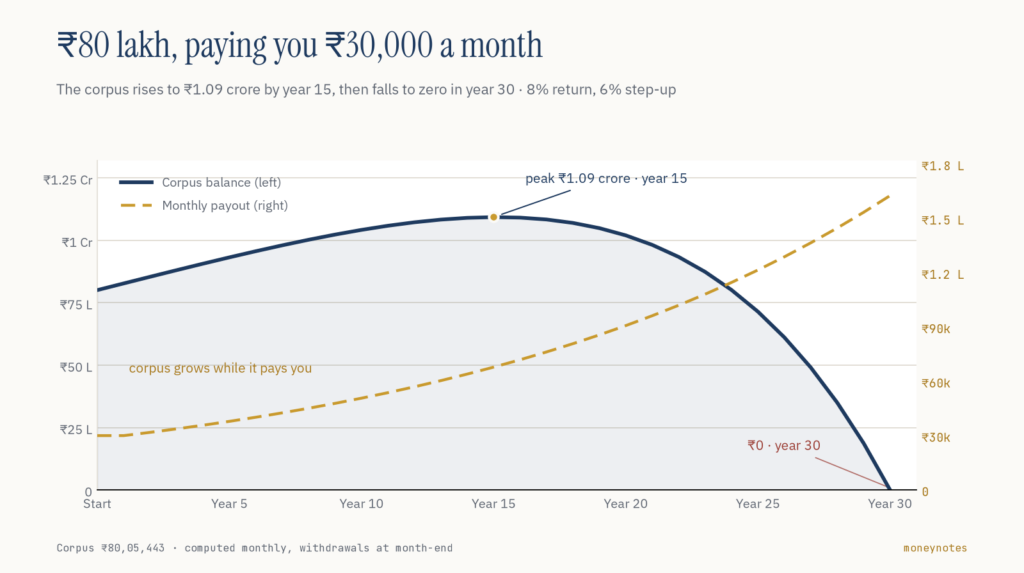
Read that table carefully, because it inverts the intuition almost everyone has. For the first fifteen years your corpus does not fall — it grows, from ₹80 lakh to ₹1.09 crore, even while paying you ₹30,000 a month and raising that payout 6% every year. Only after year 15 does the rising withdrawal outrun the return, and the balance falls from there to zero in year 30.
The formula, in other words, is exact: ₹80,05,443 buys exactly 30 years at 8%. The risk is not the arithmetic — it is the assumption underneath it. The same corpus at 7% instead of 8% lasts 26 years. At 6.5% it lasts 25. A single percentage point of return is worth five years of income. That is why the buffer belongs in the return assumption and not in a random percentage: a 30-year plan at 7% needs ₹91 lakh, and a 35-year plan at 8% needs ₹90 lakh. Both roads lead to the same place — target ₹95 lakh and you have bought yourself a return cushion and a longevity cushion at once.
A single percentage point of return is worth five years of income. That is where the buffer belongs — not in a hopeful number.
What if you start with a round ₹1 crore instead?
Here is the more useful view for most readers: given a corpus, how long does it actually last?
| Starting corpus | Monthly payout | Step-up | Money runs out in |
|---|---|---|---|
| ₹50 lakh | ₹30,000 | None | Never — corpus grows |
| ₹75 lakh | ₹30,000 | 6% a year | Year 28 |
| ₹1 crore | ₹30,000 | 6% a year | Year 42 |
| ₹1.25 crore | ₹30,000 | 6% a year | Year 60 |
| ₹1.5 crore | ₹30,000 | 6% a year | Year 88 |
| ₹1.91 crore | ₹30,000 | 6% a year | Never — truly perpetual |
8% annual return, withdrawals at month-end. “Never” means the corpus is still growing at the end of an 80-year simulation.
Two things jump out. First, ₹50 lakh is enough forever if you never raise the withdrawal — but only because you are accepting a shrinking lifestyle, which is not a plan. Second, look at how slowly the finish line moves: ₹1.25 crore buys 60 years, ₹1.5 crore buys 88, and only at ₹1.91 crore does the corpus stop declining at all. Longevity is the most expensive feature you can buy, and it is priced in crores, not lakhs.
The full corpus table: different returns, different horizons
Returns are not guaranteed, so do not plan on one number. This grid shows what ₹30,000 a month costs you across the realistic range. Read across your expected return, down your horizon.
| Portfolio return | 25 yrs, flat | 25 yrs | 30 yrs | 35 yrs | Forever |
|---|---|---|---|---|---|
| 8% — conservative | ₹39.8 L | ₹69.6 L | ₹80.1 L | ₹89.6 L | ₹1.91 Cr |
| 9% — balanced | ₹36.8 L | ₹62.7 L | ₹70.8 L | ₹77.9 L | ₹1.29 Cr |
| 10% — equity-heavy | ₹34.1 L | ₹56.8 L | ₹63.1 L | ₹68.3 L | ₹97.3 L |
| 12% — optimistic | ₹29.8 L | ₹47.3 L | ₹51.1 L | ₹54.0 L | ₹65.5 L |
Columns 3 to 6 assume a 6% annual step-up; column 2 assumes a flat withdrawal. “Forever” is the perpetual corpus. Month-end withdrawals, computed from the growing-annuity formula above.
The trap in this table is the 12% row. It looks wonderful and it is how most retirement content misleads people. A portfolio that must pay out every month cannot be 100% equity — it needs a cash and debt buffer, and that buffer drags returns. Plan at 8%. If you earn 10%, you will simply finish with a surplus, which is the only kind of error worth making.
The tax you pay on every ₹30,000 withdrawal
This is where the “corpus required” number quietly grows, and almost nobody accounts for it.
Each SWP instalment is a redemption of mutual fund units. Part of it is your original investment, which is not taxed; part is capital gain, which is. For equity-oriented funds held over 12 months, long-term capital gains are taxed at 12.5% plus 4% cess — 13% effective — but only on gains above ₹1.25 lakh per financial year. That exemption is per person, across all equity funds combined.
Worked example: ₹3,60,000 withdrawn in a year
| Share of withdrawal that is gain | Taxable gain | Tax at 13% | Net income/month |
|---|---|---|---|
| 30% — old corpus, low growth | ₹0 | ₹0 | ₹30,000 |
| 40% — typical | ₹19,000 | ₹2,470 | ₹29,794 |
| 50% — high-growth corpus | ₹55,000 | ₹7,150 | ₹29,404 |
Equity-oriented funds, units held over 12 months, ₹1.25 lakh annual LTCG exemption applied. Rates as per current income tax law; verify with your tax advisor before filing.
Two practical consequences follow.
- Gross up your withdrawal. If you need ₹30,000 net, withdraw about ₹30,200 a month and let the tax come out of the surplus. That is roughly ₹50,000 of extra corpus at 8% — trivial, and worth doing.
- Split the folio across spouses. The ₹1.25 lakh exemption is per PAN. Two folios in two names means ₹2.5 lakh of gains tax-free each year, which covers a ₹30,000 monthly SWP almost entirely.
The expensive mistake
Debt funds are taxed at your income tax slab rate, regardless of holding period, for units bought on or after 1 April 2023. A ₹30,000 SWP funded from a debt fund could be taxed at 30% instead of 13%. Use equity-oriented or hybrid funds for the withdrawal leg, and keep debt only for the short-term buffer.
Inflation: the number that doubles your corpus
If you are not retiring today, ₹30,000 is the wrong target. Here is what the same lifestyle costs later, at 6% inflation — and the corpus you need at that point to fund it for 25 years with a 6% step-up at 8% returns.
| If you start in | Monthly income you will need | Corpus required then |
|---|---|---|
| Today | ₹30,000 | ₹70 lakh |
| 5 years | ₹40,147 | ₹93 lakh |
| 10 years | ₹53,725 | ₹1.25 crore |
| 15 years | ₹71,897 | ₹1.67 crore |
| 20 years | ₹96,214 | ₹2.23 crore |
| 25 years | ₹1,28,756 | ₹2.99 crore |
Assumes 6% inflation, then a 25-year SWP at 8% return with a 6% annual step-up.
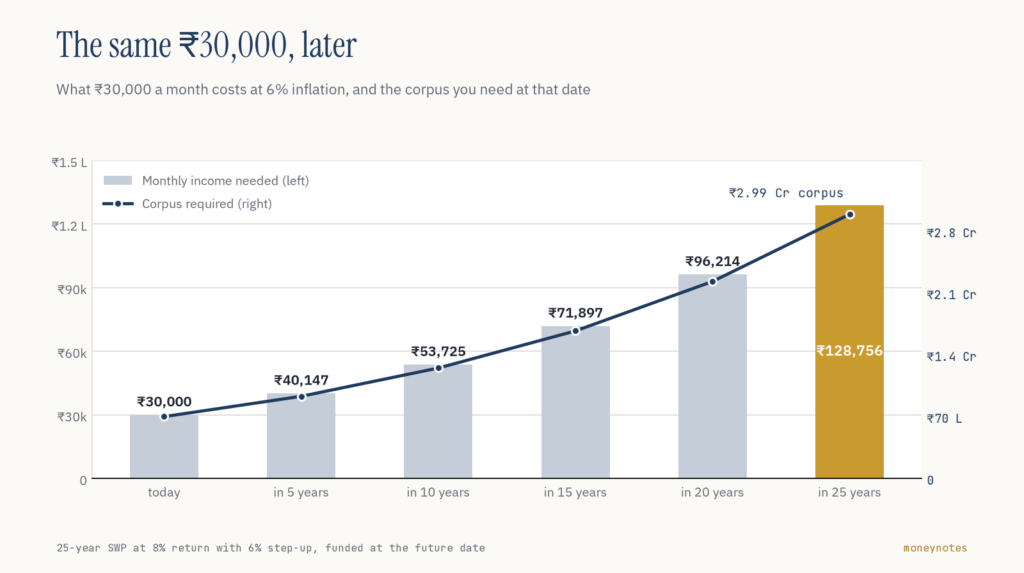
A 35-year-old planning ₹30,000 a month at 60 is actually planning for ₹71,897 a month, and therefore for a corpus of ₹1.67 crore — not ₹70 lakh. Almost every “how much do I need to retire” argument between spouses is really an argument about this one row of the table.
How to build that corpus: SIP needed for ₹80 lakh to ₹2 crore
Knowing the target is half the job. Here is the monthly investment required to get there, assuming a 12% return during the accumulation phase — a reasonable assumption for a long-horizon, equity-heavy SIP.
| Target corpus | In 10 years | In 15 years | In 20 years | In 25 years |
|---|---|---|---|---|
| ₹1 crore | ₹44,636 | ₹21,011 | ₹10,871 | ₹5,875 |
| ₹1.25 crore | ₹55,795 | ₹26,264 | ₹13,589 | ₹7,343 |
| ₹1.5 crore | ₹66,954 | ₹31,517 | ₹16,307 | ₹8,812 |
| ₹2 crore | ₹89,271 | ₹42,023 | ₹21,743 | ₹11,749 |
Monthly SIP required, 12% assumed annual return during accumulation, investments at the start of each month.
Look at the bottom-right versus the top-left. ₹5,875 a month for 25 years gets you ₹1 crore. ₹89,271 a month for 10 years gets you ₹2 crore. Time is doing almost all the work here, and the only thing that buys time is starting early — which is the least satisfying advice in personal finance and also the only advice that is reliably true.
SWP vs FD vs annuity: the same ₹30,000 a month, three ways
Before you commit to an SWP, it is worth seeing what the alternatives cost. All three are compared on the same requirement: ₹30,000 a month, in hand.
| Route | Corpus needed | Tax treatment | What happens to capital |
|---|---|---|---|
| SWP from equity funds | ₹70–80 lakh | 12.5% on gains above ₹1.25 L | Grows, then draws down |
| Bank FD interest | ₹79 lakh | Interest taxed at your slab (up to 30%) | Frozen, eroded by inflation |
| Immediate annuity | ₹55–60 lakh | Pension taxed at slab | Gone — you bought an income |
| Rental property | ₹1.5 crore+ | Rent taxed at slab, 30% deduction | Illiquid, maintenance risk |
FD at 6.5% pre-tax for a 30% slab investor (4.55% post-tax). Annuity at 6–6.5% payout rates. Illustrative, not a recommendation of any product.
The FD number is the one that surprises people. To net ₹30,000 a month from an FD in the 30% slab, you need about ₹79 lakh — more than the SWP — and at the end of 25 years your corpus is still ₹79 lakh, having lost roughly 70% of its purchasing power to inflation. The SWP starts smaller in nominal terms but ends with a corpus that has grown.
The annuity is the cheapest on paper and the most expensive in practice, because you hand over the capital permanently. It is genuinely useful for one narrow case: the portion of your money you cannot afford to see fluctuate, where longevity insurance is worth the cost. It is a poor choice for your entire corpus.
How to actually run a ₹30,000 SWP without getting hurt
Use the bucket strategy, not a single fund
Split the corpus into three buckets. Bucket 1: two years of withdrawals — ₹7.2 lakh at ₹30,000 a month — in a liquid or ultra-short debt fund. Bucket 2: years 3 to 7 in short-duration debt or conservative hybrid. Bucket 3: everything else in equity or aggressive hybrid. You withdraw from Bucket 1, refill it from Bucket 3 once a year when markets are up, and never sell equity into a crash. This single structure is what makes an 8% blended return achievable while keeping your withdrawals safe.
Choose the growth option, never IDCW
IDCW — the old “dividend” option — forces a payout and is taxed as income in your hands. The growth option lets you control exactly how much you redeem and when, which is the entire point of an SWP, and it keeps the tax calculation in your favour.
Set the date, and keep it boring
Schedule the SWP for the 7th or 10th of the month, not the 1st. It gives the NAV a few days to settle and keeps the money out of your spending account for the weekend. Then leave it alone.
Step up your withdrawal once a year
Every April, raise the instalment by 6% — the same rate you assumed in the calculation. If you skip the step-up, you are quietly accepting a pay cut in real terms every single year.
Review, do not react
Look at the plan once a year: has the corpus drifted from the projection, has the return assumption held, has inflation moved? Then rebalance back to target. Do not check it monthly and do not stop the SWP in a falling market — that converts a temporary paper loss into a permanent one, and it is the most common way retirees destroy their own plan.
Keep the emergency fund outside the corpus
Six to twelve months of expenses in a separate liquid fund, untouched by the SWP. A medical bill or a house repair funded from the SWP corpus at the wrong moment costs you years of runway.
Five mistakes that break an SWP
- Assuming 12% returns on a withdrawal portfolio. A portfolio that pays out monthly cannot be fully in equity. Plan at 8% and treat anything higher as a bonus.
- Ignoring the inflation step-up. A flat ₹30,000 for 25 years is a 70% pay cut in real terms. The step-up is the difference between the ₹40 lakh and ₹70 lakh columns.
- Forgetting tax on redemptions. At 13% on gains, a ₹30,000 withdrawal is worth about ₹29,800 — small, but free to fix, and much larger if you use the wrong fund category.
- Planning on the return you hope for, not the one you will get. ₹80 lakh lasts 30 years at 8%, 26 years at 7% and 25 years at 6.5%. One percentage point of return is worth five years of income — so build the buffer into the return assumption, not into a hopeful number.
- Starting the SWP before you have finished accumulating. An SWP is a decumulation tool. Starting one while you still have 15 years of earning left locks in a lower corpus and a lower payout for life.
Frequently asked questions
How much corpus do I need for ₹30,000 per month from an SWP?
At an 8% return, ₹40 lakh funds a flat ₹30,000 for 25 years, ₹70 lakh funds it for 25 years with a 6% annual increase, ₹80 lakh stretches it to 30 years, and ₹1.91 crore makes it permanent. If you also want to cover the tax on redemptions, add roughly 1% to any of these figures.
Is ₹1 crore enough for a ₹30,000 monthly SWP?
Yes, comfortably. ₹1 crore paying ₹30,000 a month and rising 6% a year at an 8% return lasts about 42 years — from age 60 that takes you past 100. It is not enough to be truly perpetual; for that you need about ₹1.91 crore.
Can an SWP last forever?
Yes, if your withdrawal rate stays below your real return. At 8% returns and 6% inflation your real return is 1.887%, so a corpus of ₹3,60,000 ÷ 0.01887 = ₹1.91 crore is perpetual. Below that corpus the money runs out eventually — later than you think, but it does run out.
What return should I assume for an SWP portfolio?
8% for a balanced portfolio of roughly 60–70% equity and 30–40% debt, which is what a withdrawal phase should look like. Use 7% for a stress test and 10% as an optimistic case. Never plan on 12% for money you are actively drawing from.
Should I run the SWP from an equity fund or a debt fund?
Use equity-oriented or hybrid funds for the long-term portion — gains held over 12 months are taxed at 12.5% above ₹1.25 lakh, far better than the slab rate. Use debt funds only for the two-year cash buffer, because debt fund gains bought after 1 April 2023 are taxed entirely at your slab rate.
How is an SWP taxed?
Each instalment is a redemption with a capital gain. For equity-oriented funds held over 12 months, gains above ₹1.25 lakh per financial year are taxed at 12.5% plus cess. For debt funds, the entire gain is taxed at your slab rate. The exemption is per PAN, so splitting the folio between spouses effectively doubles it.
How much corpus do I need for ₹50,000 per month?
Roughly ₹1.33 crore for 30 years with a 6% annual step-up at 8% returns, or about ₹3.21 crore if you want it to last forever. Every figure in this guide scales linearly with the withdrawal amount.
Does an SWP reduce my capital?
Yes, always — that is what it is. You are redeeming units, so the number of units falls every month. The question is not whether capital falls but whether the return on the remaining capital outpaces the withdrawal. When it does, your corpus can still grow even while paying you, as the ₹1.5 crore case above shows.
Can I increase my SWP amount every year?
Yes, and you should. Most fund houses let you modify the instalment amount online at any time. Raise it by 6% every year, or by the actual CPI number, so that your purchasing power stays flat.
Is ₹30,000 a month enough to live on in India?
That depends entirely on your city and your fixed costs — a paid-off home in a tier-2 city is a very different budget from rented accommodation in Mumbai or Bengaluru. The arithmetic in this guide works for any amount; substitute your real monthly expense figure, not the ₹30,000 used here.
The bottom line
For ₹30,000 a month, ₹80 lakh is the number to aim at if you are planning a 30-year retirement with inflation protection at a realistic 8% return. Add 15–20% for sequence-of-returns risk and tax, and target ₹95 lakh. If you want the corpus to survive you and pass to your family intact, aim for ₹1.91 crore.
The arithmetic is the easy part — four inputs, one formula, and a spreadsheet. The hard part is the discipline: starting early enough, keeping the equity allocation through bad years, stepping the withdrawal up every year, and not touching the corpus for anything except the income it was built to produce.
Run the numbers with your own return assumption and horizon before you commit. A 1% difference in the return you actually earn is worth roughly ₹10 lakh of corpus at this scale — which is a good reason to keep the portfolio boring, cheap, and diversified.
Disclaimer. This article is educational and uses illustrative assumptions; it is not investment, tax or legal advice. Mutual fund returns are not guaranteed and the value of units can fall. Tax rates and rules are as per the income tax law in force at the time of writing and may change. Consult a SEBI-registered investment adviser and a qualified tax professional before acting on these figures.On this page