
There’s a moment most middle-class Indians quietly experience.
It usually happens at night.
You’re scrolling through your phone… seeing someone’s foreign trip, someone’s new car, someone celebrating “financial freedom” at 40.
And then you look at your own bank balance.
You tell yourself: “If only I had more money to invest.”
But here’s what I’ve learned after more than a decade of watching markets, portfolios, and ordinary investors transform their lives:
We don’t lack money. We lack consistency.
₹3,000 per month feels small.
Almost forgettable.
But over 20 years? It can quietly become one of the smartest financial decisions of your life.
This article is not theory. It’s not motivational fluff. It’s what actually happens when disciplined investing meets time.
Let’s talk about the real numbers. The psychology. The mistakes people make. And the future projections most blogs won’t show you.
The Power of ₹3,000: Why Small SIPs Matter More Than Big Promises
When I started advising young professionals, most believed investing required at least ₹10,000–₹15,000 monthly.
They were wrong.
What matters more than size is:
- Time
- Compounding
- Consistency
- Asset selection
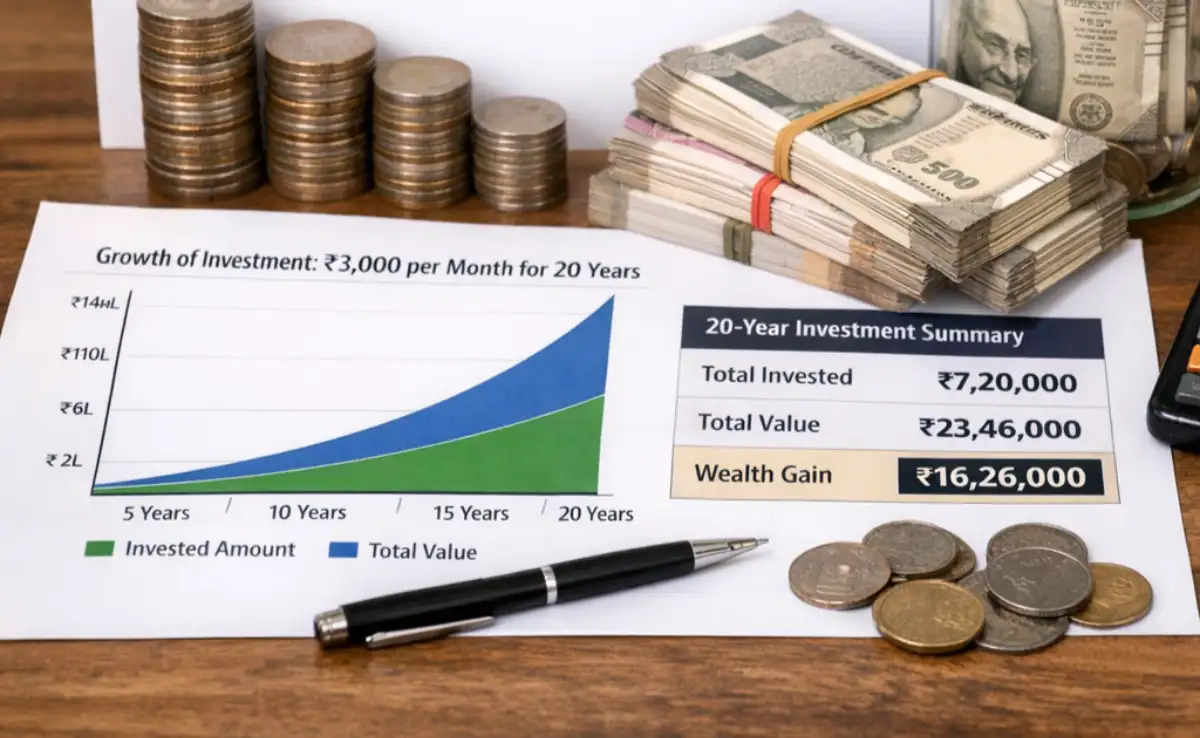
₹3,000 per month = ₹36,000 per year
Over 20 years = ₹7.2 lakh invested
Now here’s the real question:
What can ₹7.2 lakh become in 20 years?
That depends on return.
And returns depend on where you invest.
Scenario 1: Conservative Approach (Debt Funds / Hybrid 7–8%)
Let’s assume a steady 8% annual return.
This is achievable through:
- Balanced advantage funds
- Conservative hybrid mutual funds
- High-quality debt instruments
Here’s what happens.
20-Year Projection at 8% Annual Return
| Year | Total Invested (₹) | Portfolio Value (₹) | Approx Growth |
|---|---|---|---|
| 5 | 1,80,000 | 2,20,000 | Stable growth |
| 10 | 3,60,000 | 5,50,000 | Compounding visible |
| 15 | 5,40,000 | 10,50,000 | Accelerated phase |
| 20 | 7,20,000 | 17,80,000 | Nearly 2.5x invested |
You invest ₹7.2 lakh.
You get around ₹17–18 lakh.
Safe? Yes.
Life-changing? Not quite.
Scenario 2: Equity Mutual Funds (12% Average Return)
Now we’re entering serious wealth-building territory.
India’s long-term equity markets have historically delivered around 11–13% over long cycles. Not every year. But over 15–20 years? Yes.
Let’s assume 12%.
20-Year Projection at 12% Annual Return
| Year | Total Invested (₹) | Portfolio Value (₹) | CAGR | Wealth Multiplier |
|---|---|---|---|---|
| 5 | 1,80,000 | 2,45,000 | 12% | 1.36x |
| 10 | 3,60,000 | 6,95,000 | 12% | 1.93x |
| 15 | 5,40,000 | 14,60,000 | 12% | 2.7x |
| 20 | 7,20,000 | 29,90,000 | 12% | 4.15x |
Now we’re talking.
₹7.2 lakh becomes nearly ₹30 lakh.
That’s the difference asset allocation makes.
But here’s something most people miss:
The real magic happens after year 12.
Compounding isn’t linear. It’s emotional. It tests patience. Then it rewards stubborn consistency.
What If India Grows Faster? (14–15% Scenario)
Between 2003–2008 and 2014–2017, Indian equity investors saw higher-than-average returns.
With:
- Manufacturing push
- Digital economy expansion
- Demographic dividend
- Infrastructure boom (2026–2030 projections remain strong)
A 14% long-term SIP return isn’t unrealistic for disciplined equity investing.
Let’s see.
20-Year Projection at 14% Annual Return
| Year | Total Invested (₹) | Portfolio Value (₹) | Growth Phase |
|---|---|---|---|
| 5 | 1,80,000 | 2,60,000 | Slow build |
| 10 | 3,60,000 | 7,60,000 | Acceleration |
| 15 | 5,40,000 | 17,40,000 | Wealth curve bends upward |
| 20 | 7,20,000 | 39,00,000+ | Nearly 5.5x |
Same ₹3,000.
Now almost ₹40 lakh.
This is the difference between saving and investing.
The 2026–2030 Outlook: Why 20-Year Investing Looks Even More Powerful Today
We are entering a very different economic cycle compared to 2005.
Here’s what I’m observing as someone tracking macro trends:
- India’s GDP projected to grow 6–7% annually (2026–2030 trend)
- Retail SIP contributions crossing ₹20,000+ crore monthly
- Manufacturing + PLI schemes gaining momentum
- Increasing financialization of savings (money moving from gold/FD to equities)
Market Outlook Snapshot (2026–2030 Trend-Based Projection)
| Factor | 2026 | 2027 | 2028 | 2029–2030 Outlook |
|---|---|---|---|---|
| GDP Growth | 6.5% | 6.8% | 7% | Stable 6–7% |
| SIP Inflows | ₹22,000 Cr/month | Rising | Strong | Structural trend |
| Equity Participation | Increasing | Broader Tier-2 adoption | Expanding | Long-term bull case |
| Inflation | 4–5% | Controlled | Stable | Moderate |
What does this mean?
Long-term disciplined SIP investors are likely to benefit from:
- Structural economic growth
- Expanding corporate earnings
- Rising market depth
No guarantees. But the odds favor patience.
The Psychological Curve of a 20-Year Investor
Let me tell you something no calculator shows.
Year 1–3:
You doubt everything.
Year 4–7:
Markets fall once. You panic. You consider stopping.
Year 8–12:
You finally understand volatility.
Year 13–20:
Compounding starts doing heavy lifting.
Most investors quit before year 7.
The winners stay.
Inflation Reality: Is ₹30–40 Lakh Enough After 20 Years?
We need honesty here.
If inflation averages 5%, money loses nearly half its purchasing power in 20 years.
₹40 lakh in 2046 won’t feel like ₹40 lakh today.
So what should you do?
Two things:
- Increase SIP every year (Step-up SIP 5–10%)
- Stay invested in growth assets
Let’s see what happens if you increase SIP by just 5% annually.
Step-Up SIP (₹3,000 Start, 5% Annual Increase, 12% Return)
| Year | Approx Final Value (₹) |
|---|---|
| 20 Years | 45–48 Lakh |
Now we’re in a different league.
Same starting ₹3,000.
Just discipline.
Risks You Must Respect
I’ve seen investors destroy 10 years of wealth because they ignored these:
- Stopping SIP during crashes
- Switching funds every year
- Investing without emergency fund
- Overexposure to small-cap mania
Equity returns aren’t smooth.
Expect:
- 20–30% corrections
- 1–2 bad years every decade
- News-driven panic
But over 20 years?
Volatility becomes background noise.
Where Should You Invest ₹3,000 Today?
Not random funds.
Here’s a balanced structure I recommend for young investors (long horizon 20+ years):
- 60% Flexi-cap / Nifty 50 Index
- 20% Mid-cap
- 10% International exposure
- 10% Debt / Liquid for stability
Rebalance every year.
Simple.
No overengineering.
The Hidden Benefit: Financial Identity Shift
This is something calculators can’t measure.
When you invest ₹3,000 monthly for 20 years:
- You become disciplined
- You think long-term
- You stop chasing quick money
- You build investor mindset
The biggest return isn’t just money.
It’s maturity.
Frequently Asked Questions
1. Is ₹3,000 SIP really enough to create wealth?
Yes — if time horizon is 15–20 years and equity allocation is appropriate. Small SIPs compounded consistently outperform irregular large investments.
2. What if markets crash during my 20-year period?
They will.
Multiple times.
But crashes benefit long-term SIP investors because you accumulate more units at lower prices.
3. Should I choose index funds or active funds?
For beginners, index funds provide:
- Lower cost
- Predictability
- Simplicity
Experienced investors may add selective active exposure.
4. What happens if I skip SIP for 2–3 months?
Not disastrous.
But habit disruption is the real risk. Restart immediately.
5. Can ₹3,000 monthly make me financially independent?
On its own, no.
But as income grows and SIP increases yearly, it becomes a powerful wealth pillar.
The Truth Most People Realize Too Late
₹3,000 feels small today.
But 20 years from now, you won’t regret investing it.
You’ll regret not starting earlier.
I’ve seen people delay investing for 5 years — and lose nearly ₹10–15 lakh in potential compounding.
Time is the multiplier.
Money is just the fuel.
Final Thought (Read This Slowly)
If you start today:
In 2046…
You could have:
- ₹30–40 lakh corpus
- Investing confidence
- Market experience
- Financial discipline
Or…
You could have excuses.
The difference is ₹3,000 and consistency.
Start small.
Increase yearly.
Stay patient.
Your future self is quietly waiting.
If this gave you clarity, don’t just read it.
Open your investment app. Set up that SIP. Let time do what it does best.