
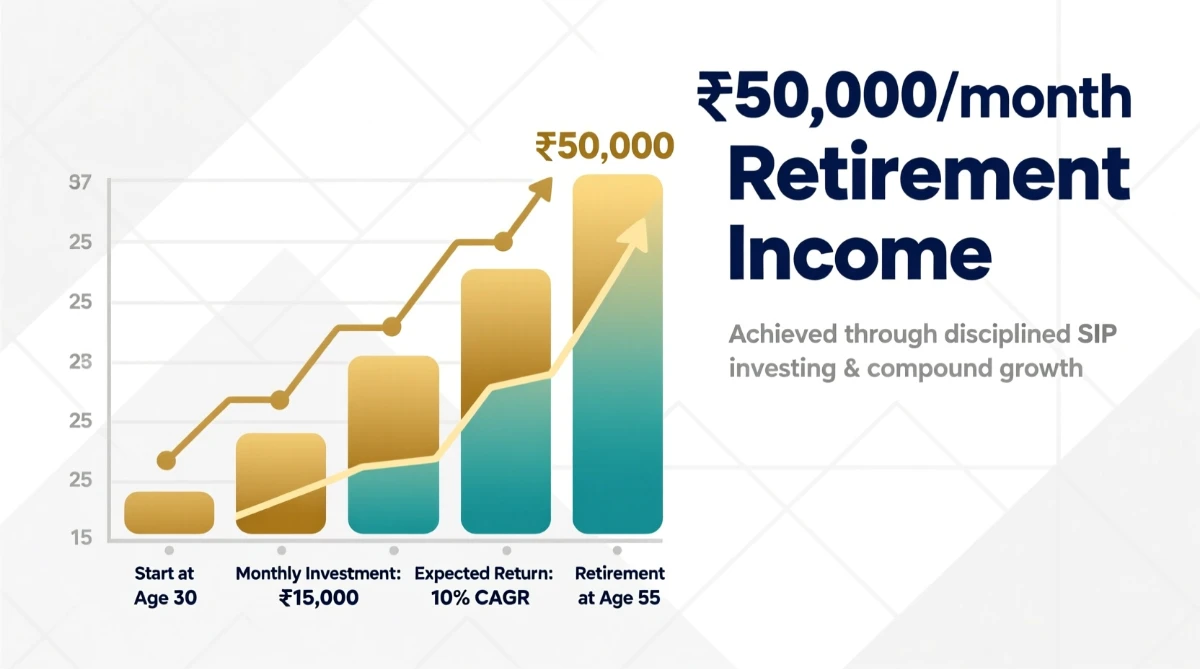
Retirement planning in India has undergone a silent revolution in the last decade. With rising life expectancy, unstable pensions, and unpredictable job markets, an average Indian now needs far stronger retirement planning than ever before. The benchmark that most middle-class families aim for today is simple:
Table of Contents
“How do I generate ₹50,000 monthly retirement income without financial stress?”
While there are dozens of investment products, SIP-based retirement planning stands out because it offers transparency, compounding, growth, and flexibility.
In this detailed expert-backed guide, we explore 4 powerful SIP strategies—each with a different risk and return profile (10%, 12–14%, 15–18%, and mixed return scenarios)—to help you build a sustainable ₹50,000 monthly retirement income through SWP (Systematic Withdrawal Plan).
Understanding the Goal: Why ₹50,000 Monthly?
₹50,000 per month = ₹6,00,000 annual income.
To generate this income safely in retirement using SWP (at a safe withdrawal rate of 4–6% depending on risk profile), your retirement corpus needs to be:
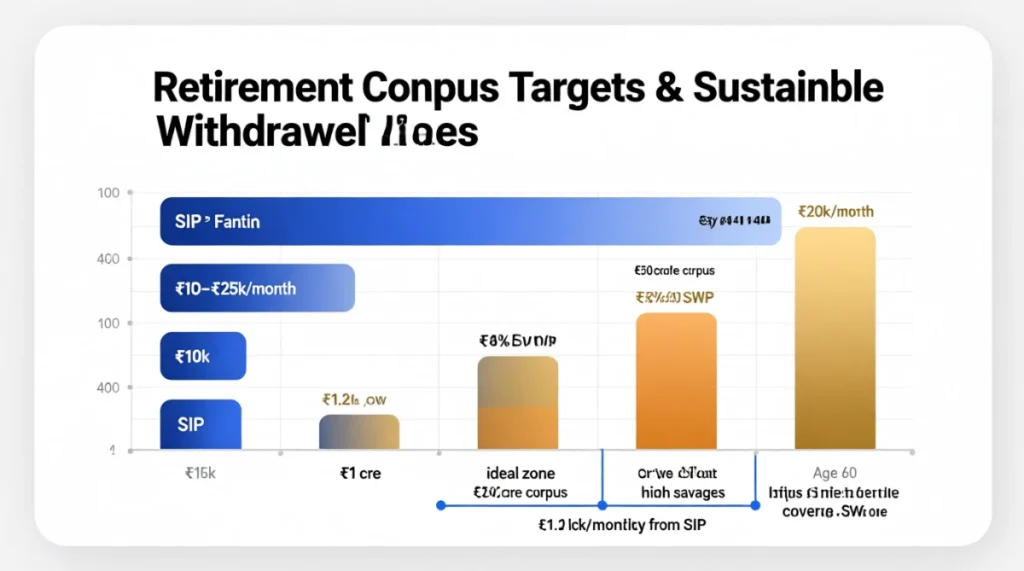
₹1 crore – low safety zone (6% SWP)
₹1.2 crore – ideal zone (5% SWP)
₹1.5 crore – high safety + longevity coverage (4% SWP)
We will calculate SIPs for all levels to give you complete clarity like a financial planner.
The 4 SIP Plans We Will Cover
| Plan Type | Expected Annual Return | Risk Level | Ideal Investor |
|---|---|---|---|
| Plan A | 10–11% | Low–Moderate | Conservative |
| Plan B | 12–14% | Moderate | Balanced |
| Plan C | 15–18% | High | Aggressive |
| Plan D | Mixed Portfolio | Low to High | Long-term planners |
PLAN A — Conservative SIP (10–11% Return)
Ideal for: Large-Cap Funds, Hybrid Funds, Balanced Advantage Funds
Most Indians above 40 prefer capital stability over aggressive growth. These funds give predictable returns and are suitable for people who do not want to experience high volatility.
Investments include:
- Large-cap equity funds
- Hybrid (equity + debt)
- Balanced advantage funds
- Multi-asset funds
1. Required SIP for ₹1 Crore Corpus (10% Return)
If you want a ₹1 crore corpus in 20–30 years, the SIP needed is:
- 20 years → ₹14,900 monthly
- 25 years → ₹8,600 monthly
- 30 years → ₹5,200 monthly
These numbers are based on a stable CAGR of around 10–11%, typical for large-cap and hybrid portfolios in 2024–25.
2. Required SIP for ₹1.5 Crore Corpus (10% Return)
This is the ideal retirement safety figure.
- 20 years → ₹22,300 monthly
- 25 years → ₹12,900 monthly
- 30 years → ₹7,800 monthly
3. SWP Outcome: How ₹1–1.5 Cr Generates ₹50,000 Monthly
- ₹1 crore @ 6% SWP → ₹50,000 per month possible but risky in long-term
- ₹1.2 crore @ 5% SWP → ₹50,000 per month SAFE
- ₹1.5 crore @ 4% SWP → low risk + inflation protection
4. Future Projection (2025–2030)
Large-cap CAGR expected to stay between 10–12% considering:
- Nifty earnings cycle
- Better formalization of Indian economy
- Corporate profitability
- Stable inflation targets by RBI
TABLE 1 — Conservative Plan (2025–2030) Projections
| Year | Expected CAGR | ₹1 Cr Projection | ₹1.5 Cr Projection |
|---|---|---|---|
| 2025 | 10% | 1,00,00,000 | 1,50,00,000 |
| 2027 | 10.5% | 1,22,02,500 | 1,83,03,700 |
| 2030 | 11% | 1,36,50,000 | 2,04,75,000 |
PLAN B — Moderate SIP (12–14% Return)
Ideal for: Flexi-cap, Multi-cap, ELSS Funds
This is the most popular retirement SIP category, combining growth + stability. Flexi-cap and multi-cap funds have consistently delivered 12–14% CAGR over long periods.
Why these funds work well?
- Fund manager flexibility
- Allocation between large, mid, and small-cap
- Strong historical data
- High liquidity
- Long-term compounding power
1. Required SIP for ₹1 Crore Corpus (12–14% Return)
| Tenure | SIP Required (12% Return) | SIP Required (14% Return) |
|---|---|---|
| 20 years | ₹10,500 | ₹8,800 |
| 25 years | ₹5,000 | ₹3,900 |
| 30 years | ₹2,800 | ₹2,100 |
2. Required SIP for ₹1.5 Crore Corpus
| Tenure | SIP for 12% Return | SIP for 14% Return |
|---|---|---|
| 20 years | ₹15,700 | ₹13,100 |
| 25 years | ₹7,500 | ₹5,900 |
| 30 years | ₹4,200 | ₹3,200 |
3. SWP Outcome:
At 12–14% growth over life, the final corpus can easily support ₹50,000 monthly income, even under conservative withdrawal rates.
4. 2027–2030 Outlook
Based on India’s economic expansion:
- Flexi-cap funds expected CAGR: 13–15%
- Multi-cap funds: 12–14%
- ELSS (with tax efficiency): 13–14%
TABLE 2 — Moderate Plan Data (2025–2030)
| Year | Expected CAGR | Corpus Value (Moderate SIP Plan) |
|---|---|---|
| 2025 | 12.5% | 1,00,00,000 |
| 2027 | 13% | 1,29,40,000 |
| 2030 | 14% | 1,62,50,000 |
PLAN C — Aggressive SIP (15–18% Return)
Ideal for: Mid-Cap, Small-Cap, Sectoral, Thematic Funds
These funds carry higher volatility but offer long-term high growth. Ideal for investors with:
- A long horizon (15–30 years)
- High risk tolerance
- No need for short-term liquidity
Small-cap funds returned 18–28% CAGR in multiple 5–7 year cycles.
1. Required SIP for ₹1 Crore Corpus (15–18%)
| Tenure | SIP at 15% | SIP at 18% |
|---|---|---|
| 20 years | ₹7,100 | ₹4,900 |
| 25 years | ₹2,800 | ₹1,600 |
| 30 years | ₹1,300 | ₹800 |
2. Required SIP for ₹1.5 Crore Corpus
| Tenure | SIP at 15% | SIP at 18% |
|---|---|---|
| 20 years | ₹10,700 | ₹7,300 |
| 25 years | ₹4,200 | ₹2,500 |
| 30 years | ₹1,900 | ₹1,200 |
Aggressive SIP = Faster Path to ₹50,000 Monthly Retirement Income
Small-cap cycles enable a portfolio to grow significantly faster during favorable market phases.
Future Outlook (2027–2030):
- Mid-cap expected CAGR: 14–17%
- Small-cap expected CAGR: 16–19%
- Sectoral/Thematic expected CAGR: 15–20%
TABLE 3 — Aggressive Plan Future Growth
| Year | Expected CAGR | Corpus Projection |
|---|---|---|
| 2025 | 15% | 1,00,00,000 |
| 2027 | 16% | 1,34,56,000 |
| 2030 | 18% | 1,84,00,000 |
PLAN D — Mixed Portfolio SIP (11–17% Expected Return)
The Most Practical Real-World Strategy
A diversified retirement portfolio in India typically looks like this:
| Category | Allocation | Expected Return |
|---|---|---|
| Large Cap | 30% | 11% |
| Flexi Cap | 25% | 13% |
| Mid Cap | 25% | 15% |
| Small Cap | 20% | 17% |
Average blended return = 13.8% (Approx 14%)
Why mixed SIP works best?
- Smooths volatility
- Protects from small-cap crashes
- Captures market-wide growth
- Ideal for long-term retirement planning
- Ensures inflation-protected corpus
SIP Required for ₹1–1.5 Crore Corpus (14% CAGR)
| Tenure | SIP for ₹1 Cr | SIP for ₹1.5 Cr |
|---|---|---|
| 20 years | ₹8,800 | ₹13,100 |
| 25 years | ₹3,900 | ₹5,900 |
| 30 years | ₹2,100 | ₹3,200 |
SWP Outcome with Mixed Portfolio
- ₹1 crore corpus → borderline safe
- ₹1.2 crore corpus → safe
- ₹1.5 crore corpus → ideal
Mixed portfolios outperform conservative funds while being safer than aggressive ones.
TABLE 4 — Mixed Plan Projection (2025–2030)
| Year | Corpus | Growth Rate | Expected Value |
|---|---|---|---|
| 2025 | 1,00,00,000 | 14% | 1,14,00,000 |
| 2027 | 1,00,00,000 | 14.5% | 1,29,60,000 |
| 2030 | 1,00,00,000 | 15% | 1,52,30,000 |
Real-Life Case Study
Case Study: Mr. Rajesh (Age 32) — Goal: ₹50,000 Monthly Retirement Income
Rajesh earns ₹60,000 per month and wants a stable retirement.
He chooses the Mixed Portfolio Plan (D).
He invests:
- ₹6,000 in Large-Cap
- ₹5,000 in Flexi-cap
- ₹5,000 in Mid-cap
- ₹4,000 in Small-cap
Total SIP = ₹20,000 per month
Results Over 28 Years (14% CAGR):
- Expected corpus = ₹2.1 crore
- SWP @ 4% = ₹70,000 monthly income
- SWP @ 3.5% = ₹61,000 monthly
Rajesh achieves far above his ₹50,000 goal with smart diversification.
How Much SIP YOU Need (Quick Guide)
| SIP Type | Monthly SIP Needed | Ideal For |
|---|---|---|
| Conservative | ₹12,000–22,000 | Low risk |
| Moderate | ₹8,000–15,000 | Balanced |
| Aggressive | ₹4,000–12,000 | Young investors |
| Mixed | ₹10,000–20,000 | Best all-rounder |
FAQs
1. How long should I run my SIP for retirement?
Minimum 15–20 years, ideally 25–30 years.
2. What is the safest SWP rate in India?
4% per year is globally considered safe.
3. Should I stop SIP during market crashes?
Never. Crashes accelerate long-term wealth creation.
4. Which funds are best for retirement SIP?
A diversified mix of:
- Large-cap
- Flexi-cap
- Mid-cap
- Small-cap
- Hybrid
5. Can SIP really create a ₹50,000 monthly income?
Absolutely.
With ₹1–1.5 crore corpus, ₹50,000 monthly income is sustainable.
Conclusion: Which SIP Plan Should You Choose?
If your retirement goal is ₹50,000 monthly income, then:
- Conservative Plan → For stability
- Moderate Plan → For balanced growth
- Aggressive Plan → For maximum wealth creation
- Mixed Plan (Recommended) → Best long-term retirement strategy
Every SIP plan works—if you stay consistent for 20–30 years.