
The short answer. No fitment factor has been recommended yet. The 8th Central Pay Commission is still meeting unions and has not filed its report.
The number in the news today is an estimate: a JP Morgan report puts the factor at 1.83, which turns a ₹18,000 basic pay into ₹32,940. Unions are asking for 3.833, which turns the same ₹18,000 into ₹68,994.
And the part that gets lost: 1.83 does not mean an 83% raise. DA is folded into basic pay at the same moment, so the real increase in basic pay plus DA is about 12%.
Where the 8th Pay Commission stands on 27 November 2026
The Commission was set up on 3 November 2025 with an 18-month mandate, so its report is due around May 2027. By its own public updates it has finished roughly 70% of its tenure: final meetings with unions in Delhi are under way and department-wise data is being compiled.
Three things are officially settled. Everything else is expectation.
- DA is 63% from 1 July 2026, after a 3 point hike approved by the Cabinet on 28 October 2026. It covers about 48.54 lakh employees and 68.71 lakh pensioners, and costs ₹10,016 crore a year.
- No fitment factor is fixed. The Commission has said nothing about its preferred formula.
- DA merger is not on the table. The Centre has clarified that no such proposal is under consideration.
| Date | What happens | Status |
|---|---|---|
| 3 Nov 2025 | 8th CPC constituted | Done |
| Oct 2026 | 3% DA hike, DA reaches 63% | Done |
| Nov 2026 | 70% tenure done, final union talks | Ongoing |
| May 2027 | Report deadline, 18 months | Expected |
| Nov 2027 | Implementation, JP Morgan estimate | Estimate |
Sources: Commission statements of 27 November 2026; Cabinet release of 28 October 2026; JP Morgan note reported 27 November 2026.
What a fitment factor actually is
A fitment factor is one multiplier. It converts your old basic pay in the 7th CPC matrix into your new basic pay in the 8th CPC matrix.
For the 7th Pay Commission that number was 2.57. Minimum basic pay went from ₹7,000 to ₹18,000, minimum pension from ₹3,500 to ₹9,000, and the annual increment stayed at 3%.
Two things it is not:
- Not applied to gross salary. Only basic pay in the matrix is multiplied. HRA, TA and special pay are treated separately.
- Not a percentage increase in take-home pay. That is the trap in the next section.
The mistake almost every article makes: 1.83 is not an 83% hike
Here is the mechanism nobody prints, and it is the most useful thing on this page.
When a pay commission revises pay, the existing DA is absorbed into the new basic pay. You do not keep your old DA on top of your new basic. Your DA resets to zero and starts climbing again from the next instalment.
So the honest comparison is not “new basic vs old basic”. It is “new basic vs old basic plus old DA”:
// today, at 63% DA
Basic + DA = Basic × 1.63
// after a 1.83 factor
New basic = Basic × 1.83(new DA starts at 0%)
// the real change
1.83 ÷ 1.63 = 1.1227 → +12.3%
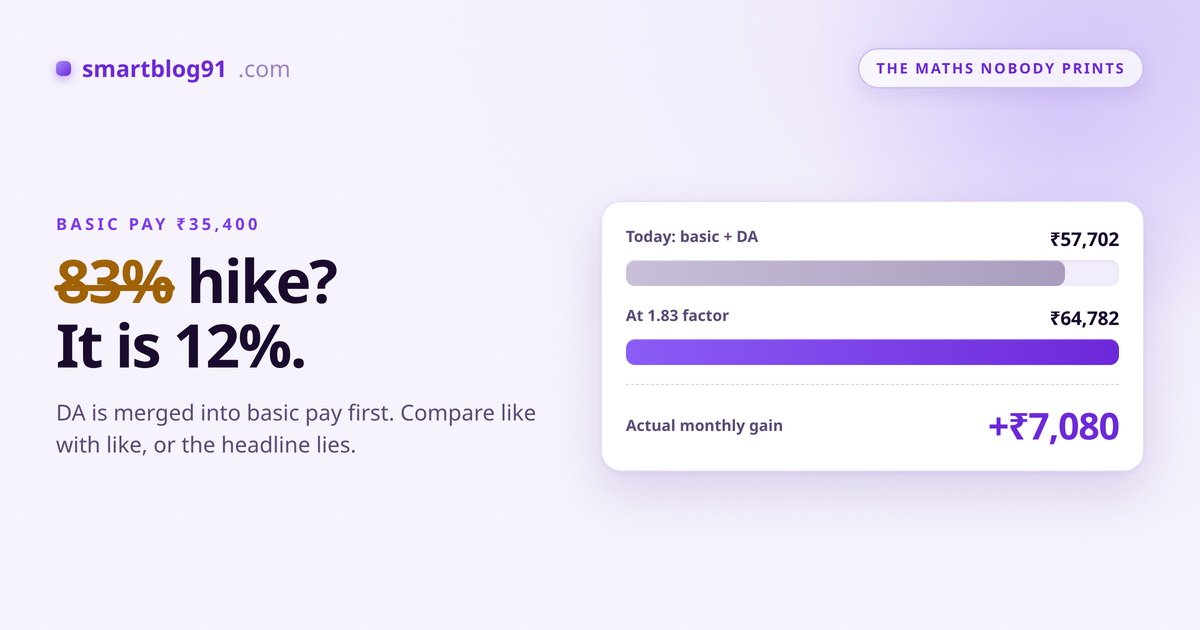
Twelve percent. Not eighty-three percent. On a ₹35,400 basic pay that is about ₹7,080 a month — a real gain worth planning for, but nothing like the headline number.
You can check the method against the last pay commission. In 2016 the factor was 2.57 and DA was 125%:
2.57 ÷ (1 + 1.25) = 2.57 ÷ 2.25 = 1.1422 → +14.2%
That matches the official statement that the 7th CPC raised pay and pension by “at least 14.29%” after accounting for the prevailing DA. Same arithmetic, different year.
Why JP Morgan says 14% and this article says 12%. Their note builds the factor from a 60% DA base, which was the rate on 1 January 2026: 1.83 ÷ 1.60 = +14.4%. DA is now 63%, so the same factor buys slightly less. Both are right for their own assumptions. A 1.83 factor lands somewhere around a 12–14% increase in basic pay plus DA, and the gap widens with every DA instalment before implementation.
How to calculate your own revised pay in 30 seconds
You do not need a calculator. Three steps, using the basic pay printed on your salary slip:
- Basic pay × 1.63 = what you get today as basic plus DA at 63%.
- Basic pay × fitment factor = your new basic pay. Use 1.83 for the estimate, 3.833 for the union demand.
- Subtract the first from the second = your monthly gain.
Worked example, basic pay ₹35,400:
- Today: 35,400 × 1.63 = ₹57,702
- At 1.83: 35,400 × 1.83 = ₹64,782
- Monthly gain: 64,782 − 57,702 = ₹7,080
- Yearly gain: 7,080 × 12 = ₹84,960
Swap 1.83 for 3.833 and the same ₹35,400 becomes ₹1,35,688, a gain of ₹77,986 a month. That is why the two numbers cannot both be called “the 8th Pay Commission increase”.
Salary ready-reckoner: 16 pay levels at 1.83
Entry basic pay of each level in the 7th CPC matrix. “Today” is basic plus DA at 63%. The gain column is the honest comparison, for the reason explained above.
| Basic pay | Today (basic+DA) | New basic @ 1.83 | Monthly gain |
|---|---|---|---|
| ₹18,000 | ₹29,340 | ₹32,940 | +₹3,600 |
| ₹19,900 | ₹32,437 | ₹36,417 | +₹3,980 |
| ₹21,700 | ₹35,371 | ₹39,711 | +₹4,340 |
| ₹25,500 | ₹41,565 | ₹46,665 | +₹5,100 |
| ₹29,200 | ₹47,596 | ₹53,436 | +₹5,840 |
| ₹35,400 | ₹57,702 | ₹64,782 | +₹7,080 |
| ₹44,900 | ₹73,187 | ₹82,167 | +₹8,980 |
| ₹56,100 | ₹91,443 | ₹1,02,663 | +₹11,220 |
| ₹67,700 | ₹1,10,351 | ₹1,23,891 | +₹13,540 |
| ₹78,800 | ₹1,28,444 | ₹1,44,204 | +₹15,760 |
| ₹1,23,100 | ₹2,00,653 | ₹2,25,273 | +₹24,620 |
| ₹1,44,200 | ₹2,35,046 | ₹2,63,886 | +₹28,840 |
| ₹1,82,200 | ₹2,96,986 | ₹3,33,426 | +₹36,440 |
| ₹2,05,400 | ₹3,34,802 | ₹3,75,882 | +₹41,080 |
| ₹2,25,000 | ₹3,66,750 | ₹4,11,750 | +₹45,000 |
| ₹2,50,000 | ₹4,07,500 | ₹4,57,500 | +₹50,000 |
Estimates, not entitlements. Multiply the monthly gain by 12 for the yearly figure.
Same basic pay, three different factors
Only the new basic pay is shown. To get your gain, subtract your basic pay × 1.63 from the column value.
| Basic pay | @ 1.83 JP Morgan | @ 2.57 7th CPC | @ 3.833 Union ask |
|---|---|---|---|
| ₹18,000 | ₹32,940 | ₹46,260 | ₹68,994 |
| ₹19,900 | ₹36,417 | ₹51,143 | ₹76,277 |
| ₹21,700 | ₹39,711 | ₹55,769 | ₹83,176 |
| ₹25,500 | ₹46,665 | ₹65,535 | ₹97,742 |
| ₹29,200 | ₹53,436 | ₹75,044 | ₹1,11,924 |
| ₹35,400 | ₹64,782 | ₹90,978 | ₹1,35,688 |
| ₹44,900 | ₹82,167 | ₹1,15,393 | ₹1,72,102 |
| ₹56,100 | ₹1,02,663 | ₹1,44,177 | ₹2,15,031 |
| ₹67,700 | ₹1,23,891 | ₹1,73,989 | ₹2,59,494 |
| ₹78,800 | ₹1,44,204 | ₹2,02,516 | ₹3,02,040 |
| ₹1,23,100 | ₹2,25,273 | ₹3,16,367 | ₹4,71,842 |
| ₹1,44,200 | ₹2,63,886 | ₹3,70,594 | ₹5,52,719 |
| ₹1,82,200 | ₹3,33,426 | ₹4,68,254 | ₹6,98,373 |
| ₹2,05,400 | ₹3,75,882 | ₹5,27,878 | ₹7,87,298 |
| ₹2,25,000 | ₹4,11,750 | ₹5,78,250 | ₹8,62,425 |
| ₹2,50,000 | ₹4,57,500 | ₹6,42,500 | ₹9,58,250 |
A 1.83 factor gives about +12.3% over today’s basic plus DA. A 3.833 factor gives about +135%.
Notice the percentage is identical at every level: a fitment factor is a flat multiplier, so it does not help junior and senior employees differently. That is exactly why the railways’ supervisors’ association wants a graded factor, from 2.92 at Level 1 to 4.38 at Levels 17 and 18.
Minimum pay and minimum pension at each factor
| Factor | Min basic pay | Min pension |
|---|---|---|
| 1.83 JP Morgan estimate | ₹32,940 | ₹16,470 |
| 2 Moderate estimate | ₹36,000 | ₹18,000 |
| 2.57 Same as 7th CPC | ₹46,260 | ₹23,130 |
| 3 Union floor demand | ₹54,000 | ₹27,000 |
| 3.833 NC-JCM / AIDEF demand | ₹68,994 | ₹34,497 |
Baseline: ₹18,000 minimum basic pay and ₹9,000 minimum pension under the 7th CPC.
Pension: same factor, smaller cushion
Pension is revised on the same principle, with the factor applied to basic pension. Pensioners get dearness relief at the same rate as employees’ DA, so the comparison works identically.
| Basic pension | New pension @ 1.83 | Gain vs today | New pension @ 3.833 |
|---|---|---|---|
| ₹9,000 | ₹16,470 | +₹1,800 | ₹34,497 |
| ₹12,000 | ₹21,960 | +₹2,400 | ₹45,996 |
| ₹15,000 | ₹27,450 | +₹3,000 | ₹57,495 |
| ₹18,000 | ₹32,940 | +₹3,600 | ₹68,994 |
| ₹25,000 | ₹45,750 | +₹5,000 | ₹95,825 |
| ₹35,000 | ₹64,050 | +₹7,000 | ₹1,34,155 |
| ₹50,000 | ₹91,500 | +₹10,000 | ₹1,91,650 |
| ₹75,000 | ₹1,37,250 | +₹15,000 | ₹2,87,475 |
DR taken at 63%. Family pension and commuted portions are computed separately and are not included.
Two things pensioners should keep in mind. First, JP Morgan estimates an average of about ₹15,000 more per month across 1.20 crore beneficiaries — that average is pulled up by senior grades, so a Level 1 pensioner will see far less. Second, if you retired under the National Pension System rather than the old defined-benefit scheme, the fitment factor changes your pay, not your pension rules; your corpus is what pays you.
Arrears: the lump sum is bigger than the monthly gain
Pay commissions are backdated. The 7th CPC took effect from 1 January 2016 and was notified mid-year, which is why anyone serving then remembers a large arrears credit.
The same is expected here. JP Morgan assumes implementation in November 2027 and estimates ₹4 lakh crore of the ₹7.2 lakh crore total going out as arrears, averaging about ₹3.40 lakh per beneficiary.
The arithmetic: arrears are roughly your monthly gain multiplied by the months between the effective date and the order date. At 22 months and ₹7,080, that is about ₹1.56 lakh.
Do not spend arrears as income. Arrears are taxed in the year you receive them, and a ₹1.5–3 lakh credit can push you into a higher slab. Section 89 relief lets you spread the tax over the years the arrears relate to, but you must claim it in your return — it is not automatic. Keep the tax portion aside first.
What the fitment factor does not change
- Allowances are separate. HRA is a percentage of basic pay (27%, 18% or 9% by city class), so it rises on its own. TA and other fixed allowances need their own revision.
- Your increment stays at 3%. A higher basic pay simply makes each future 3% worth more in rupees.
- Promotion structure is unchanged. You still move to the next cell in the new matrix.
- State employees are outside this. Each state runs its own commission; many adopt the central factor later, some do not.
- Nothing here is official. Every figure today, including these, is an estimate or a demand.
Is 3.833 realistic? A quick sanity check
Unions want 3.833, which lifts minimum basic pay from ₹18,000 to ₹68,994 — a 3.8x jump. Here is why that is almost certainly not happening.
The cost of a revision is proportional to the increase over today’s basic plus DA, not to the factor itself. JP Morgan puts 1.83 at ₹7.2 lakh crore, which is the cost of an increase of 0.20 over today’s 1.63 baseline. Scale the same relationship to 3.833 — an increase of 2.203 — and you get roughly ₹79 lakh crore, about eleven times as much.
| Factor | Increase over today’s 1.63 | Rough cost |
|---|---|---|
| 1.83 | 0.20 | ₹7.2 lakh cr |
| 2 | 0.37 | ~₹13 lakh cr |
| 2.57 | 0.94 | ~₹34 lakh cr |
| 3.833 | 2.20 | ~₹79 lakh cr |
A proportional scaling of the JP Morgan estimate, for illustration. Real costs differ with allowances, headcount and the effective date. A sanity check, not a forecast.
For context, the Union Budget’s entire capital expenditure is a fraction of that number. Which is why the realistic landing zone sits between 1.83 and 2.57, with 2.0 to 2.3 the band most neutral observers would pick. Retail inflation crossing 6% in October 2026 strengthens the unions’ case but does not create fiscal room.
The part nobody writes: what the hike is worth in 20 years
A 12% raise feels small because it arrives as a slightly larger payslip. Invested, it is not small at all.
Take the ₹18,000 basic pay case. The gain is ₹3,600 a month. Put that into an equity SIP at 12% a year and leave it alone:
| Monthly SIP | 10 years | 20 years | 25 years |
|---|---|---|---|
| ₹2,000 small hike | ₹4.6 L | ₹20.0 L | ₹38.0 L |
| ₹3,600 Level 1 at 1.83 | ₹8.4 L | ₹36.0 L | ₹68.3 L |
| ₹6,000 mid level at 1.83 | ₹13.9 L | ₹59.9 L | ₹1.14 Cr |
| ₹15,000 JP Morgan average | ₹34.9 L | ₹1.50 Cr | ₹2.85 Cr |
12% annual return, contributions at the start of each month, compounded monthly. Illustrative, not a promise.
The ₹15,000 average gain, invested for 20 years, becomes about ₹1.5 crore. That is the number worth remembering next time a pay commission headline appears — not the 1.83.
How to route it, in order
- Emergency fund first. Six months of expenses in a liquid or sweep-in fund. A hike is the easiest time to build it, before your expenses grow to absorb it.
- Then raise the SIP by the full amount. Use a step-up SIP so it happens automatically.
- Then check term insurance and health cover. A higher salary means a higher replacement need. The boring step most people skip.
- Treat arrears as capital, not salary. It is an allocation decision, not a spending decision.
Read next: the best 15-year investment plan uses the same three-layer structure as above. For raising an existing SIP, see ₹1,000 vs ₹5,000 monthly SIP over 10, 20 and 30 years. And if you are closer to retirement, read the ₹30,000-a-month corpus calculation before deciding what to do with arrears.
Five mistakes to avoid while the numbers are open
- Do not borrow against an expected hike. The factor is not fixed and arrears arrive after tax.
- Do not compare a factor with a percentage. 1.83 is a multiplier on basic pay; 12% is the change in basic plus DA. Both can be true.
- Do not plan on 3.833. Plan on 1.83 to 2.0 and treat anything above as a bonus.
- Do not forget DA restarts at zero. In year one your gross pay rises by less than your basic pay does.
- Do not trust a number without your DA rate in it. Any “8th pay commission calculator” that shows a flat figure without asking for basic pay and DA is not calculating anything.
Frequently asked questions
What is the fitment factor right now?
None has been recommended or approved. The Commission is still consulting and has not submitted its report. The only published number is JP Morgan’s 1.83 estimate, against a union demand of 3.833.
Does 1.83 mean my salary rises by 83%?
No. The factor is applied to basic pay at the same time as existing DA is merged into it. Your basic plus DA today is 1.63 times basic pay at 63% DA, so a 1.83 factor raises basic plus DA by about 12%.
When will it be implemented?
The Commission was constituted on 3 November 2025 with an 18-month window, so the report is due around May 2027. JP Morgan expects implementation in November 2027. An effective date of 1 January 2026 is widely expected but not officially confirmed.
Will DA be merged into basic pay?
The government says no such proposal is under consideration. The absorption still happens mechanically, because the factor is applied to basic pay when DA is already high. That is how the 7th CPC worked too.
What will the minimum salary be?
Minimum basic pay is ₹18,000 today. At 1.83 it becomes ₹32,940, at 2.57 ₹46,260, and at 3.833 ₹68,994. Only the Commission’s report fixes this.
Will pension rise by the same factor?
Pension is normally revised with the same factor on basic pension. At 1.83 the minimum pension of ₹9,000 becomes ₹16,470 a month; at 3.833 it becomes ₹34,497.
Are arrears taxable?
Yes, in the year you receive them. Section 89 relief can spread the tax over the years the arrears relate to, but it must be claimed in your return.
Is 3.833 realistic?
Unlikely. If 1.83 costs about ₹7.2 lakh crore, scaling the same relationship puts 3.833 near ₹79 lakh crore. A realistic range is 1.83 to 2.57.
Does this apply to state employees?
No. Each state has its own commission. Many adopt the central factor or a close variant with a lag, but the 8th CPC covers central government employees and pensioners, including defence and railway personnel.
Will HRA and TA increase too?
Allowances are revised separately. HRA is a percentage of basic pay, so it rises automatically. TA and other fixed allowances need their own revision.
Disclaimer: This article is for information only. It is not financial advice, and it is not an official statement of the 8th Central Pay Commission or the Government of India. No fitment factor has been recommended or approved as of 27 November 2026. All revised pay and pension figures are estimates built from the 7th CPC pay matrix, a 63% DA rate and published fitment factor scenarios. Actual entitlements will be fixed by the Commission’s report and the government’s order. Mutual fund investments are subject to market risk; the SIP projections are illustrations at an assumed 12% annual return and are not guaranteed.