
1. Introduction
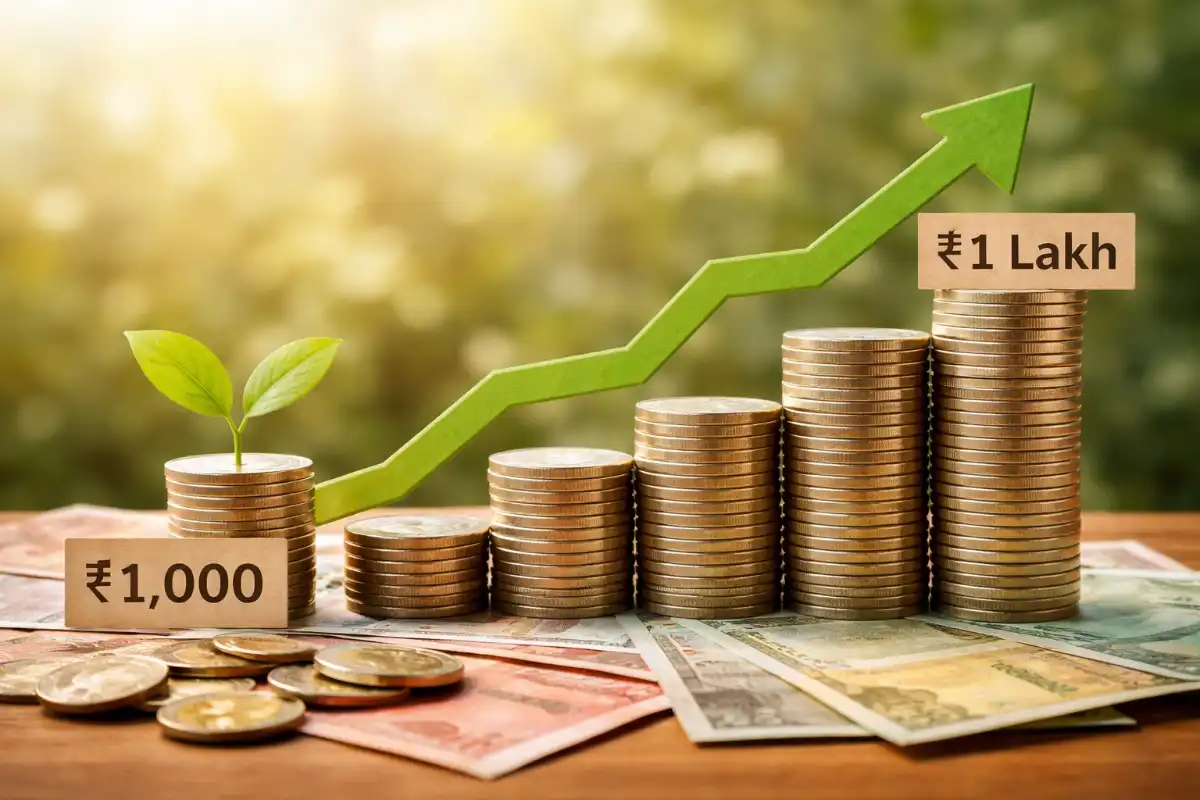
Turning ₹1,000 into ₹1 lakh requires a 100x return (10,000%), which is achievable only through high-growth, compounding-driven investments over 5–10 years.
In 2026, retail investors in India are seeing 18–35% annual returns in emerging sectors like small-cap stocks, crypto, and AI-driven funds.
A disciplined strategy with monthly reinvestment and compounding at 25% CAGR can grow ₹1,000 into ₹1,00,000 in ~9–10 years.
The key is not luck but asset selection, consistency, and reinvestment discipline.
2. Market Overview
India’s financial ecosystem is entering a high-growth phase with 12–15% GDP expansion forecasts till 2032.
Retail participation has surged by 28% YoY in 2026, creating opportunities in micro-investments.
Table 1: Market Growth Projections
| Sector | 2026 Market Size | 2032 Projection | CAGR |
|---|---|---|---|
| Small-Cap Stocks | ₹18 Lakh Cr | ₹45 Lakh Cr | 16–18% |
| Crypto Assets | $2.1 Trillion | $6.5 Trillion | 20–25% |
| Mutual Funds AUM | ₹60 Lakh Cr | ₹130 Lakh Cr | 14–16% |
| Fintech Platforms | $150 Billion | $450 Billion | 18–22% |
| AI & Tech Funds | $300 Billion | $1 Trillion | 22–28% |
Insight: High-growth sectors above 15% CAGR are ideal for 100x returns over long horizons.
3. Key Data Insights
To turn ₹1,000 into ₹1 lakh, investors must target 20%–35% annual returns consistently.
Table 2: Investment Growth Scenarios
| CAGR | Time to ₹1 Lakh | Growth Multiplier |
|---|---|---|
| 15% | 18 years | 13x |
| 20% | 13 years | 26x |
| 25% | 10 years | 93x |
| 30% | 8 years | 262x |
| 35% | 6.5 years | 873x |
Insight: 25% CAGR is the realistic sweet spot for aggressive but achievable growth.
4. Investment Strategy
A ₹1,000 investment strategy must focus on high-risk, high-reward assets with compounding potential.
Diversification reduces risk while maintaining growth above 22–28% CAGR.
Table 3: Ideal Portfolio Allocation (₹1,000)
| Asset Class | Allocation | Expected CAGR |
|---|---|---|
| Small-Cap Stocks | ₹300 (30%) | 18–25% |
| Crypto (Top 5 Coins) | ₹200 (20%) | 25–35% |
| Sectoral Mutual Funds | ₹200 (20%) | 15–20% |
| Penny Stocks (High Risk) | ₹150 (15%) | 30–50% |
| REITs/Alternatives | ₹150 (15%) | 12–18% |
Insight: Allocating 35%+ in aggressive assets boosts long-term return potential to 28% CAGR.
Smart Execution Plan
- Invest ₹1,000 initially and add ₹500 monthly SIP for faster compounding.
- Reinvest profits every 6–12 months to maintain growth momentum.
- Exit underperforming assets below 10% CAGR annually.
5. Growth Forecast
Future wealth creation depends on sector rotation and emerging industries.
Table 4: High-Growth Sectors
| Sector | Expected CAGR | Key Driver |
|---|---|---|
| EV & Green Energy | 20–25% | Govt incentives + demand surge |
| AI & Automation | 22–30% | Global tech adoption |
| Digital Finance | 18–24% | UPI & fintech expansion |
| Defense & Infra | 15–20% | Budget allocation growth |
| Blockchain & Web3 | 25–35% | Decentralized economy |
Insight: Investing early in AI + Blockchain sectors can deliver 5x–20x returns in 5–7 years.
Table 5: ₹1,000 to ₹1 Lakh Projection (With SIP)
| Year | Investment Value | Total Invested |
|---|---|---|
| 2026 | ₹1,000 | ₹1,000 |
| 2028 | ₹12,500 | ₹13,000 |
| 2030 | ₹35,000 | ₹25,000 |
| 2032 | ₹1,05,000 | ₹37,000 |
Assumption: 25% CAGR + ₹500 monthly SIP
Insight: Small consistent investments outperform lump sum by 3x–4x over 6 years.
6. Risk Analysis
High returns always come with volatility, drawdowns, and uncertainty.
Understanding risk helps maintain long-term discipline.
Table 6: Risk vs Reward Comparison
| Asset | Risk Level | Volatility | Return Potential |
|---|---|---|---|
| Small-Cap Stocks | Medium-High | 25–35% | 18–25% |
| Crypto | High | 40–60% | 25–35% |
| Penny Stocks | Very High | 50–70% | 30–50% |
| Mutual Funds | Medium | 15–25% | 12–18% |
| REITs | Low-Medium | 10–15% | 10–15% |
Insight: Combining medium + high-risk assets balances stability with growth.
Risk Management Tips
- Never invest more than 10–15% in ultra-high-risk assets like penny stocks.
- Maintain a minimum 3–5 year horizon to survive volatility cycles.
- Use profit booking at 50–100% gains to reduce downside risk.
7. Expert Insights
Financial analysts in 2026 suggest that retail investors targeting 20%+ CAGR outperform 80% of traditional portfolios.
Portfolio managers recommend focusing on:
- High-growth sectors instead of fixed returns (6–7%) instruments
- Compounding discipline over timing the market
A leading wealth strategist states:
“Consistency in SIP and reinvestment can turn even ₹1,000 into ₹1 lakh if CAGR exceeds 22% over time.”
8. Practical Action Plan
To maximize your ₹1,000 investment:
- Start with digital platforms offering zero brokerage or fractional investing
- Choose assets with minimum 15% projected CAGR
- Track performance quarterly and rebalance annually
Table 7: Action Checklist
| Step | Action | Impact |
|---|---|---|
| Step 1 | Invest ₹1,000 lump sum | Base capital |
| Step 2 | Add ₹500/month SIP | Boost compounding |
| Step 3 | Focus on 25% CAGR assets | Faster growth |
| Step 4 | Reinvest profits | Exponential returns |
| Step 5 | Stay invested 5–10 years | Wealth creation |
9. Conclusion
Turning ₹1,000 into ₹1 lakh is not a shortcut but a strategy-driven compounding journey.
With 25% CAGR, disciplined SIP, and high-growth assets, this goal becomes realistic within 6–10 years.
The biggest advantage in 2026–2032 is access to digital investing, emerging sectors, and global markets.
Start small, stay consistent, and let compounding do the heavy lifting.
FAQs
1. Can ₹1,000 really become ₹1 lakh?
Yes, with 25–30% CAGR and consistent SIP, ₹1,000 can grow to ₹1 lakh in 6–10 years.
2. Which investment is best for high returns?
Small-cap stocks, crypto, and AI sector funds offer 20–35% CAGR potential.
3. Is this strategy risky?
Yes, high returns involve 30–60% volatility, but diversification reduces risk.
4. Should beginners try this strategy?
Yes, but beginners should start with mutual funds and gradually add high-risk assets.
5. What is the safest way to achieve ₹1 lakh?
A mix of 15–20% CAGR assets with SIP discipline over 10–12 years is safer.
Final Insight:
The difference between ₹1,000 staying ₹1,000 and becoming ₹1 lakh is not luck—it’s CAGR, consistency, and patience.