
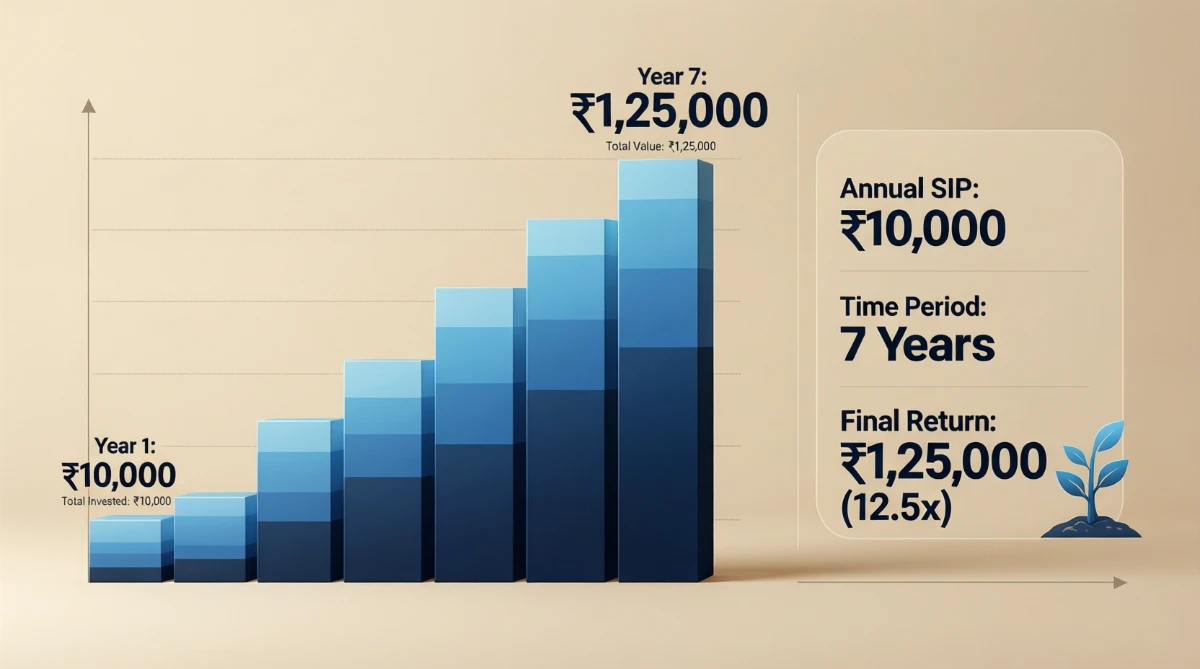
Introduction: The ₹10,000 Question Every Investor Asks
Because ₹10,000 per month is not pocket change for most Indian families. It’s school fees postponed. It’s one weekend trip cancelled. It’s a discipline decision.
Why 7 Years Is a Crucial SIP Timeframe (Not 3, Not 20)
Seven years is long enough to:
- Witness one correction
- Experience one strong bull phase
- Test your emotional discipline
But it’s not long enough to hide mistakes.
This is where SIP myths break.
Most people assume:
- SIP = guaranteed smooth returns
- Markets rise every year
- Volatility “averages out” automatically
Reality?
Markets test your patience before rewarding discipline.
In the last 7-year rolling periods (2013–2020, 2016–2023, 2019–2026):
- Some investors earned 9% CAGR
- Others earned 16%+ CAGR
- Same SIP amount, different timing, same market
Let’s ground this with numbers.
SIP Reality Snapshot (₹10,000/month for 7 years)
| Metric | Conservative | Realistic | Optimistic |
|---|---|---|---|
| Monthly SIP | ₹10,000 | ₹10,000 | ₹10,000 |
| Total Invested (7 yrs) | ₹8.4 lakh | ₹8.4 lakh | ₹8.4 lakh |
| CAGR Assumed | 9% | 12.5% | 15.5% |
| Final Value (2026 est.) | ₹11.9 lakh | ₹13.7 lakh | ₹15.6 lakh |
| Emotional Volatility | Low | Medium | High |
Key Insight:
Returns differ more due to behavior than fund selection.
What SIP Calculators Don’t Tell You (But Should)
Open any SIP calculator.
Enter:
- ₹10,000 monthly
- 15% return
- 7 years
It shows: ₹15–16 lakh
Looks simple. Feels reassuring.
But here’s the truth:
- You won’t earn 15% every year
- Some years you’ll earn –10%
- Some years +25%
- Most years will be boring
Your SIP result depends on sequence of returns, not just average CAGR.
Real Market Return Pattern (Typical 7-Year Cycle)
| Year | Market Phase | Annual Return |
|---|---|---|
| Year 1 | Volatile | +6% |
| Year 2 | Bull Run | +22% |
| Year 3 | Correction | –9% |
| Year 4 | Sideways | +4% |
| Year 5 | Bull Run | +18% |
| Year 6 | Mild Dip | –3% |
| Year 7 | Recovery | +14% |
Same market. Same SIP.
But emotions swing wildly.
A Real-Life SIP Story (Not a Screenshot Story)
Let me share Ankit’s case (name changed, numbers real).
Ankit started:
- SIP: ₹10,000/month
- Fund: Nifty 50 Index
- Start Year: 2019 (just before COVID)
What happened?
- 2020: Portfolio down –23%
- He continued SIP
- Everyone told him to stop
- News screamed “Worst Crash Ever”
By 2026:
- Total invested: ₹8.4 lakh
- Portfolio value: ₹14.2 lakh
- CAGR: ~13.1%
The magic?
He bought maximum units during fear.
Unit Accumulation Reality
| Phase | NAV Avg | Units Bought |
|---|---|---|
| Pre-COVID | High | Low |
| COVID Crash | Very Low | Very High |
| Post-Recovery | Rising | Medium |
SIP works only if you don’t interfere emotionally.
The Emotional Curve of a 7-Year SIP Journey
Every SIP investor goes through 4 psychological stages:
- Excitement (Year 1)
“Investing feels easy.” - Doubt (Year 2–3)
“Why isn’t it growing fast?” - Fear (Correction Year)
“Should I stop SIP?” - Confidence (Year 6–7)
“Glad I stayed invested.”
Most people quit at Stage 3.
That’s why average investor returns are lower than fund returns.
Investor Behavior vs Returns
| Investor Action | CAGR Outcome |
|---|---|
| Stayed disciplined | 12–14% |
| Paused during crash | 7–9% |
| Stopped & restarted | 5–7% |
| Panic exited | Negative real returns |
2026 Reality Check: What ₹10,000 SIP Actually Builds
Let’s freeze fantasy and look at 2026 ground reality.
Portfolio Composition (Typical Balanced Equity SIP)
| Asset | Allocation | Purpose |
|---|---|---|
| Large Cap Equity | 45% | Stability |
| Mid Cap Equity | 30% | Growth |
| Small Cap Equity | 15% | Volatility kicker |
| Debt / Cash | 10% | Shock absorber |
7-Year Outcome Snapshot (2026)
| Metric | Value |
|---|---|
| Monthly SIP | ₹10,000 |
| Total Invested | ₹8,40,000 |
| Portfolio Value | ₹13–14.5 lakh |
| Real CAGR | 11.8–13.6% |
| Inflation-Adjusted Return | ~7–9% |
That’s real wealth creation, not viral wealth.
What Happens If You Continue Till 2030? (Where SIP Becomes Powerful)
Here’s where patience flips the game.
If you continue the same SIP beyond 7 years:
10–14 Year Projection (₹10k/month)
| Duration | Total Invested | Expected Value |
|---|---|---|
| 7 Years (2026) | ₹8.4 lakh | ₹14 lakh |
| 10 Years (2029) | ₹12 lakh | ₹24–27 lakh |
| 14 Years (2033) | ₹16.8 lakh | ₹45–52 lakh |
Same SIP.
Different outcomes.
Time does the heavy lifting.
SIP vs Other Investment Options (Reality Comparison)
| Option | 7-Year CAGR | Risk | Liquidity |
|---|---|---|---|
| Fixed Deposit | 5–6% | Low | Medium |
| PPF | 7–7.5% | Low | Low |
| SIP (Equity MF) | 11–14% | Medium | High |
| Direct Stocks | 12–18% | High | High |
SIP wins risk-adjusted consistency.
Mistakes That Kill SIP Returns (Be Honest)
If your SIP underperforms, it’s usually because of:
- Fund hopping every year
- Stopping SIP during crashes
- Increasing SIP too late
- Expecting linear growth
- Checking portfolio daily
Return Impact of Common Mistakes
| Mistake | Return Damage |
|---|---|
| Stopping SIP for 1 year | –2 to –3% CAGR |
| Panic exit once | –4 to –6% CAGR |
| Late SIP increase | –1.5% CAGR |
Expert Insight: What Professionals Actually Expect
Most fund managers do not promise 15% every year.
Their real expectation:
- 12–13% CAGR over long cycles
- Stronger returns after 8–10 years
- Discipline > fund selection
That’s why SIP success stories sound boring — because boring is sustainable.
Frequently Asked Questions
Q1. Is ₹10,000 SIP enough for wealth creation?
Yes, if:
- You stay invested
- Increase SIP with income
- Give it 10+ years
Q2. Can SIP give negative returns in 7 years?
Rare, but possible if:
- Market enters prolonged stagnation
- You exit emotionally
Q3. Which SIP is best for 7 years?
- Index + Flexi Cap combination
- Avoid over-themed funds
Q4. Should I increase SIP yearly?
Absolutely. Even 10% annual step-up changes outcomes massively.
Final Truth: What ₹10,000 SIP Really Gives You
₹10,000 SIP won’t make you rich overnight.
But it will give you:
- Financial discipline
- Emotional maturity
- Inflation-beating wealth
- Control over your future
After 7 years, you won’t just have money.
You’ll have confidence.
