
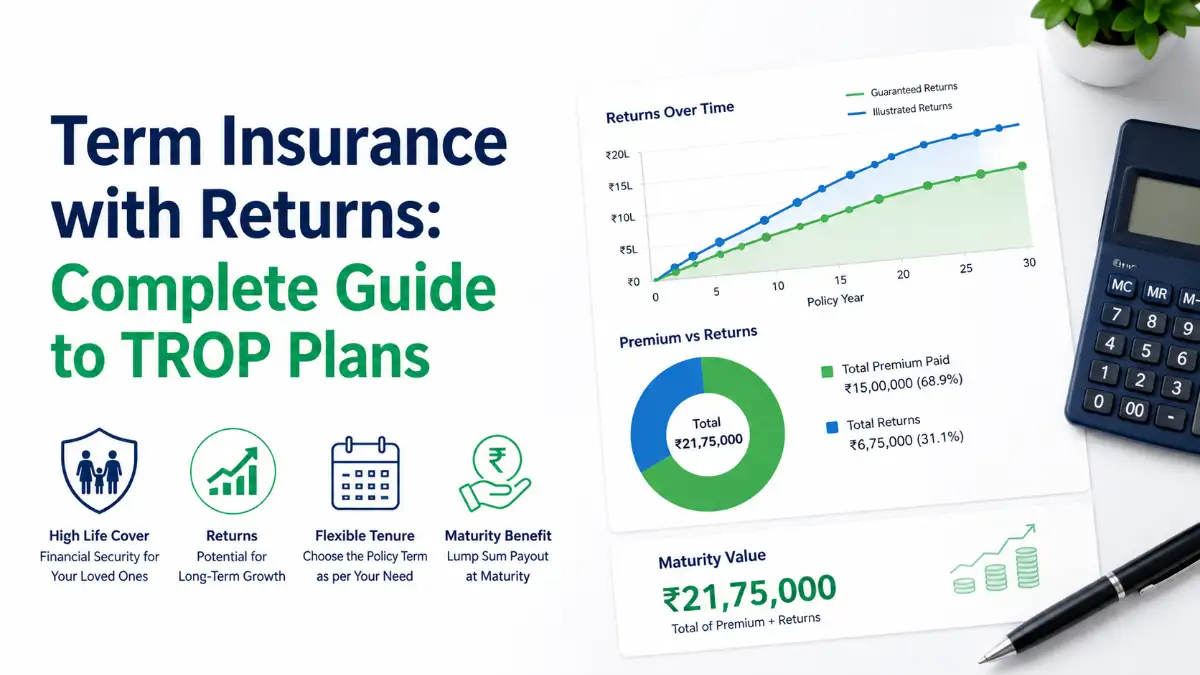
Most Indians who understand term insurance have one fear: “What if I survive the entire policy term? I’ll have paid lakhs of rupees in premiums and get back nothing.” This fear prevents millions from buying the most important financial protection they need.
Term Insurance with Return of Premium — commonly called TROP — was designed to fix exactly this problem. It is a type of pure-risk term insurance plan that combines two powerful benefits in one product:
If you die during the policy term
Your Family Gets the Full Sum Assured
- ₹1 Crore (or more) paid to your nominee
- Paid as lump sum, monthly income, or both
- Death benefit is always 100% tax-free
- Claim settlement within 1–3 working days
If you survive the policy term
You Get ALL Your Premiums Back
- 100% of base premiums refunded at maturity
- Completely tax-free under Section 10(10D)
- No market risk — guaranteed return of capital
- Like a forced savings deposit with life cover
Simple Definition: Pay ₹X as premium every year for 20–30 years. Your family gets ₹1 Crore if you die. You get all your ₹X back if you survive. Either way, you don’t “lose” money. This is the core appeal of TROP.

TROP is officially classified as a Non-Linked, Non-Participating, Pure Risk insurance product — meaning it is not connected to the stock market and does not share in the insurer’s profits. The premium refund at maturity is a guaranteed, contractual obligation.
How TROP Works — Step by Step
Choose Your Sum Assured & Policy Term
Select a life cover amount (e.g. ₹1 Crore) and policy duration (typically 15–40 years). The longer the term, the more total premiums you pay — and the more you get back at maturity.
Pay Premiums Regularly
Pay fixed annual, semi-annual, quarterly, or monthly premiums throughout the policy term. Premium amounts are locked at the time of policy purchase and do not increase.
Stay Covered for the Full Term
Throughout the policy, your family is protected by the full sum assured in case of your death — exactly like a regular term plan.
Two Possible Endings
If you die during the term: Nominee gets the full sum assured. If you survive: Insurer returns 100% of all base premiums paid. Taxes (GST), rider premiums, and any extra charges are excluded from the refund.
Real-Life Example: Rahul, Age 30, Delhi
Scenario A — Rahul Dies at Age 50 (During Policy Term)
TROP Plan: ₹1 Crore Sum Assured | 30-Year Term | ₹28,000/year Premium
Annual Premium Paid ₹28,000
Premiums Paid so far (20 years) ₹5,60,000
His Family Receives ₹1,00,00,000 (₹1 Crore)
Tax on Death Benefit ₹0 (fully exempt)
Scenario B — Rahul Survives the Full 30-Year Term
TROP Plan: ₹1 Crore Sum Assured | 30-Year Term | ₹28,000/year Premium
Total Premiums Paid (30 years) ₹8,40,000
Maturity Refund Received ₹8,40,000 (100% back)
Tax on Maturity Payout ₹0 (exempt u/s 10 (10D))
Net Cost of 30 Years of ₹1 Cr Cover ₹0 (if you exclude time value of money)
Important Note on “What’s Returned”: Only base premiums are refunded. GST (now ₹0 on life insurance as of September 2025), rider premiums (e.g., critical illness add-on), and extra risk loadings are not included in the maturity refund. Always confirm the exact refund amount in your policy document.
TROP vs Regular Term Plan: Key Differences
The core trade-off is simple: a regular term plan is cheaper, TROP gives you your money back. Here is a detailed comparison to help you decide.
| Feature | Regular Term Plan | TROP (Money-Back Term) |
|---|---|---|
| Maturity Benefit | None — policy ends, no payout | 100% premium refund |
| Death Benefit | Full sum assured to nominee | Full sum assured to nominee |
| Premium Amount | Lower (cheaper) | 30–60% higher |
| Life Cover Quality | Same pure risk protection | Same pure risk protection |
| Market Risk | None | None |
| Tax Benefit (Premium) | Section 80C up to ₹1.5L (old regime) / Section 123 (new ITA 2025) | Same — Section 80C / Section 123 |
| Maturity Payout Tax | No maturity payout | Tax-free u/s 10(10D) |
| Psychological Benefit | Low — feels like “wasted” money if no claim | High — “nothing lost” peace of mind |
| Riders Available | Yes (Critical Illness, Accident, etc.) | Yes — same riders available |
| Surrender Value | Usually none (pure term) | None if lapsed before term end |
| Best For | Maximizing coverage per rupee of premium | Risk-averse, conservative investors |
The single biggest factor: TROP premiums are significantly higher. A 30-year-old non-smoking male buying ₹1 Crore cover for 30 years might pay ₹9,000–12,000/year in a regular term plan versus ₹25,000–35,000/year in TROP. The premium difference can be invested in PPF or mutual funds — but that involves discipline and risk that many people are unwilling to take on.
Best Term Insurance with Return of Premium Plans in India 2026
Based on claim settlement ratios, solvency ratios, plan features, and customer trust, here are the top TROP plans available in India as of June 2026.
| Insurer & Plan | CSR (FY 2025–26) | Solvency Ratio | Key TROP Feature | Max Cover Age |
|---|---|---|---|---|
| HDFC Life Click 2 Protect Super | 99.71% | 1.94x | Flexible ROP variant; whole life option | 85 years |
| Axis Max Life Smart Term Plan Plus | 99.79% | 1.88x (above 1.5x mandated) | Special Exit Value — 2X premiums paid back; 64 CI riders | 85 years |
| SBI Life eShield Next | 99.83% | 2.04x | Highest CSR in India; SBI banking network | 80 years |
| ICICI Pru iProtect Smart | 99.04% | 2.05x | 1-day claim settlement; accidental disability cover | 85 years |
| Tata AIA Sampoorna Raksha Promise | 98.02% | Above 1.5x | Cover up to 100 years; built-in ROP feature | 100 years |
| Bajaj Life eTouch II (Life Shield Plus) | 99.33% | 2.66x (highest) | Early exit value option; 99.29% same-day settlement | 85 years |
| LIC Jeevan Amar (ROP Variant) | 98.35% | Government-backed | Entry age up to 80 years; govt trust | 80 years |
| Kotak e-Term Insurance (TROP) | 98.5% | Above 1.5x | Flexible payout options (lump sum + income) | 75 years |
Pro Tip: Don’t pick a plan on price alone. A TROP plan with a 95% CSR that is ₹2,000 cheaper annually is not worth it — if your family’s claim gets rejected, the premium savings mean nothing. Always prioritize insurers with CSR above 98% and solvency ratio well above the IRDAI-mandated 1.5x.
Claim Settlement Ratios: Why This Is the Most Important Number
The Claim Settlement Ratio (CSR) tells you what percentage of death claims the insurer actually paid in a financial year. A CSR of 99.5% means the insurer settled 995 out of every 1,000 claims filed. The higher this number, the more confident you can be that your family will receive the death benefit without hassle.
| Life Insurer | CSR FY 2025–26 | Amount Settlement Ratio (ASR) | Industry Standing |
|---|---|---|---|
| SBI Life Insurance | 99.83% | ~96% | Highest CSR; 2nd largest insurer |
| Axis Max Life Insurance | 99.79% | 96.37% | Top-rated by Ditto (4.9/5) |
| HDFC Life Insurance | 99.71% | 96.72% (highest ASR) | Leads on amount settlement |
| Bajaj Life Insurance | 99.33% | Above industry avg | Highest solvency (4.37x) |
| ICICI Prudential Life | 99.04% | ~94% | 1.2 day avg turnaround |
| Tata AIA Life Insurance | 98.02% | ~95% | Whole-life TROP till 100 years |
| LIC of India | 98.35% | ~92% | Government-backed; largest insurer |
| Industry Average | ~97% | 94.83% | IRDAI Published Data |
Beyond CSR, also check the Amount Settlement Ratio (ASR) — this measures what proportion of total claim value was actually paid. An insurer with high CSR but low ASR might approve many small claims quickly while delaying large-value claims. HDFC Life leads on ASR at 96.72%, making it especially reliable for ₹1 Crore+ policies.
Tax Benefits of TROP: Section 80C, 10(10D), and the New Tax Regime
TROP is one of the few financial instruments that offers dual tax benefits — deduction on premium payment AND tax exemption on the money received back. Here’s how it works under India’s tax laws in 2026:
| Tax Benefit | Provision | Limit / Condition | Applies To |
|---|---|---|---|
| Premium Deduction (Old Regime) | Section 80C / Section 123 (ITA 2025) | Up to ₹1.5 Lakh per year | Annual TROP premium paid |
| Death Benefit Exemption | Section 10(10D) / Schedule II | 100% tax-free, no limit | Sum assured paid to nominee |
| Maturity Payout Exemption | Section 10(10D) | Sum assured ≥ 10× annual premium (post-Apr 2012 policies) | 100% premium refund on survival |
| New Tax Regime (2025–26) | No 80C deduction | Premium deduction NOT available | Those opting for new regime |
New Tax Regime Alert (2026): Under the new default income tax regime, the Section 80C deduction (now Section 123 under the Income Tax Act 2025) is not available. However, the death benefit and maturity payout still remain tax-free under Section 10(10D) equivalent provisions. If you are on the new regime, factor in that TROP loses its premium deduction benefit — this changes the overall ROI calculation.
Who Benefits Most from TROP’s Tax Advantages?
Three types of taxpayers find TROP’s tax treatment most valuable under the old regime: salaried individuals trying to fill their ₹1.5 Lakh Section 80C quota without locking money into ELSS funds with a 3-year lock-in; self-employed individuals who want a forced savings discipline with guaranteed, tax-free return of capital; and conservative investors who want a guaranteed outcome without market exposure, particularly those in the 30% tax bracket where the 80C deduction saves ₹46,800 per year.
TROP vs Regular Term: Actual Premium Comparison (₹1 Crore, 30 Years)
To make a fair comparison, here are indicative annual premium figures for a 30-year-old non-smoking male buying ₹1 Crore of life cover for a 30-year policy term. Actual premiums vary by insurer, health profile, and add-ons — always get a quote online.
| Plan Type | Annual Premium (Approx.) | Total Paid in 30 Yrs | Maturity Benefit | Net Cost of Cover |
|---|---|---|---|---|
| Regular Term Plan | ₹8,000 – ₹14,000 | ₹2.4L – ₹4.2L | ₹0 (nothing back) | ₹2.4L – ₹4.2L total |
| TROP Plan | ₹22,000 – ₹35,000 | ₹6.6L – ₹10.5L | ₹6.6L – ₹10.5L back | ₹0 (nominal cost if no claims) |
| Premium Difference | ₹14,000 – ₹21,000/year extra | ₹4.2L – ₹6.3L more paid | Fully recovered at maturity | Opportunity cost = key question |
The Opportunity Cost Question
This is where the TROP debate gets real. If you take the premium difference (say ₹18,000/year) and invest it in a PPF (7.1% p.a.) or equity mutual fund (assumed 12% p.a. long term) for 30 years, you could potentially accumulate ₹17 Lakh to ₹54 Lakh — significantly more than the TROP maturity refund. This is the argument made by financial advisors who prefer pure term + invest-the-rest.
However, TROP wins on three counts that this math ignores: guaranteed outcome (no market risk), zero discipline required (premiums are forced savings), and psychological comfort (the feeling that you didn’t “lose” money matters for many buyers). For risk-averse Indians who won’t actually invest the difference systematically, TROP is often the better real-world choice.
GST Removed on Life Insurance: What This Means for TROP in 2026
Major Update: As per Government of India Notification No. 16/2025, GST is not applicable on individual life insurance policies effective 22 September 2025. This is a landmark change for all term plan and TROP buyers in India.
Before September 2025, TROP buyers were paying 18% GST on every premium payment — adding ₹3,600 extra on a ₹20,000 annual premium. Over a 30-year policy, this GST accumulation was significant. Since GST was excluded from the maturity refund calculation, buyers were effectively losing money on GST payments forever.
With GST now at zero on life insurance:
The effective premium you pay is lower. The maturity refund covers a higher proportion of total outgo. TROP’s financial math is more favorable than it was before September 2025. New policyholders in 2026 benefit from the cleanest version of TROP since the product’s introduction. Existing policyholders should check with their insurer how this affects their policy — most insurers are passing on the benefit via reduced effective premium or adjusted refund clauses.
Who Should Buy TROP? (And Who Should Not)
Buy TROP If You Are…
- Risk-averse and want guaranteed return of capital
- Unable to stay disciplined with separate investments
- Using old tax regime and want to maximize 80C deductions
- Self-employed with irregular income needing forced savings
- Approaching retirement and want a maturity payout at policy end
- An NRI wanting cover for Indian dependents + DTAA tax benefits
- Someone psychologically uncomfortable with “losing” premiums
Skip TROP If You Are…
- A disciplined investor who will invest the premium difference in mutual funds/PPF
- Under the new tax regime (lose the 80C benefit)
- Young (25–28) with many years to compound investments
- Looking for pure investment returns — TROP has no returns beyond principal
- Budget-constrained — the higher TROP premium may strain finances
- Already well-covered with term insurance and seeking additional protection
Special Cases Where TROP Makes Excellent Sense
Retirement planning for senior citizens: A TROP policy maturing at age 60–65 provides a guaranteed tax-free lump sum exactly when retirement income is needed. Home loan borrowers: Taking TROP to match your home loan tenure means the maturity payout coincides with loan clearance — providing a financial reset. NRIs: India’s DTAA agreements with many countries ensure the TROP maturity payout may not be taxed twice — consult a CA for your specific country of residence.
Section 10TROP vs Other Insurance & Investment Options
| Product | Life Cover | Returns | Market Risk | Ideal For |
|---|---|---|---|---|
| TROP | ✓ Full Sum Assured | 100% premium refund (guaranteed) | None | Risk-averse, want guaranteed ROP |
| Regular Term + PPF/Mutual Fund | ✓ Full Sum Assured | 7–12%+ (market-linked or fixed) | Low to High (depends on fund) | Disciplined investors, higher potential returns |
| ULIP | Partial (sum assured or fund value) | Market-linked (can be negative) | High | Long-term investors okay with market risk |
| Endowment / Money Back | Limited sum assured | 4–6% IRR (low returns) | None | Conservative investors — but TROP is usually better value |
| Whole Life Insurance | Lifetime cover | Surrender value / bonus | None | Estate planning, lifetime protection need |
Bottom Line: TROP is NOT an investment product. It is a protection product with a premium refund. Do not compare it against mutual funds or PPF for returns — compare it against traditional endowment or money-back plans, against which TROP almost always wins on transparency, flexibility, and value.
Verdict: Is Term Insurance with Returns (TROP) Worth Buying in 2026?
After analyzing plans, premiums, tax rules, the GST elimination, and the financial math — here is our clear verdict:
Final Verdict
TROP is worth buying for the right person — and a poor choice for the wrong one.
There is no universal answer. The decision depends entirely on your tax regime, investment discipline, risk appetite, and income stability.
✓ Buy TROP If
- You hate the idea of “losing” premiums
- You are on the old tax regime
- You cannot trust yourself to invest the difference
- You want guaranteed, tax-free capital return
- You are self-employed or have irregular income
✗ Skip TROP If
- You are a disciplined SIP investor
- You are on the new tax regime
- You are young (25–28) with long investment horizon
- You understand opportunity cost of higher premiums
- You want maximum coverage per rupee spent
If you do decide TROP is right for you, choose from insurers with CSR above 98.5%, check both the claim count ratio and the Amount Settlement Ratio, confirm the exact refund clause in your policy document, and verify how the GST removal (September 2025) is applied to your specific plan. The best TROP plan in 2026 is the one from a financially strong insurer that you will actually keep paying for 30 years — never buy a policy you might lapse.
Frequently Asked Questions
What is term insurance with return of premium (TROP)?
TROP is a term insurance plan that refunds 100% of all base premiums paid at the end of the policy term if you survive. Your family gets the full sum assured in case of your death during the term — giving you a dual benefit of life cover and guaranteed money back.
Is the TROP maturity payout (premium refund) taxable in India 2026?
No. The premium refund received at TROP maturity is fully exempt from income tax under Section 10(10D) of the Income Tax Act, provided the sum assured is at least 10 times the annual premium (for policies issued after 1 April 2012). The death benefit is also always tax-free regardless of sum assured amount.
Is GST charged on TROP premiums in 2026?
No. Per the Government of India Notification No. 16/2025, GST is not applicable on individual life insurance policies effective 22 September 2025. New TROP policyholders in 2026 do not pay any GST on premiums.
Which is the best term insurance plan with money back in India 2026?
Top choices include SBI Life eShield Next (CSR: 99.83%), Axis Max Life Smart Term Plan Plus (CSR: 99.79%), HDFC Life Click 2 Protect Super (CSR: 99.71%, highest ASR at 96.72%), Bajaj Life eTouch II (highest solvency at 4.37x), and Tata AIA Sampoorna Raksha Promise (cover up to 100 years). The best plan depends on your age, health, sum assured, and preferred insurer trust level.
Is TROP better than endowment or money-back plans?
Almost always yes. Traditional endowment and money-back plans from LIC or other insurers typically offer low effective returns (4–6% IRR), limited and expensive life cover, and complex bonus structures. TROP offers much higher, transparent life cover for the same premium dollars, a simple guaranteed refund structure, and better tax efficiency. If you are choosing between traditional savings-linked insurance and TROP, TROP wins on value in most scenarios.
How does TROP affect my 80C deductions under the new tax regime?
Under the new default income tax regime (2025–26), Section 80C deductions (now Section 123 under the Income Tax Act 2025) are not available. This means TROP premiums do not provide a tax deduction if you are on the new regime. However, the death benefit and maturity payout exemptions under Section 10(10D) still apply. If you are a new-regime taxpayer, the financial math of TROP changes — factor this into your decision carefully.
