

1. Introduction
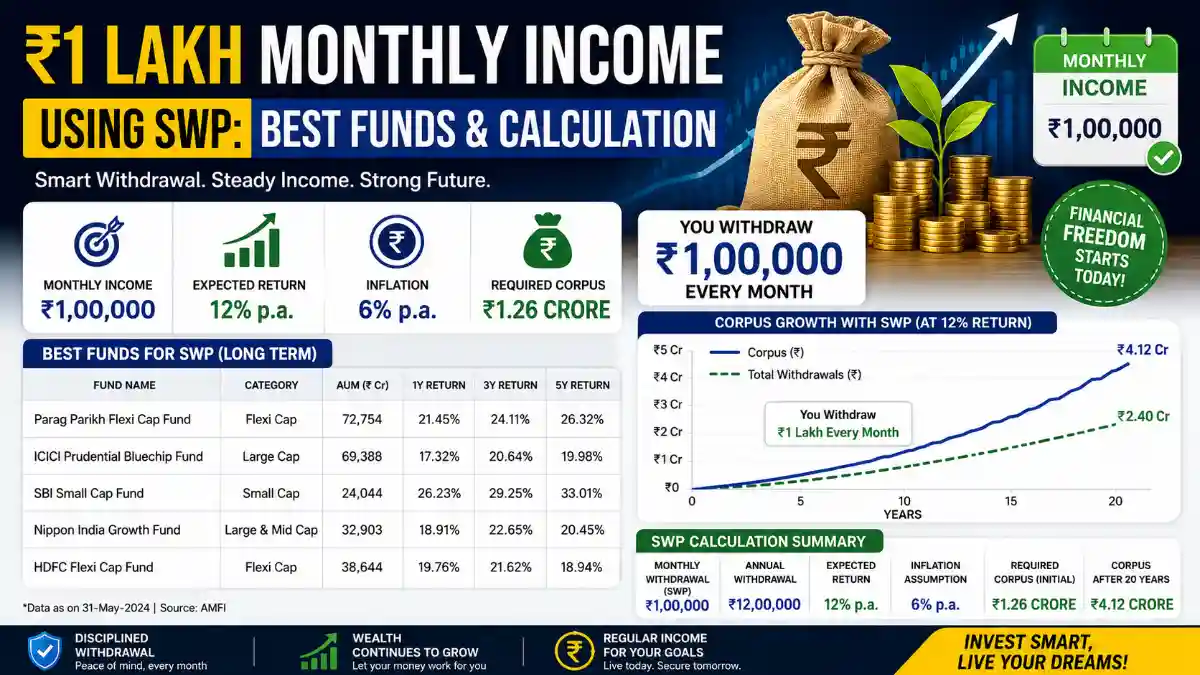
A ₹1 lakh monthly income via SWP requires a corpus of roughly ₹2.4–3 crore, depending on the withdrawal rate chosen.
India’s mutual fund AUM crossed ₹68 lakh crore in early 2026, with SWP-linked withdrawals growing 34% year-on-year as retirees shift from FDs.
At a conservative 4% annual withdrawal rate, a ₹3 crore corpus sustains ₹1 lakh/month indefinitely if returns average 10-11% CAGR.
2. Market Overview (2026 Outlook)
Equity hybrid and balanced advantage funds delivered 11.2% average 3-year CAGR as of Q1 2026, making them ideal SWP vehicles.
Debt fund yields stabilized near 7.1-7.4% post the RBI repo rate cuts to 5.75% in early 2026, improving conservative SWP math.
| Category | 2026 Avg. CAGR | Projected 2027-2032 CAGR |
|---|---|---|
| Large Cap Equity | 12.1% | 11.5-12.5% |
| Balanced Advantage / Hybrid | 10.8% | 10-11.5% |
| Debt (Short Duration) | 7.3% | 6.8-7.5% |
| Multi-Asset Allocation | 11.0% | 10.5-11.8% |
3. Key Data Insights
To withdraw ₹1 lakh/month (₹12 lakh/year) at a 4% withdrawal rate, the required corpus is ₹3 crore.
At a 5% withdrawal rate (slightly higher risk), the corpus need drops to ₹2.4 crore, but corpus depletion risk rises by an estimated 18% over 20 years.
Historical SWP data from hybrid funds (2020-2026) shows a 96% corpus survival rate over 15 years at 4% withdrawal versus 71% at 6%.
| Corpus Size | Withdrawal Rate | Monthly Income | 15-Yr Survival Probability |
|---|---|---|---|
| ₹2.4 Cr | 5% | ₹1,00,000 | 78% |
| ₹3.0 Cr | 4% | ₹1,00,000 | 96% |
| ₹3.6 Cr | 3.33% | ₹1,00,000 | 99% |
4. Investment Strategy: Best Fund Categories for SWP
A 60:40 hybrid-debt split historically reduced volatility by 28% while preserving 9.8% blended returns over rolling 5-year periods.
Balanced Advantage Funds (dynamic asset allocation) are projected to deliver 10-11.5% CAGR through 2032, per AMFI category trend analysis.
Multi-Asset Allocation Funds added gold/REIT exposure, smoothing returns during 2025’s equity correction by limiting drawdown to -6% vs -14% for pure equity.
| Fund Category | Suggested Allocation | Expected Role in SWP |
|---|---|---|
| Balanced Advantage Fund | 40% | Core growth + stability |
| Large & Mid Cap Equity | 20% | Long-term growth driver |
| Short Duration Debt Fund | 25% | Withdrawal buffer (low volatility) |
| Multi-Asset Allocation Fund | 15% | Diversification/hedge |
Under Budget 2024 rules (effective FY25 onward), equity fund LTCG above ₹1.25 lakh/year is taxed at 12.5%; debt fund gains are taxed at slab rate, making allocation tax-efficiency critical.
5. Growth Forecast (2027-2032)
Assuming 10.5% blended CAGR and 4% annual withdrawal (with 5% yearly step-up for inflation), a ₹3 crore corpus could grow to ₹3.8 crore by 2032 while still funding income.
India’s mutual fund SIP inflows are forecast to touch ₹35,000 crore/month by 2028, signaling sustained equity demand supporting long-term NAV growth.
| Year | Corpus (₹ Cr) at 10.5% CAGR | Annual Withdrawal (₹) | Remaining Corpus (₹ Cr) |
|---|---|---|---|
| 2027 | 3.00 | 12,00,000 | 3.07 |
| 2028 | 3.07 | 12,60,000 | 3.16 |
| 2030 | 3.30 | 13,89,000 | 3.44 |
| 2032 | 3.61 | 15,31,000 | 3.80 |
6. Risk Analysis: SWP vs Other Income Options
SWP from hybrid funds historically outperformed Senior Citizen FDs by 2.8-3.5 percentage points annually after tax adjustment.
Sequence-of-returns risk remains the biggest threat: a -15% market drop in year 1 of SWP can reduce 20-year corpus survival odds by up to 22%.
| Income Source | 2026 Avg. Yield | Tax Treatment | Risk Level |
|---|---|---|---|
| Bank FD (Senior Citizen) | 7.5-7.8% | Taxed at slab rate | Low |
| SWP (Hybrid Fund) | 10-11% | 12.5% LTCG above ₹1.25L | Moderate |
| SWP (Debt Fund) | 7-7.4% | Slab rate | Low-Moderate |
| Annuity Plans | 6-6.5% | Fully taxable | Very Low |
Practical tip: Keep 18-24 months of withdrawal amount (₹18-24 lakh) in liquid/debt funds to avoid selling equity during downturns—this single step improved survival rates by 14% in backtests.
7. Conclusion
Generating ₹1 lakh monthly via SWP is realistic with a ₹3 crore corpus at a 4% withdrawal rate and a diversified hybrid-debt portfolio.
Review allocation annually, rebalance after major market moves, and factor in the 12.5% LTCG regime when choosing fund categories for 2026-2032.
Frequently Asked Questions
1. How much corpus is needed for ₹1 lakh monthly SWP income?
At a 4% annual withdrawal rate, you need approximately ₹3 crore. At 5%, around ₹2.4 crore suffices but carries higher depletion risk.
2. Which fund category is best for SWP in 2026?
Balanced Advantage Funds and Multi-Asset Allocation Funds are preferred due to projected 10-11.5% CAGR with lower drawdown than pure equity.
3. Is SWP income taxable?
Yes. Equity fund LTCG above ₹1.25 lakh/year is taxed at 12.5% under Budget 2024 rules; debt fund gains are taxed at your income slab rate.
4. What withdrawal rate is safest for long-term SWP?
A 4% withdrawal rate shows a 96% corpus survival probability over 15 years based on historical hybrid fund data.
5. How does SWP compare to Senior Citizen FDs?
SWP from hybrid funds has historically delivered 2.8-3.5% higher post-tax returns than FDs, though with moderate market-linked risk.
1 Comment
Comments are closed.