
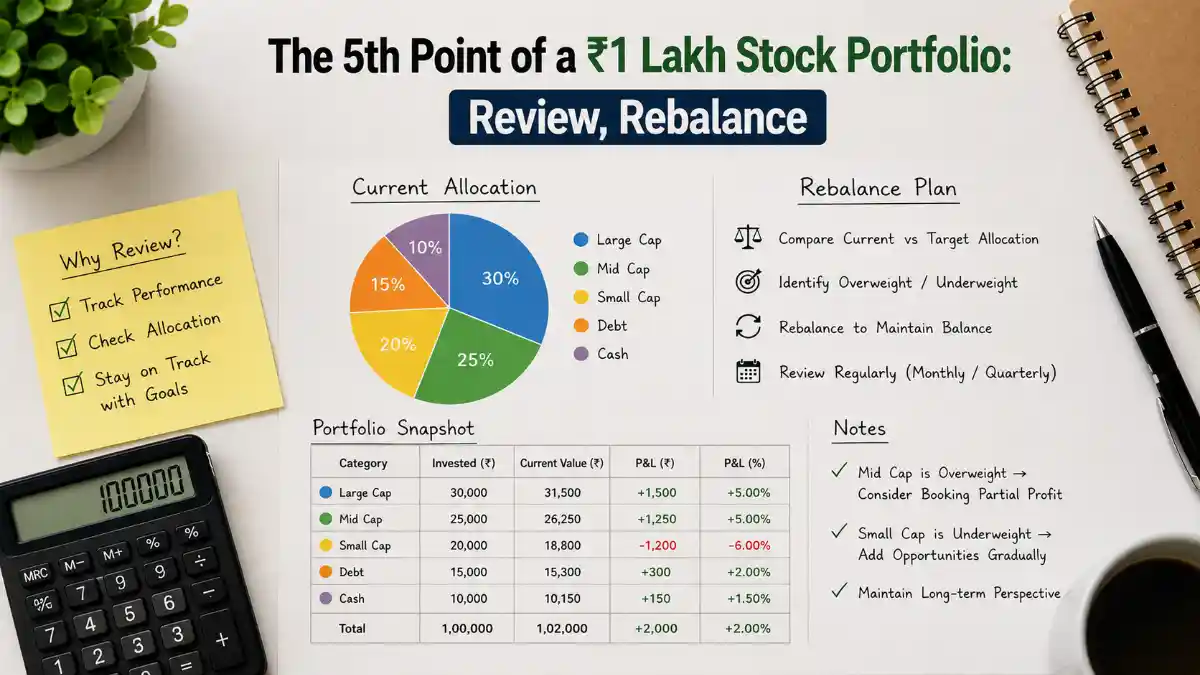
Quick Answer: What Is the 5th Point of a ₹1 Lakh Stock Portfolio?
The 5th point of building a ₹1 lakh stock portfolio is “Review, Rebalance & Stay Disciplined.” After you have defined your goals (Point 1), assessed risk (Point 2), allocated across asset classes (Point 3), and selected your stocks with proper position sizing (Point 4), the 5th point ensures your portfolio remains optimized for long-term wealth creation. This step involves quarterly portfolio reviews, annual rebalancing, tax-loss harvesting, and maintaining emotional discipline during market volatility.
Key Insight: Studies show that investors who rebalance their portfolios annually earn 1.5% higher risk-adjusted returns compared to those who buy and forget. For a ₹1 lakh portfolio growing at 12% CAGR, disciplined rebalancing can add approximately ₹15,000–₹20,000 in extra value over 5 years.
Understanding the 5-Point Framework for ₹1 Lakh Portfolio
Before diving deep into the 5th point, let’s quickly recap the complete framework that every Indian investor should follow when deploying ₹1 lakh in the stock market:
| Point | Action | Purpose | Time Required |
|---|---|---|---|
| Point 1 | Define Goals & Time Horizon | Direction for investment | 1–2 hours |
| Point 2 | Risk Profiling & Emergency Fund | Capital protection | 30 minutes |
| Point 3 | Asset Allocation (Equity:Debt:Gold) | Risk management | 1 hour |
| Point 4 | Stock Selection & Position Sizing | Wealth creation | 4–6 hours |
| Point 5 | Review, Rebalance & Discipline | Sustained performance | 2–4 hours/quarter |
Why Most Investors Fail at Point 5
According to AMFI data, over 65% of Indian retail investors who start with ₹1 lakh in direct stocks either exit within 18 months or let their portfolios drift into unmanageable allocations. The primary reason? They skip or poorly execute Point 5.
“The stock market is a device for transferring money from the impatient to the patient.” — Warren Buffett
Why Point 5 Is the Most Critical (And Most Ignored)
The Portfolio Drift Problem
Let’s say you allocated your ₹1 lakh as follows in January 2026:
| Asset/Stock | Initial Allocation | Weight |
|---|---|---|
| Nifty 50 ETF | ₹30,000 | 30% |
| Large-Cap Stock A | ₹20,000 | 20% |
| Mid-Cap Stock B | ₹15,000 | 15% |
| Mid-Cap Stock C | ₹15,000 | 15% |
| Small-Cap Stock D | ₹10,000 | 10% |
| Liquid Fund (Cash) | ₹10,000 | 10% |
After 12 months (December 2026):
| Asset/Stock | Value (Est.) | New Weight | Drift |
|---|---|---|---|
| Nifty 50 ETF | ₹34,500 (+15%) | 28.7% | -1.3% |
| Large-Cap Stock A | ₹22,000 (+10%) | 18.3% | -1.7% |
| Mid-Cap Stock B | ₹21,000 (+40%) | 17.5% | +2.5% |
| Mid-Cap Stock C | ₹13,500 (-10%) | 11.3% | -3.7% |
| Small-Cap Stock D | ₹14,000 (+40%) | 11.7% | +1.7% |
| Liquid Fund | ₹10,500 (+5%) | 8.8% | -1.2% |
| Total | ₹1,15,500 |
Notice the drift? Your small-cap and mid-cap winners have grown beyond your risk tolerance, while your defensive positions have shrunk. Without rebalancing, you’re now overexposed to volatile small-caps and underexposed to stable large-caps — exactly the opposite of what a prudent investor wants.
The Cost of Ignoring Point 5
| Scenario | 5-Year Value (Est.) | Risk Level |
|---|---|---|
| Disciplined Rebalancing (Annual) | ₹1,76,200 | Moderate |
| Buy-and-Forget (No Rebalancing) | ₹1,62,000 | High |
| Panic Selling in Downturns | ₹1,28,000 | Very High |
Assumptions: 12% average CAGR, rebalancing maintains target risk profile
How to Review Your ₹1 Lakh Stock Portfolio
The Quarterly Review Ritual (90 Minutes Every 3 Months)
Step 1: Check Portfolio Health Metrics (20 minutes)
Run these quick checks on your portfolio:
- Allocation Drift Check: Has any stock crossed 25% of your portfolio? Has any sector crossed 40%?
- Performance vs. Benchmark: Is your portfolio beating Nifty 50 TRI over 6 months and 1 year?
- Stock-Specific Triggers: Any earnings misses, management changes, or sector headwinds?
- Liquidity Status: Do you still have 10% in liquid assets for emergencies?
Step 2: Fundamental Health Check (40 minutes)
For each stock in your portfolio, ask:
| Question | Red Flag | Green Flag |
|---|---|---|
| Has revenue growth dropped below 10% for 2 quarters? | ⚠️ Warning | ✅ Healthy |
| Is debt-to-equity rising above industry average? | ⚠️ Warning | ✅ Healthy |
| Has promoter holding decreased significantly? | 🚨 Sell Signal | ✅ Healthy |
| Is P/E ratio 30% above 5-year average? | ⚠️ Overvalued | ✅ Fair Value |
| Any corporate governance issues? | 🚨 Sell Signal | ✅ Clean |
Step 3: Market Environment Assessment (30 minutes)
- Interest Rate Cycle: RBI cutting or hiking rates? (Affects equity valuations)
- FII/DII Flows: Are foreign investors buying or selling India?
- Sector Rotation: Which sectors are leading? Is your portfolio aligned?
- Global Risks: US Fed policy, crude oil prices, geopolitical tensions
Free Tools for Portfolio Review
| Tool | Best For | Cost |
|---|---|---|
| Ticker.finology.in | Indian stock fundamentals | Free |
| Screener.in | Financial ratio analysis | Free/Paid |
| Moneycontrol Portfolio | Tracking & alerts | Free |
| ETMONEY | Mutual fund tracking | Free |
| Google Sheets | Custom tracking | Free |
Rebalancing Strategies for Small Portfolios
Strategy 1: Calendar-Based Rebalancing (Recommended for Beginners)
Frequency: Once every 6 or 12 months
Trigger: Fixed date (e.g., 1st April or 1st October)
Action: Sell overweight positions, buy underweight positions
Example for ₹1 Lakh Portfolio:
Your target allocation after 1 year:
- Large-Cap: 50% (₹50,000)
- Mid-Cap: 30% (₹30,000)
- Small-Cap: 10% (₹10,000)
- Cash/Liquid: 10% (₹10,000)
Current values after market movements:
- Large-Cap: ₹45,000 (37.5%)
- Mid-Cap: ₹52,000 (43.3%) ← Overweight
- Small-Cap: ₹15,000 (12.5%) ← Slightly Overweight
- Cash: ₹8,000 (6.7%) ← Underweight
Rebalancing Action:
- Sell ₹12,000 worth of Mid-Cap stocks
- Sell ₹2,500 worth of Small-Cap stocks
- Buy ₹5,000 worth of Large-Cap stocks
- Add ₹9,500 to Liquid Fund
Strategy 2: Threshold-Based Rebalancing (For Active Investors)
Trigger: When any asset class deviates by more than 5% from target
Best For: Investors who can monitor portfolios monthly
| Asset Class | Target | Rebalance When |
|---|---|---|
| Large-Cap | 50% | Goes below 45% or above 55% |
| Mid-Cap | 30% | Goes below 25% or above 35% |
| Small-Cap | 10% | Goes below 7% or above 13% |
| Cash | 10% | Goes below 7% or above 13% |
Strategy 3: Cash Flow Rebalancing (Best for SIP Investors)
Method: Instead of selling winners, direct new SIP money toward underweight assets
Advantage: Zero transaction costs, zero capital gains tax
Best For: Those adding ₹5,000–₹10,000 monthly to their portfolio
Tax Optimization: The Hidden Wealth Multiplier
Understanding Capital Gains for ₹1 Lakh Portfolio
| Holding Period | Tax Rate | Strategy |
|---|---|---|
| Short-Term (< 1 year) | 20% | Avoid frequent trading |
| Long-Term (> 1 year) | 12.5% above ₹1.25 lakh LTCG exemption | Hold quality stocks > 1 year |
| STT | 0.1% on sell | Unavoidable, minimal impact |
Tax-Loss Harvesting for Small Portfolios
Even with ₹1 lakh, you can use tax-loss harvesting:
- Identify Losers: Stock C in our example fell 10% (₹1,500 loss)
- Sell Before March 31: Book the ₹1,500 short-term capital loss
- Offset Gains: Use this loss to offset gains from Stock B (₹6,000 profit)
- Net Taxable Gain: ₹4,500 instead of ₹6,000
- Buy Back: Wait for 2 months or buy a similar stock to maintain exposure
Pro Tip: For FY 2025-26, the LTCG exemption limit is ₹1.25 lakh per year. With a ₹1 lakh portfolio, you’re unlikely to cross this in Year 1, but as your portfolio grows, this becomes critical.
Tax-Efficient Rebalancing Rules
- Prioritize selling stocks held > 1 year (lower tax rate)
- Use Section 80C benefits if investing through ELSS (₹1.5 lakh limit)
- Time rebalancing near FY end (March) for tax-loss harvesting
- Consider ETFs over direct stocks for lower turnover and tax efficiency
Emotional Discipline: The Real 5th Point
The Psychology of a ₹1 Lakh Investor
When you start with ₹1 lakh, every ₹5,000 movement feels massive (5% of capital). This emotional intensity leads to three deadly behaviors:
1. Panic Selling
Scenario: Market drops 15% in 2 months. Your ₹1 lakh is now ₹85,000.
Emotional Response: “I need to save what’s left. Sell everything!”
Reality: If you sell, you lock in losses. Historically, Nifty 50 recovers from 15% corrections within 8–14 months.
Discipline Rule: “Never make portfolio decisions when Nifty is down > 10% in a month. Wait 72 hours.”
2. FOMO Buying
Scenario: A small-cap stock doubles in 3 months. Everyone on Twitter is talking about it.
Emotional Response: “I’m missing out. I need to buy NOW!”
Reality: By the time retail investors pile in, smart money is often exiting.
Discipline Rule: “If a stock has risen > 50% in 3 months, wait for a 10% correction before adding.”
3. Overtrading
Scenario: You check your portfolio 10 times a day and feel the urge to “do something.”
Emotional Response: “Let me book profits on this and rotate to that.”
Reality: Excessive trading in a ₹1 lakh portfolio erodes 2–4% annually in brokerage and taxes.
Discipline Rule: “Set a maximum of 6 transactions per year (buy + sell combined).”
The “Sleep Test” for Portfolio Health
Ask yourself every quarter:
“Can I sleep peacefully tonight knowing my portfolio composition?”
If the answer is NO, your allocation is too aggressive. Rebalance toward safer assets immediately.
Common Mistakes Investors Make at Point 5
Mistake 1: Reviewing Too Frequently
Problem: Checking portfolio daily leads to emotional decisions
Solution: Review quarterly, not daily. Set calendar reminders for 1st April, 1st July, 1st October, 1st January
Mistake 2: Rebalancing After Every Market Move
Problem: Excessive transaction costs and tax inefficiency
Solution: Use 5% threshold rule or semi-annual calendar rebalancing
Mistake 3: Ignoring Corporate Actions
Problem: Missing bonus issues, stock splits, dividends that affect your allocation
Solution: Update your tracking sheet within 48 hours of any corporate action
Mistake 4: Not Recording Reasons
Problem: Forgetting why you bought a stock leads to premature selling
Solution: Maintain an “Investment Thesis” document for each stock
Template:
Stock: [Name]
Buy Date: [Date]
Buy Price: ₹[Price]
Target Allocation: [X]%
Investment Thesis: [Why you bought]
Exit Triggers: [What would make you sell]
Review Date: [Next quarterly review]
Mistake 5: Neglecting to Scale Up Knowledge
Problem: Using the same strategy when portfolio grows from ₹1 lakh to ₹5 lakh
Solution: Evolve your review framework as portfolio size increases
| Portfolio Size | Review Frequency | Rebalancing Strategy |
|---|---|---|
| ₹1–2 Lakhs | Quarterly | Calendar-based |
| ₹2–5 Lakhs | Monthly | Threshold + Calendar |
| ₹5–10 Lakhs | Monthly | Threshold + Tax-aware |
| ₹10+ Lakhs | Bi-weekly | Professional advisory |
Actionable Checklist for Your ₹1 Lakh Portfolio
Immediate Actions (This Week)
- Create a Google Sheet or use a portfolio tracker to record all holdings
- Set calendar reminders for quarterly reviews (every 3 months)
- Define your target allocation percentages (Large:Mid:Small:Cash)
- Write a one-paragraph investment thesis for each stock you own
- Set up price alerts for 20% above and 20% below your buy price
Quarterly Review Checklist
- Check allocation drift (>5% from target?)
- Review last quarter’s earnings for each stock
- Compare portfolio return vs. Nifty 50 TRI
- Check for any corporate governance red flags
- Assess if any stock has hit your “exit trigger”
- Rebalance if threshold crossed
- Update investment thesis if fundamentals change
Annual Review Checklist
- Full tax-loss harvesting analysis
- Reassess risk profile (has income/stability changed?)
- Review and update financial goals
- Check if portfolio size warrants professional advice
- Document lessons learned from mistakes
Frequently Asked Questions
Q1. How often should I rebalance my ₹1 lakh stock portfolio?
A: For a ₹1 lakh portfolio, semi-annual (every 6 months) or annual rebalancing is optimal. More frequent rebalancing leads to higher transaction costs and taxes, which can eat into your returns. Use the calendar method: pick two dates (e.g., 1st April and 1st October) and stick to them.
Q2. Should I sell my winners to rebalance, or just add new money?
A: With ₹1 lakh, prefer adding new money to underweight assets rather than selling winners. This avoids capital gains tax and brokerage costs. However, if a single stock crosses 25% of your portfolio or if you need to reduce risk urgently, selling a portion of winners is justified.
Q3. What if I don’t have time for quarterly reviews?
A: At minimum, do a biannual review (every 6 months). If even that’s difficult, consider shifting from direct stocks to:
- Index ETFs (Nifty 50, Nifty Next 50) — auto-rebalancing
- Flexi-cap mutual funds — professional management
- Smallcases — curated portfolios with rebalancing alerts
Q4. How do I know if my portfolio is performing well?
A: Compare your portfolio’s annual return against:
- Nifty 50 Total Return Index (benchmark for large-cap)
- Nifty Midcap 150 TRI (if you have mid-cap exposure)
- Your own target return (e.g., 12% CAGR for long-term goals)
If you’re consistently underperforming the benchmark by >3% for 2+ years, your stock selection needs improvement.
Q5. Is rebalancing really necessary for just ₹1 lakh?
A: Yes, absolutely. While ₹1 lakh seems small, the habits you build now determine your success when the portfolio grows to ₹10 lakh or ₹1 crore. Rebalancing:
- Controls risk
- Enforces “buy low, sell high” discipline
- Prevents concentration risk
- Builds investor discipline
Think of it as gym training — the weights are light now, but the form you learn is for life.
Q6. What are the best apps to track a ₹1 lakh stock portfolio?
A: For Indian investors:
- ETMONEY — Best for beginners, mutual fund + stock tracking
- Moneycontrol — Most comprehensive data
- Ticker by Finology — Excellent for fundamental analysis
- Google Finance — Simple, clean interface
- Excel/Google Sheets — Most customizable
Q7. Should I book profits if my portfolio doubles?
A: Not necessarily. If your ₹1 lakh becomes ₹2 lakh:
- Check allocation drift: If one stock is now 40% of portfolio, trim it
- Check valuations: If P/E is 2x historical average, consider partial profit booking
- Check goals: If you need the money in 1 year, book profits. If goal is 10 years away, let winners run with trailing stop-losses
Q8. How does the 5th point change as my portfolio grows?
A:
| Portfolio Size | Point 5 Evolution |
|---|---|
| ₹1–3 Lakhs | Manual quarterly review, simple rebalancing |
| ₹3–10 Lakhs | Monthly review, tax-loss harvesting, sectoral caps |
| ₹10–50 Lakhs | Professional portfolio management, derivative hedging |
| ₹50+ Lakhs | Dedicated PMS, global diversification, estate planning |
Final Thoughts: Mastering the 5th Point
The first four points of building a ₹1 lakh stock portfolio — goal setting, risk assessment, asset allocation, and stock selection — get all the attention. But Point 5 is where wealth is actually preserved and multiplied.
Think of your portfolio like a garden:
- Point 1–2: Deciding what to plant (goals & climate)
- Point 3: Designing the layout (allocation)
- Point 4: Planting the seeds (buying stocks)
- Point 5: Watering, pruning, and protecting from pests (review, rebalance, discipline)
A garden left unattended becomes a jungle. A portfolio left unattended becomes a risk bomb.
Your 30-Day Challenge
- Day 1–3: Set up your portfolio tracker
- Day 4–7: Write investment theses for each holding
- Day 8–14: Do your first full portfolio review using this guide
- Day 15–21: Rebalance if needed (or plan your next SIP allocation)
- Day 22–30: Set up automated calendar reminders for future reviews
Remember: The best time to start disciplined portfolio management was when you bought your first stock. The second-best time is today.
