
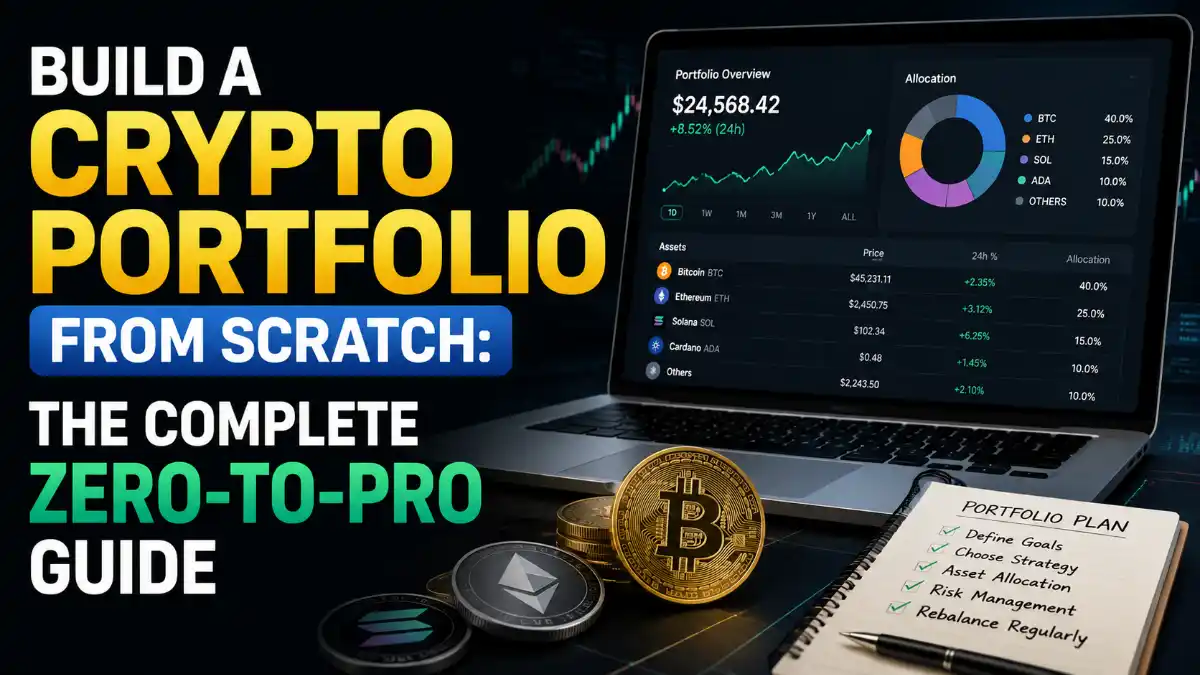
Everything you need to go from zero crypto knowledge to a structured, resilient portfolio — allocation models, DCA strategy, wallets, security, India tax rules, and rebalancing. No hype. No shilling. Just a framework that survives bear markets.

Quick Answer (For Readers in a Hurry)
A sound crypto portfolio in 2026 allocates 50-70% to Bitcoin and Ethereum as core holdings, 20-30% to large-cap altcoins (SOL, LINK, BNB), 5-15% to speculative small-cap bets, and 5-10% to stablecoins as dry powder. Use Dollar-Cost Averaging (DCA) to enter over 12-16 weeks, hold in a hardware wallet for anything over a small learning amount, and rebalance quarterly. In India, every crypto sale attracts 30% tax under Section 115BBH and 1% TDS under Section 194S — keep records from day one.
What Is a Crypto Portfolio?
A crypto portfolio is a structured collection of cryptocurrency assets — Bitcoin, Ethereum, altcoins, stablecoins, and tokens — selected and sized according to a deliberate investment strategy. The key word is structured. If you bought coins at random across different moods and market cycles without a plan, you do not have a portfolio. You have a collection of tokens accumulated through excitement and regret. The difference matters.
A real portfolio has four things a random collection does not:
- An investment thesis — a written reason for why you hold each asset and what would make you sell it.
- Defined allocation rules — target percentages for each tier, not vibes.
- Clear risk parameters — a maximum position size, a stop-loss policy, and a rebalancing trigger.
- A rebalancing framework — a schedule for reviewing and adjusting, not emotional reactions to price moves.
In 2026, building a sound crypto portfolio is both easier and more important than ever. The asset class has matured: Bitcoin has deep ETF infrastructure with over $100 billion in assets under management, Ethereum has liquid staking and restaking ecosystems, and genuine diversification across crypto asset types is now achievable. But the same maturity that makes it easier to build a sensible portfolio also means the days of blind 100x bets are largely over for blue-chip assets. Strategy matters more than luck.
Market Context: Where Crypto Stands in August 2026
Before you build anything, understand the market you are building in. The right portfolio allocation changes depending on where you are in the market cycle. Building during a euphoric bull market looks different from building during a correction, and building in “Bitcoin Season” looks different from building during altcoin season.
As of late August 2026, here is the macro picture:
| Metric | Value | What It Means |
|---|---|---|
| Total crypto market cap | ~$2.63 trillion | Down from the Nov 2021 all-time high of ~$2.97T but well above the 2022 bear market low of ~$798B |
| Bitcoin dominance | ~59% | Capital is concentrated in Bitcoin; altcoins typically underperform in this regime |
| BTC price | ~$77,600 | Consolidating well below the cycle peak |
| ETH price | ~$2,437 | Ethereum dominance at ~11% |
| Fear & Greed Index | ~31 (Fear) | Market sentiment is fearful — historically a zone for patient accumulation |
What This Means for You
With Bitcoin dominance at 59% and the Fear & Greed Index in the “Fear” zone (31), the honest starting allocation for most beginners in August 2026 is Bitcoin-heavy. When dominance is above 55%, capital is concentrating in Bitcoin and altcoins typically underperform. A Bitcoin-heavy allocation is not a prediction that altcoins will never rally — it is an acknowledgment that, right now, the largest and safest asset is also where the momentum is. Wait for a sustained break below 55% dominance before meaningfully increasing altcoin weight.
Step 1: Define Your Risk Tier and Time Horizon
1Before you look at a single coin, answer two questions honestly. Your answers determine everything that follows.
Question 1: How much of your total investable money belongs in crypto?
Crypto can move 10% in a day without asking your permission. That is why serious investors treat crypto as a high-risk slice of a broader plan, not the whole plan.
- 1-5% (Conservative): Meaningful exposure with minimal impact if crypto crashes 80%. Good for people with lower risk tolerance or who are new to crypto.
- 5-15% (Balanced): Higher potential upside, but a crash will be felt. For people who have done their research and have a higher risk tolerance.
- 15%+ (Aggressive): High conviction, high risk. Only appropriate if you truly understand the risks and this money is not needed for living expenses, emergencies, or retirement.
If your total investment portfolio is worth ₹10,00,000 and you choose 5%, your crypto budget is ₹50,000. That is your starting point — not what you would like to invest, but what you can genuinely afford to leave untouched.
Question 2: Can you hold through a 50% drawdown without panic-selling?
If the answer is no, choose a conservative allocation. The market will test you within months. Bitcoin has dropped 50%+ multiple times and always recovered to new highs (so far), but the investors who benefit from those recoveries are the ones who did not sell at the bottom. The rule is simple: never put money into crypto that you cannot genuinely afford to leave untouched for 12-36 months. Forced selling at the wrong time is how portfolios fail — not bad coin selection.
Step 2: Choose Your Allocation Model
2The most widely recommended approach for beginners is the Core/Satellite model: a solid core of established assets surrounded by smaller satellite positions in promising projects. Based on your risk tier, pick one of the three models below.
Conservative Portfolio
For investors who want exposure to crypto with minimal sleepless nights. The bulk sits in the two most established assets.

Balanced Portfolio
For investors who want to participate in the broader crypto growth story while keeping risk manageable. This is the most recommended starting point for beginners in 2026.

Aggressive Portfolio
For experienced investors who have been through at least one full market cycle and understand what they are holding. Higher altcoin exposure means higher potential returns — and higher potential losses.

Portfolio Blueprints by Starting Capital
Here is what each model looks like with real numbers, assuming you are using a major exchange like CoinDCX, WazirX, or Binance India.
Starting with ₹5,000 (Learning Amount)
- BTC (50%) — ₹2,500
- ETH (30%) — ₹1,500
- 1 large-cap alt, e.g. SOL (10%) — ₹500
- Stablecoin buffer (10%) — ₹500
At this level, keep it dead simple. Two coins is fine. The goal is to learn how buying, storing, and tracking work — not to maximise returns.
Starting with ₹50,000
- BTC (40%) — ₹20,000
- ETH (20%) — ₹10,000
- SOL (8%) — ₹4,000
- LINK (5%) — ₹2,500
- BNB (5%) — ₹2,500
- Speculative (2 coins, 6%) — ₹3,000
- Stablecoin buffer (10%) — ₹5,000
Starting with ₹2,00,000
- BTC (40%) — ₹80,000
- ETH (20%) — ₹40,000
- SOL (8%) — ₹16,000
- LINK (5%) — ₹10,000
- AVAX (5%) — ₹10,000
- ARB or OP (4%) — ₹8,000
- Speculative basket (3-4 coins, 8%) — ₹16,000
- Stablecoin buffer (10%) — ₹20,000
Position Sizing Rule
No single altcoin position should exceed 5-10% of your total crypto allocation. BTC and ETH can be larger (20-40% each) because of their lower failure risk. If a speculative project goes to zero — which happens regularly — it should be painful, not portfolio-destroying.
Step 3: Set Up Your Infrastructure (Exchange + Wallet)
3You need three things before buying a single token: a way to buy, a way to store securely, and a way to track it all.
1. Choose a Regulated Exchange
For Indian users, stick with FIU-IND registered exchanges. These platforms comply with India’s anti-money laundering framework and handle 1% TDS deduction automatically on your trades.
| Exchange | Strength | Best For |
|---|---|---|
| CoinDCX | Large coin selection, clean app | Beginners who want variety |
| CoinSwitch | Simplest interface, low fees | First-time buyers |
| WazirX | INR deposits via UPI | Quick INR onboarding |
| Binance India | Deep liquidity, global features | Experienced users |
Complete KYC (Aadhaar + PAN), connect your bank account or UPI, and start with a small purchase to test the full flow — buy, withdraw, and store — before committing larger amounts.
2. Choose a Wallet (Self-Custody is Non-Negotiable for Serious Portfolios)
In crypto, how you store an asset is part of the investment decision itself. If your coins sit on an exchange, you do not truly own them — you have an IOU from the exchange. If the exchange is hacked, frozen, or goes bankrupt, your funds can disappear overnight. The rule is simple: not your keys, not your coins.
Hot Wallets (Software — for small amounts and DeFi)
Free apps connected to the internet. Good for daily transactions and interacting with DeFi protocols. Never store large amounts in a hot wallet.
- MetaMask — the standard for Ethereum and EVM-compatible chains
- Phantom — the leading Solana wallet
- Trust Wallet — multi-chain, beginner-friendly
Hardware Wallets (Cold Storage — for long-term holdings)
Physical devices that store your private keys offline. This is where the bulk of your portfolio should live. In 2026, the two dominant brands are Ledger and Trezor, with SafePal and Tangem as alternatives.
| Wallet | Price | Secure Element | Open Source | Best For |
|---|---|---|---|---|
| Trezor Safe 3 | $79 | EAL6+ | Yes (full firmware) | Best security-per-dollar; first hardware wallet |
| Trezor Safe 5 | $169 | EAL6+ | Yes (full firmware) | Touchscreen + Shamir Backup |
| Trezor Safe 7 | $249 | Dual EAL6+ (TROPIC01) | Yes (full firmware + auditable chip) | Maximum auditability; post-quantum ready |
| Ledger Nano S Plus | $79 | EAL6+ | No (app layer only) | Broadest coin support at entry price |
| Ledger Nano X | $149 | EAL5+ | No (app layer only) | Mobile-first users (Bluetooth) |
| Ledger Nano Gen5 | $179 | EAL6+ | No (app layer only) | DeFi users who want mobile + clear signing |
| SafePal S1 Pro | $90 | EAL6+ | Yes (GitHub) | Air-gapped security at low cost |
| Tangem 3-card set | $70 | EAL6+ | Firmware audited | Non-technical users; no seed phrase to manage |
Which Wallet Should You Buy?
If you hold under ₹1,00,000 in crypto, a Trezor Safe 3 ($79) or Ledger Nano S Plus ($79) is sufficient. If you want open-source transparency and auditability, lean Trezor. If you want the broadest coin support and a polished mobile app, lean Ledger. If you hold ₹10,00,000+ and want maximum security, consider the Trezor Safe 7 ($249) — it ships the first independently auditable secure element (TROPIC01) and post-quantum firmware verification. For non-technical family members, the Tangem card set eliminates seed phrase management entirely.
Seed Phrase Security — The Most Important Paragraph in This Guide
Your seed phrase (12 or 24 words) is the master key to your wallet. Anyone who has it controls your funds — permanently and irreversibly. Write it down on paper or engrave it on metal. Store it offline in a secure location. Never type it into a website. Never send it in a message. Never photograph it. Support staff will never ask for it. If someone asks for your seed phrase, they are trying to steal your money. This is not a theoretical risk — seed phrase theft is the single most common way people lose crypto.
3. Set Up Portfolio Tracking and Tax Tools
- CoinGecko or CoinMarketCap — free price tracking and market data
- CoinStats or Zerion — aggregate CEX holdings, DeFi positions, and staking rewards in one dashboard
- Koinly or CoinTracker — automatic tax calculation from exchange and wallet imports (critical for India’s 30% VDA tax and 1% TDS reporting)
Step 4: Build the Core (Bitcoin and Ethereum)
4Your core holdings should be assets you are willing to hold through a 50% drawdown. If that thought makes you sick, reduce your allocation. For most beginners, the core means Bitcoin and Ethereum as anchor positions.
Bitcoin (BTC)
Bitcoin is the lowest-risk, highest-liquidity, most-institutional crypto asset. As of early 2026, spot Bitcoin ETFs hold over $100 billion in assets under management. It has a hard supply cap of 21 million coins, making it the closest thing crypto has to a store of value — often called “digital gold.” The institutional consensus around Bitcoin as a treasury reserve asset has solidified, with sovereign funds and corporations adding it to their balance sheets.
How to hold: Self-custody on a hardware wallet for long-term storage. Do not chase yield on BTC unless you understand the counterparty risk. If you want exposure without managing wallets, a spot Bitcoin ETF (available through some brokerage accounts) is a valid alternative.
Ethereum (ETH)
Ethereum is the dominant smart contract platform — the backbone of crypto’s application layer. It supports DeFi, NFTs, Layer-2 scaling solutions, restaking, and thousands of decentralised applications. It has the deepest developer ecosystem, the most total value locked in smart contracts, and the deepest institutional recognition after Bitcoin.
How to hold: For long-term holders, staking via a liquid staking protocol (Lido, Rocket Pool) earns 3-4% APY while maintaining liquidity — you receive a liquid token (stETH) that you can use in DeFi while earning staking rewards.
Why 50-70% in BTC and ETH Is Smart, Not Boring
Together, BTC and ETH represent over 60% of the total crypto market cap. Putting 60-70% of your crypto allocation into them is not conservative — it is the rational choice for participating in the sector’s growth without taking on the much higher failure risk of smaller projects. Many experienced investors with years of altcoin exposure have concluded their best risk-adjusted returns came from simply holding more Bitcoin.
Step 5: Add Large-Cap Altcoins
5Once your core is in place, add 2-3 large-cap altcoins to capture broader market upside. “Large-cap” in crypto means a market cap above roughly $5-10 billion — projects with proven ecosystems, real usage, and enough liquidity that you can exit positions without significant slippage.
Screening Criteria for Large-Cap Altcoins
- Top 20 by market cap on CoinMarketCap or CoinGecko
- At least 2 years of continuous operation (survived at least one bear market)
- Real, measurable usage — not just price speculation
- Active developer ecosystem (check GitHub commits and protocol upgrades)
- Liquid enough to exit at any reasonable size without moving the market
- A clear use case: does the token solve a real problem?
- Sensible tokenomics: understand the supply schedule, inflation rate, and utility
Examples of Established Large-Cap Altcoins (2026)
| Token | Sector | Market Cap (Aug 2026) | Role in Portfolio |
|---|---|---|---|
| Solana (SOL) | Layer-1 blockchain | ~$60.5B | High-speed, low-fee alternative to Ethereum; fastest-growing developer ecosystem |
| BNB | Exchange token / BNB Chain | ~$91.6B | Utility within the Binance ecosystem; discounted trading fees |
| XRP | Payments | ~$86.8B | Cross-border payment infrastructure; institutional partnerships |
| Chainlink (LINK) | Oracle infrastructure | Top 15 | Connects smart contracts to real-world data; foundational DeFi infrastructure |
| Avalanche (AVAX) | Layer-1 blockchain | Top 20 | Subnet architecture for enterprise and gaming use cases |
| Arbitrum (ARB) / Optimism (OP) | Ethereum Layer-2 | Top 50 | Scaling solutions that inherit Ethereum’s security |
Limit yourself to 3-5 coins in this tier, each with a 4-8% allocation, to avoid over-diversification. With 20 positions, you cannot track news, unlock events, or technical developments for all of them. Research from the Journal of Financial Economics shows that roughly 90% of diversification benefit is captured by 10-15 positions — and in crypto, where correlations are extremely high during crashes, that saturation point comes even earlier. 8-10 total positions is the sweet spot.
Step 6: Add a Small Speculative Slice
6This is the high-risk, high-reward slice. Allocate to early-stage DeFi protocols, AI-crypto projects, gaming tokens, real-world asset (RWA) tokenisation, or new Layer-2 solutions. Treat this money as if it could go to zero — because in crypto, sometimes it does.
The logic: a small 5% allocation that 10x’s can meaningfully boost your portfolio. If it fails, your core holdings keep you safe. But the inverse is also true — a large speculative position that goes to zero can destroy years of gains. This is why the speculative bucket must never exceed 15% of your total crypto allocation until you have been through at least one full market cycle.
Hot Sectors to Watch in 2026
- AI & DeFAI: AI agents managing DeFi positions, AI-powered trading, decentralised compute. The intersection of AI and crypto is the most actively discussed narrative.
- DePIN (Decentralised Physical Infrastructure): Helium, Render, Filecoin — real-world utility creating sustainable demand for tokens.
- RWA (Real-World Assets): Tokenised treasuries, real estate, and commodities bringing traditional finance on-chain.
- Memecoins: If you trade memecoins, treat it as entertainment with a fixed budget. Never more than 2-3% of your portfolio. This is gambling, not investing.
Stop-Loss Rule for Speculative Positions
If a speculative position drops 40%, sell and redeploy into core holdings. Do not average down without re-validating the investment thesis from scratch. “It’s down 80% so it must bounce” is not a thesis — it is hope. Hope is not a strategy.
Step 7: Use Dollar-Cost Averaging (DCA)
7Timing the market perfectly is not possible consistently — and attempting to do so is the number one cause of underperformance among retail crypto investors. Dollar-Cost Averaging (DCA) means investing a fixed amount at regular intervals, regardless of price.
Instead of investing your entire budget at once (and potentially buying at a local high), you spread purchases over time. You buy more units when prices are lower and fewer when prices are higher. It does not guarantee better returns, and it does not make losses disappear. What it does is remove the paralysis of “is this the right time?” and the emotional devastation of investing everything at what turns out to be a local top.
A Practical DCA Plan for ₹50,000
| Parameter | Value |
|---|---|
| Total capital | ₹50,000 |
| Entry period | 12-16 weeks |
| Weekly contribution | ₹3,000 – ₹4,000 |
| Allocation per contribution | Follow your target split every time |
| Review cadence | Every 30 days — not every price alert |
Set up recurring buys on your exchange for the core holdings (BTC and ETH). Automation removes emotion. Most major Indian exchanges support recurring purchase features. For altcoins, place manual buys on the same schedule.
When to Deploy the Stablecoin Buffer
Keep 5-10% of your portfolio in stablecoins (USDC or USDT) as dry powder. When the market drops 20%+ in a short period and the Fear & Greed Index falls below 25 (“Extreme Fear”), deploy this reserve to buy BTC and ETH at a discount. This is the closest thing to a systematic “buy low” rule — but only use it during genuine panics, not every 5% dip.
Step 8: Secure Your Portfolio
8Security in crypto is not optional. There is no bank to call, no fraud department to reverse a transaction, no insurance for self-custodied funds. Once a transaction is confirmed on the blockchain, it is irreversible. This makes security hygiene the single most important habit you will build.
The Security Stack
- Hardware wallet for long-term holdings. Anything you plan to hold for more than a few weeks should move off the exchange and into cold storage.
- Separate hot wallet for DeFi interactions. Use a dedicated hot wallet with only the funds you need for active transactions. Never connect your main holdings to dApps.
- Revoke token approvals regularly. Every time you interact with a DeFi protocol, you grant it permission to spend tokens from your wallet. Use
revoke.cashto review and revoke unused approvals. - Use a passphrase (25th word). A BIP-39 passphrase creates a separate, hidden wallet on the same seed phrase. Even if someone steals your seed, they cannot access the passphrase-protected wallet without the passphrase.
- Never share your seed phrase. Ever. Not with support, not with friends, not with anyone. If someone asks, they are trying to steal your funds.
- Enable 2FA on all exchange accounts. Use an authenticator app (Google Authenticator, Authy), not SMS-based 2FA, which is vulnerable to SIM-swap attacks.
- Beware of phishing. Bookmark exchange URLs. Never click links in emails or DMs claiming to be from your exchange or wallet provider. Check the URL bar every time.
- Test small transactions first. When sending crypto to a new address for the first time, send a small test amount. Verify it arrives before sending the full amount.
Step 9: Put Idle Assets to Work (Yield)
9Idle crypto is wasted crypto. Once your portfolio is established and secured, you can generate passive income on your holdings. Start with the lowest-risk options and only move up the risk ladder as you understand each strategy.
Low Risk: Stablecoin Yield
Lend USDC or USDT on established lending protocols. Realistic yields are 5-10% APY without exotic strategies.
- Where: Aave, Compound, or Morpho for overcollateralised lending
- Risk: Smart contract risk (protocol exploits) and depegging risk (stablecoin losing its $1 peg)
Medium Risk: Liquid Staking
Stake ETH or SOL and receive a liquid token (stETH, JitoSOL) you can use in DeFi while earning staking rewards. You earn the base staking yield (3-4% for ETH) plus any additional yield from using the liquid token as collateral.
- Where: Lido (ETH), Jito or Marinade (SOL), Rocket Pool (ETH)
- Risk: Slashing risk (validator misbehaviour), smart contract risk, and liquid token depeg risk
Higher Risk: Liquidity Provider (LP) Positions
Provide liquidity to decentralised exchanges and earn trading fees. Concentrated liquidity (Uniswap v3 style) earns more but requires active management.
- Where: Uniswap, Raydium, Orca
- Risk: Impermanent loss is real. Only provide liquidity for pairs you would hold anyway. If the two assets diverge significantly in price, you can end up with less value than if you had simply held.
Yield Tax Reminder for India
Staking rewards, airdrops, and mining rewards are taxed twice in India: first at your income slab rate on receipt (as “income from other sources” at fair market value), then again at 30% under Section 115BBH when you sell the coin. For a 30%-slab investor, this is effectively double taxation. Factor this into your yield calculations before chasing high APY numbers.
Step 10: Rebalance on a Schedule
10Over time, your portfolio will drift. If Bitcoin pumps 50% while your altcoins stay flat, your 40/20/20/15/5 split might become 55/15/15/10/5. Suddenly, you are taking on more concentration risk than you intended. Rebalancing brings allocations back to target, forcing you to sell high and buy low automatically.
Two Rebalancing Methods
Calendar Rebalancing (Easiest)
Set a reminder every 3 or 6 months. On that date, sell overweight assets and buy underweight ones. This is the easiest to stick to but may react slowly to market moves. Monthly is the sweet spot for most long-term investors — quarterly is too infrequent given how quickly crypto markets move.
Threshold Rebalancing (Tighter)
Rebalance whenever an asset’s allocation deviates by more than 15-20% from its target. For example, if BTC should be 40% but has grown to 48% (a 20% relative drift: 8% / 40%), you trim back to 40%. This keeps risk tighter but triggers more transactions.
Hybrid (Recommended)
Monthly review plus immediate action on extreme moves. This balances discipline with adaptability and is recommended for active investors managing five or more positions.
Tax-Efficient Rebalancing
The simplest way to rebalance without triggering taxable events: direct new DCA purchases toward underweight positions instead of selling overweight ones. If BTC has grown from 40% to 50% of your portfolio, stop buying BTC temporarily and allocate your weekly DCA to ETH and altcoins until the balance is restored. You avoid selling, which means no capital gains tax — only the 1% TDS on new purchases.
When to Take Profits
Rebalancing is not about market timing — it is about maintaining the risk profile you chose when you were thinking clearly, not in the heat of a bull run. But profit-taking matters. A simple rule: when a position doubles in value, trim 20-30%. Keep the original investment amount as “house money” and let the rest ride. This locks in gains and prevents the portfolio from becoming overly concentrated in a single asset that has run up far beyond its target allocation.
Crypto Tax in India: The Complete 2026 Guide
If you are in India, understanding the tax rules is not optional — it is as important as choosing the right coins. India taxes cryptocurrency and other Virtual Digital Assets (VDAs) under one of the strictest regimes globally. The rules are blunt by design.
The Three Rules That Matter
1. Flat 30% Tax on All Gains (Section 115BBH)
Every rupee of profit from transferring a VDA — selling, swapping, or spending crypto — is taxed at a flat 30%, plus 4% Health and Education Cess (effective rate 31.2%). No slab benefit. No long-term/short-term distinction. No exemption threshold. Even ₹1 of gain is taxed at 30%. Your income tax slab does not reduce this rate.
2. 1% TDS on Every Transfer (Section 194S)
Since 1 July 2022, every buyer of a VDA must deduct 1% TDS on the sale consideration. In practice, Indian exchanges (CoinDCX, WazirX, CoinSwitch, etc.) handle this automatically — the rupee amount you receive on a sell is 99% of the gross sale price. For peer-to-peer (P2P) trades or foreign exchange transactions, the buyer is legally responsible for deducting and depositing the TDS using Form 26QE within 30 days. This TDS is not an additional tax — it is a prepayment you claim as credit against your final 30% liability when filing your ITR.
3. No Loss Set-Off, Ever
This is the single most misunderstood rule. A loss on transferring one VDA cannot be set off against gains from another VDA, cannot be set off against any other income (salary, business, capital gains from shares), and cannot be carried forward to future years. Even two crypto transactions in the same year — one profitable and one at a loss — are computed and taxed independently, not netted against each other. A Bitcoin loss cannot reduce an Ethereum gain.
Worked Example
| Step | Calculation | Amount |
|---|---|---|
| Bought 0.5 BTC at ₹30,00,000/coin | 0.5 × ₹30,00,000 | ₹15,00,000 (cost) |
| Sold 0.5 BTC at ₹40,00,000/coin | 0.5 × ₹40,00,000 | ₹20,00,000 (sale) |
| Gain | ₹20,00,000 − ₹15,00,000 | ₹5,00,000 |
| Tax under 115BBH (30%) | 30% × ₹5,00,000 | ₹1,50,000 |
| Cess (4%) | 4% × ₹1,50,000 | ₹6,000 |
| Total tax | ₹1,56,000 | |
| TDS already withheld (1%) | 1% × ₹20,00,000 | ₹20,000 |
| Balance payable with ITR | ₹1,56,000 − ₹20,000 | ₹1,36,000 |
What Counts as a Taxable Event?
| Transaction | Tax Treatment |
|---|---|
| Buying crypto with INR | 1% TDS deducted by exchange; no capital gains tax yet |
| Selling crypto for INR | 30% tax on gains + 1% TDS on sale consideration |
| Swapping one crypto for another (e.g., BTC → ETH) | 30% tax on the BTC gain (INR value at swap) + 1% TDS |
| Holding crypto | Generally tax-free until you dispose of it |
| Moving crypto between your own wallets | Generally tax-free; keep documentation for audit trails |
| Airdrops and staking rewards | Taxed at your slab rate on receipt (FMV); 30% on further gain at sale |
| Mining rewards | Taxed at slab rate on receipt (cost of acquisition = ₹0); 30% at sale |
| Gifting crypto | Receiver taxed at slab rate (unless from close family) |
How to Report (Schedule VDA)
For AY 2026-27 (FY 2025-26 income), all VDA transactions must be reported in Schedule VDA within ITR-2 (if reporting as capital gains) or ITR-3 (if reporting as business income). The schedule requires, for each transfer:
- Date of acquisition
- Date of transfer (sale)
- Head of income (Capital Gains or Business)
- Cost of acquisition (in INR)
- Sale consideration (in INR)
- Income from transfer (sale price − cost)
Reconcile your declared income with Form 26AS (shows 1% TDS deducted by exchanges) and your Annual Information Statement (AIS), which now includes VDA-specific entries. Skipping Schedule VDA makes your return defective under Section 139(9). If you hold crypto on foreign exchanges or in overseas wallets, you must also declare it in Schedule FA (Foreign Assets) — non-disclosure triggers the Black Money Act, with penalties up to ₹10 lakh per asset and 90% penalty on the asset’s value.
From 1 April 2026: Section 509 Exchange Reporting
The Income-tax Act, 2025 introduces Section 509, requiring crypto exchanges and custodians to furnish a crypto-asset transaction statement for every user directly to the income-tax department. Your transactions will arrive in your AIS automatically. The 30% rate and 1% TDS rules continue unchanged, but reporting scrutiny is tightening significantly for AY 2027-28.
10 Mistakes That Destroy Crypto Portfolios
- Buying 20+ different coins. Managing 20 positions is stressful, expensive in fees, and means you have put money into things you do not understand. 5-10 coins is plenty for a beginner. Quality over quantity.
- Going all-in on one coin. Most altcoins underperform Bitcoin over a full market cycle. Concentration risk is real — even “solid” projects can lose 90%+.
- Diversifying into correlation, not diversification. Holding 12 altcoins that all fall together when Bitcoin falls is not a diversified portfolio. True diversification means assets with lower cross-correlation, not just different tickers.
- Rebalancing based on emotion, not schedule. “Bitcoin is going up so I will sell my alts and buy more BTC” or “this altcoin is down 40%, I will buy more to average down” — these are emotional decisions, not systematic ones. Set a schedule and stick to it.
- Never taking profits. During a bull run, having pre-set targets (e.g., trim 20-30% when a position doubles) prevents watching gains evaporate during a correction.
- No stablecoin reserve. When the market drops, having no dry powder means you either sell core holdings at a loss or miss the buying opportunity entirely.
- Performance chasing. Buying coins because they already pumped 200% is buying someone else’s profit-taking. Buy based on thesis, not recent price action.
- Mixing long-term and active trading in one account. If your long-term holdings and your trading positions share the same wallet or mental space, you will inevitably dip into long-term holdings for trades. Keep them separate.
- Ignoring taxes from day one. Every swap, every airdrop, every staking reward is a taxable event in India. Track everything from the start — reconstructing a year of transactions at tax time is a nightmare that costs more in accountant fees than tracking would have.
- Storing seed phrases digitally. Photographing, screenshotting, or typing your seed phrase into any digital format (cloud storage, notes app, password manager without offline encryption) creates a permanent attack surface. Paper or metal only.
Your 7-Day Portfolio Launch Plan
If you want to stop researching and start building, here is a concrete plan you can execute in one week.
- Day 1 — Define your plan. Write a one-page investment policy: your maximum crypto allocation (as % of total portfolio), your target allocation model (Conservative/Balanced/Aggressive), your DCA schedule, your wallet plan, and your rebalancing rule. If you cannot write that plan yet, study the fundamentals first.
- Day 2 — Set up your exchange account. Choose a FIU-IND registered exchange, complete KYC, connect your bank account or UPI, and make a small test purchase (₹500-₹1,000 of BTC) to verify the full flow works.
- Day 3 — Set up your wallet. Order a hardware wallet if your budget allows. Set up a hot wallet (MetaMask or Phantom) for now. Write down your seed phrase on paper and store it securely. Never online.
- Day 4 — Transfer funds and set up recurring buys. Transfer your investment funds to the exchange. Set up recurring weekly buys for your BTC and ETH allocations. This automates your DCA.
- Day 5 — Research and select large-cap altcoins. Use the screening criteria from Step 5. Pick 2-3 coins, each with a specific reason for being in your portfolio. Place your first buys.
- Day 6 — Allocate to the speculative bucket. Limit yourself to 1-2 hours of research. Action beats analysis paralysis. Pick 2-3 high-conviction small-caps and place small bets.
- Day 7 — Write your risk rules. Document: when you will rebalance (monthly), profit-taking thresholds (trim 20-30% when a position doubles), and what you will do in a 30%+ market crash (continue DCA, deploy stablecoin reserve if Fear & Greed < 25). Lock it in.
After the First Week
Set up your portfolio tracker (CoinStats or Zerion) and your tax tool (Koinly or CoinTracker). Connect all your exchange accounts and wallets. Move long-term holdings to your hardware wallet. Set a monthly calendar reminder for portfolio review. Then — and this is the hard part — stop checking prices daily. Once a week or once a month is plenty for a long-term DCA portfolio. Checking hourly leads to emotional decisions and stress.
Frequently Asked Questions
How much should I invest in crypto as a beginner?
Most financial advisors recommend limiting crypto to 1-5% of your total investable assets if you are conservative, and no more than 10-15% even with higher risk tolerance. Only invest money you can genuinely afford to leave untouched for 12-36 months.
What is the best crypto portfolio allocation for beginners in 2026?
A widely recommended starting allocation is 50-70% in Bitcoin and Ethereum (core), 20-30% in large-cap altcoins like SOL and LINK, 5-15% in speculative small-cap bets, and 5-10% in stablecoins as dry powder for dips. With Bitcoin dominance at ~59% in August 2026, a Bitcoin-heavy allocation is the honest starting point.
Should I use Dollar-Cost Averaging (DCA) or invest a lump sum?
DCA is recommended for beginners. Investing a fixed amount at regular intervals (weekly or monthly) removes the pressure of timing the market and reduces the impact of short-term volatility on your average entry price. Research consistently favours DCA over lump-sum entries for new portfolio builders, not because it always produces better returns on paper, but because it removes the paralysis of “is this the right time?”
Is crypto taxed in India?
Yes. India taxes gains from Virtual Digital Assets (VDAs) at a flat 30% under Section 115BBH, plus 4% cess. A 1% TDS is deducted on transfers under Section 194S. Losses cannot be set off against other income or carried forward. Report all trades in Schedule VDA of ITR-2 or ITR-3. The 1% TDS is not an additional tax — it is a prepayment you claim as credit against your final liability.
Do I need a hardware wallet for my crypto?
If you hold more than a small learning amount, yes. Hardware wallets like the Trezor Safe 3 ($79) or Ledger Nano S Plus ($79) store your private keys offline, protecting your funds from exchange hacks, phishing, and remote attacks. The rule is: not your keys, not your coins. For amounts under ₹5,000, a software wallet is acceptable while you learn.
How many cryptocurrencies should I hold?
Most beginners should hold 5-10 positions. Fewer than 5 is too concentrated; more than 15 creates complexity without proportional diversification benefit, especially since crypto assets are highly correlated during crashes. A Cambridge Associates 2023 analysis confirmed that crypto funds holding 8-12 positions delivered higher risk-adjusted returns than those holding 20+.
How often should I rebalance my crypto portfolio?
Rebalance monthly or quarterly, or whenever any asset drifts more than 10 percentage points from its target allocation. Avoid rebalancing more than twice a month — transaction fees, 1% TDS, and capital gains events compound into a meaningful performance drag. A hybrid approach (monthly review + threshold triggers for extreme moves) works best for most investors.
What is Bitcoin dominance and why does it matter?
Bitcoin dominance is Bitcoin’s market cap as a percentage of total crypto market cap. As of August 2026 it is around 59%. When dominance is high (above 55%), capital is concentrating in Bitcoin and altcoins typically underperform. When it falls below 50%, money rotates into altcoins, often signalling the start of altcoin season. Use it as one signal for when to adjust your altcoin allocation.
Can I lose all my money in crypto?
Yes. Individual cryptocurrencies can and do go to zero — more than half of all cryptocurrencies ever launched are now defunct. This is why position sizing (no single altcoin above 5-10% of portfolio), a strong BTC/ETH core, and only investing money you can afford to lose are non-negotiable rules. The framework in this guide is designed to survive catastrophic losses in any single position.
Is crypto legal in India?
Crypto is not illegal in India, but it is heavily taxed and regulated. You can buy, sell, and hold crypto on FIU-IND registered exchanges. The RBI has not banned crypto, but the government has not granted it legal tender status. All gains are taxed at 30%, and 1% TDS applies to transfers. The regulatory environment is strict but functional — the key is full tax compliance and using registered platforms.
Disclaimer: This article is for educational purposes only and does not constitute financial advice, investment recommendations, or tax advice. Cryptocurrency is a high-risk, volatile asset class. More than half of all cryptocurrencies ever launched are now defunct. Always do your own research (DYOR), consult a SEBI-registered financial advisor before making investment decisions, and consult a qualified chartered accountant for tax matters. The author and publisher are not liable for any financial losses resulting from actions taken based on this content. Never invest more than you can afford to lose.
