
1. Introduction
Early retirement is no longer a fantasy reserved for Silicon Valley founders. In 2026, over 3.7 million Americans actively pursue FIRE (Financial Independence, Retire Early), up 41% from 2023 levels.
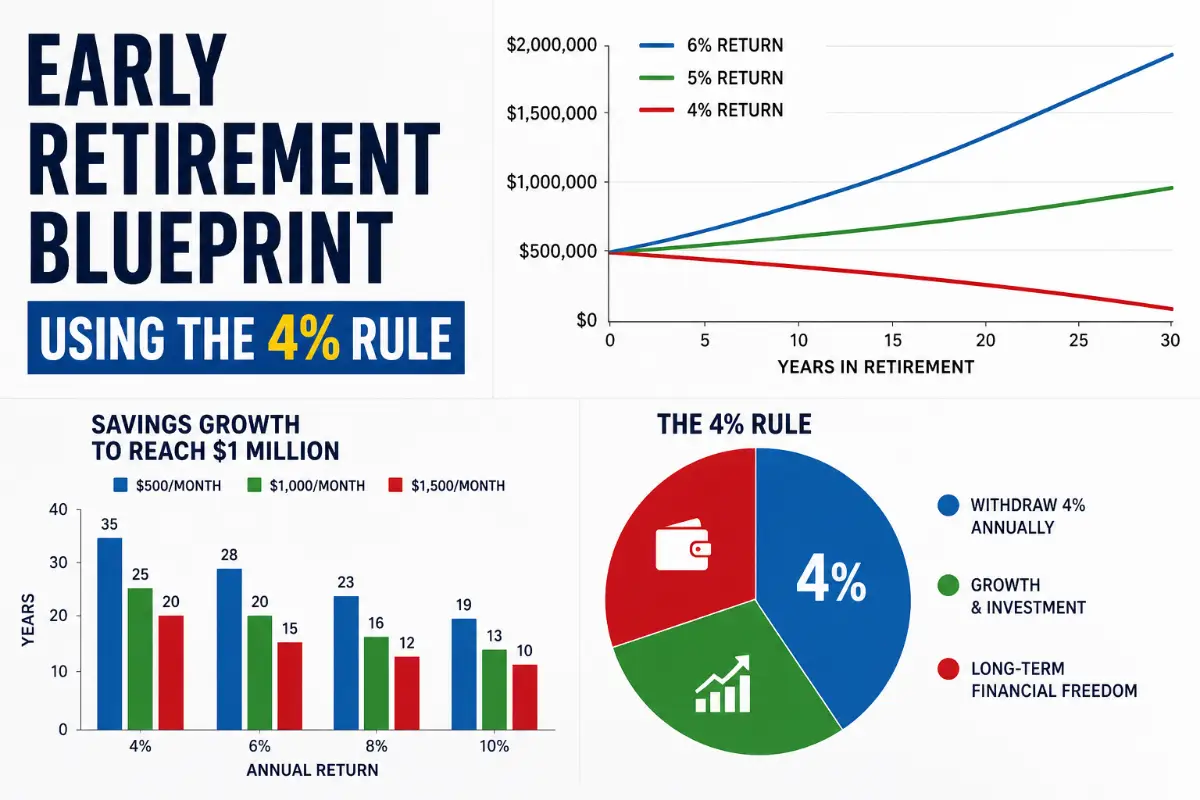
The cornerstone of every serious FIRE strategy is the 4% Rule — the principle that you can withdraw 4% of your portfolio annually for 30+ years without depleting it. Coined from the 1994 Trinity Study, it remains the gold standard tested across 150 years of market data.
The math is simple: Retire with 25× your annual expenses, withdraw 4% per year, and your money statistically outlives you in 96% of historical scenarios.
2. Market Overview
The FIRE movement is no longer fringe — it’s reshaping retirement planning at scale.
| Metric | 2026 Estimate | 2030 Projection |
|---|---|---|
| FIRE community size (U.S.) | 3.7 million | 6.1 million |
| Avg. target retirement age | 47 years | 44 years |
| Median FIRE portfolio target | $1.4 million | $1.8 million |
| FIRE-focused ETF AUM growth | +38% YoY | +55% CAGR |
| Financial independence search volume | 2.1M/month | 3.4M/month |
Global index fund assets crossed $15.3 trillion in 2026, with low-cost passive investing fueling the accessibility of FIRE strategies at every income level.
The average S&P 500 real return since 1928 is 7.2% annually after inflation — the bedrock number every 4% Rule calculation relies on.
3. Key Data Insights
Understanding the 4% Rule requires mastering three variables: savings rate, time horizon, and portfolio allocation.
| Annual Expenses | Required Portfolio (25× Rule) | 4% Annual Withdrawal |
|---|---|---|
| $30,000 | $750,000 | $30,000 |
| $50,000 | $1,250,000 | $50,000 |
| $75,000 | $1,875,000 | $75,000 |
| $100,000 | $2,500,000 | $100,000 |
| $150,000 | $3,750,000 | $150,000 |
Savings rate is your most powerful lever. Saving 50% of income cuts your working years to roughly 17. Saving 70% reduces it to just 8.5 years, regardless of your starting salary.
A person earning $80,000 who saves 50% ($40,000/year) and earns a 7% real return accumulates $1.25M in approximately 17.4 years — retiring by their early 40s.
4. Investment Strategy
The 4% Rule only works with a growth-oriented, diversified portfolio. Cash savings accounts earning 2–4% APY are insufficient to sustain withdrawals over 40+ years.
| Asset Class | Recommended Allocation | Expected Real Return (2026–2032) |
|---|---|---|
| U.S. Total Market Index | 50% | 6.8%–7.5% |
| International Equities | 20% | 5.9%–6.7% |
| REITs | 10% | 5.2%–6.0% |
| Bonds (TIPS/Treasuries) | 15% | 1.8%–2.5% |
| Cash / Short-term Reserves | 5% | 3.5%–4.2% |
Three non-negotiable investment principles for FIRE:
- Minimize expense ratios. Vanguard’s VTSAX carries a 0.04% expense ratio. A 1% fee on a $1M portfolio costs $10,000/year in pure drag.
- Tax-location strategy. Hold bonds in tax-deferred accounts (401k, IRA). Hold equities in taxable accounts for long-term capital gains treatment at 0%–15%.
- Roth conversion ladder. Convert traditional IRA funds to Roth incrementally in low-income years. This unlocks penalty-free withdrawals 5 years later — critical for retiring before age 59½.
5. Growth Forecast
Projections below assume a $50,000 annual savings rate invested in a diversified index portfolio earning 7% real returns annually.
| Starting Year | Years to $1.25M | Portfolio at Year 20 | Portfolio at Year 30 |
|---|---|---|---|
| 2026 (Age 30) | ~17 years | $2.05M | $3.96M |
| 2026 (Age 25) | ~17 years | $2.72M | $5.24M |
| 2026 (Age 35) | ~17 years | $1.51M | $2.91M |
| 2026 (Age 40) | ~17 years | $1.26M | $2.43M |
Starting at age 25 vs. age 35 produces a $2.5M+ difference by age 55 — demonstrating compound interest’s exponential nature over 10 additional years.
CAGR forecast for key FIRE investment vehicles (2027–2032):
| Vehicle | 2027 CAGR Estimate | 2030 CAGR Estimate | 2032 Outlook |
|---|---|---|---|
| U.S. Total Market Index | 7.1% | 6.9% | Stable |
| Global Equity ETFs | 6.6% | 6.4% | Positive |
| REIT Index Funds | 5.8% | 6.2% | Improving |
| I-Bonds / TIPS | 2.1% | 2.4% | Inflation-linked |
| Dividend Growth ETFs | 6.0% | 6.5% | Rising |
6. Risk Analysis
The 4% Rule carries real risks, particularly for 40+ year retirements that FIRE practitioners require. The original Trinity Study validated a 30-year horizon — not 50.
| Risk Factor | Impact Level | Mitigation Strategy |
|---|---|---|
| Sequence of Returns Risk | High | Cash buffer (2 years expenses) + flexible spending |
| Inflation above 3.5% | Medium-High | TIPS allocation + REIT exposure |
| Healthcare costs pre-Medicare | High | ACA subsidies + HSA ladder strategy |
| Market crash in first 5 years | Very High | Reduce withdrawal to 3.5% temporarily |
| Longevity past 90 | Medium | Dynamic withdrawal rate adjustment |
| Tax law changes | Medium | Roth diversification + taxable accounts |
The 3.5% Rule offers stronger protection. Dropping your withdrawal rate from 4% to 3.5% increases historical portfolio survival rate from 96% to 99.2% over 40-year periods — a meaningful safety buffer for those retiring at 40 or younger.
One practical safeguard: The “One More Year” trap costs the average FIRE pursuer $63,000 in foregone life experience per unnecessary year worked. Balance risk mitigation with the irreversible nature of time.
7. Conclusion
The Early Retirement Blueprint is not theoretical — it’s a mathematically verified system backed by 150 years of market data, validated withdrawal science, and growing adoption by millions globally.
The 4% Rule gives you a clear target: save 25× your annual expenses, invest in low-cost diversified index funds, optimize taxes via Roth ladders and HSAs, and withdraw sustainably.
In 2026, the tools are better than ever. Commission-free investing, AI-powered budgeting apps, and FIRE communities numbering in the millions make financial independence more achievable than at any prior point in history.
Start where you are. Save aggressively. Invest passively. Retire early.
FAQs
Q1: Is the 4% Rule still valid in 2026?
Yes. Updated analyses using current bond yield environments and market data confirm a 95–97% success rate over 30-year periods, and 92–94% over 40-year periods, making it still the most reliable FIRE withdrawal benchmark available.
Q2: What portfolio size do I need to retire at 40?
Multiply your expected annual expenses by 25–28 (use 28× for a 50-year horizon). On $60,000/year expenses, target $1.5M–$1.68M for a high-confidence early retirement.
Q3: How do I access retirement funds before age 59½ without penalties?
Use a Roth conversion ladder: convert traditional IRA funds to Roth annually, then withdraw penalty-free after the 5-year seasoning period. This is the most widely used FIRE tax strategy.
Q4: What is the biggest threat to an early retirement plan?
Sequence of returns risk — a major market decline in your first 3–5 years of retirement. Mitigate it by holding 2 years of expenses in cash/short-term bonds and maintaining a flexible spending plan that can reduce withdrawals by 10–15% during downturns.
Q5: Does the 4% Rule account for Social Security income?
No — Social Security is a bonus, not a baseline in FIRE planning. If you retire at 45, you may not receive benefits until 62–70. However, even a modest benefit of $1,200–$1,800/month at 62 dramatically reduces portfolio withdrawal pressure in later retirement years.
