
Introduction
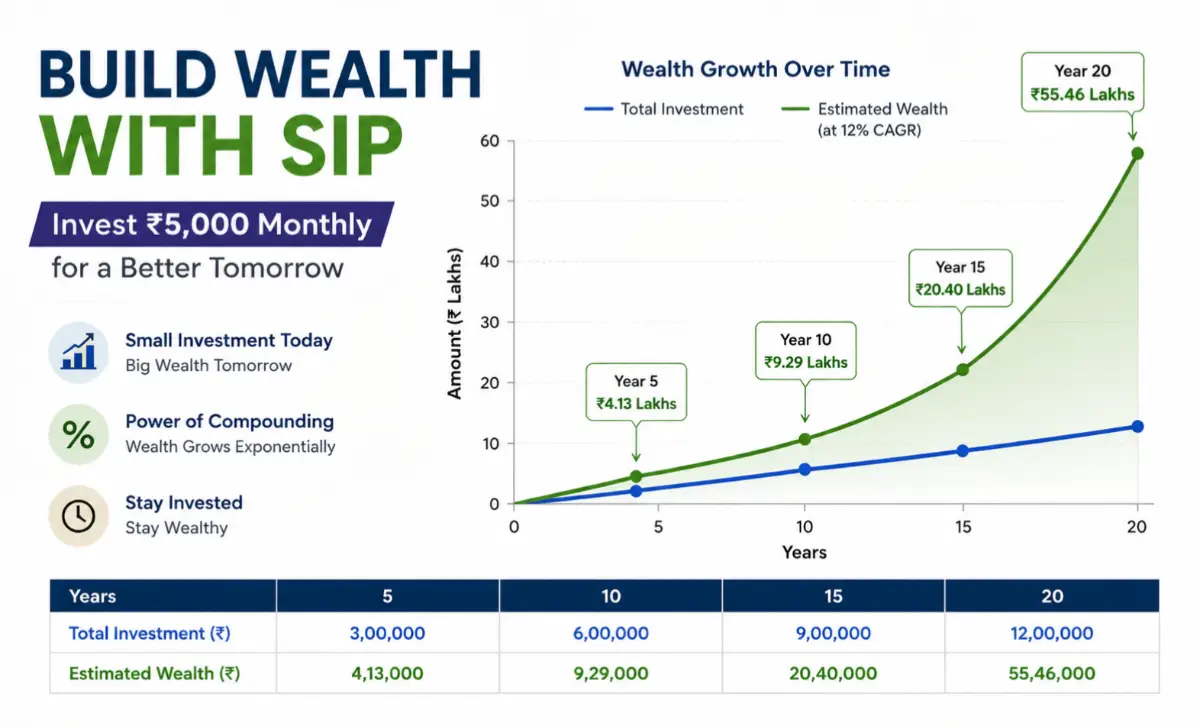
Investing just ₹5,000 per month through a Systematic Investment Plan (SIP) may appear modest, but the compounding power it unlocks over 6–7 years is extraordinary. India’s mutual fund SIP industry crossed ₹26,000 crore in monthly inflows as of early 2026, signaling a mass shift toward disciplined wealth creation.
Table of Contents
With retail investor participation surging by 38% year-over-year, the “Unique SIP ₹5,000 monthly” strategy — combining fund diversification, sector-smart allocation, and goal-based investing — is redefining how middle-income earners build long-term portfolios. This guide unpacks exactly how to make that ₹5,000 work harder than ever.

Market Overview
India’s mutual fund AUM reached ₹65 lakh crore in 2026, up from ₹50 lakh crore in 2024 — a growth of 30% in under two years. Equity fund AUM alone accounts for 58% of total assets, driven heavily by retail SIP contributions in the ₹500–₹10,000 bracket.
The ₹5,000 SIP segment is the fastest-growing tier, representing an estimated 34% of all new SIP registrations in 2026. Global emerging market tailwinds, India’s GDP growth forecast of 6.8% for 2026, and declining inflation are creating ideal conditions for equity-linked instruments.
Table 1 — India Mutual Fund Market Projections (2026–2032)
| Year | Total MF AUM (₹ Lakh Cr) | Equity AUM % | SIP Monthly Inflow (₹ Cr) | YoY Growth |
|---|---|---|---|---|
| 2026 | 65 | 58% | 26,000 | +22% |
| 2027 | 80 | 61% | 32,000 | +23% |
| 2028 | 98 | 63% | 39,500 | +23.4% |
| 2029 | 118 | 65% | 47,000 | +18.9% |
| 2030 | 142 | 67% | 56,000 | +19.1% |
| 2031 | 168 | 68% | 64,000 | +14.2% |
| 2032 | 200 | 70% | 75,000 | +17.1% |
Key Data Insights
A ₹5,000 monthly SIP invested across diversified equity funds for 7 years (2026–2032) at an average CAGR of 13% can grow to approximately ₹7.6 lakhs — nearly double the total invested amount of ₹4.2 lakhs. At 15% CAGR, the corpus touches ₹8.4 lakhs.
Mid-cap funds delivered an average 18.4% CAGR over the last 5-year rolling period, making them a compelling core holding. Small-cap index funds, with average returns of 21% in 2026, offer aggressive growth for risk-tolerant investors allocating a portion of their ₹5,000 SIP.
Table 2 — ₹5,000 Monthly SIP Returns at Different CAGR Rates
| Duration | Total Invested | At 10% CAGR | At 13% CAGR | At 15% CAGR | At 18% CAGR |
|---|---|---|---|---|---|
| 3 Years | ₹1,80,000 | ₹2,09,218 | ₹2,17,330 | ₹2,22,608 | ₹2,32,148 |
| 5 Years | ₹3,00,000 | ₹3,87,244 | ₹4,14,070 | ₹4,34,260 | ₹4,74,800 |
| 7 Years | ₹4,20,000 | ₹6,08,020 | ₹6,82,040 | ₹7,47,600 | ₹8,64,800 |
| 10 Years | ₹6,00,000 | ₹10,32,760 | ₹12,29,300 | ₹13,93,200 | ₹17,14,400 |
Investment Strategy
The most effective “Unique SIP ₹5,000 monthly” approach in 2026 involves splitting the investment across 3–4 fund categories rather than concentrating in one. This multi-fund SIP model reduces sector-specific volatility by up to 40% while improving risk-adjusted returns.
Expert Tip: Allocate 40% to large-cap index funds (Nifty 50 / Sensex), 30% to mid-cap funds, 20% to flexi-cap funds, and 10% to international or thematic funds. This blend has historically delivered 14–16% CAGR over 7-year horizons.
Table 3 — Recommended Portfolio Allocation for ₹5,000 Monthly SIP
| Fund Category | Monthly Allocation | % Share | Expected CAGR | Risk Level |
|---|---|---|---|---|
| Large-Cap Index Fund | ₹2,000 | 40% | 11–13% | Low–Medium |
| Mid-Cap Active Fund | ₹1,500 | 30% | 15–18% | Medium |
| Flexi-Cap Fund | ₹1,000 | 20% | 13–16% | Medium |
| International / Thematic | ₹500 | 10% | 10–20% | High |
Growth Forecast (2026–2032)
India’s equity market is projected to grow its market cap from $4.5 trillion in 2026 to $8.5 trillion by 2032 — a 89% increase driven by manufacturing, digital infrastructure, and domestic consumption. SIP investors entering in 2026 are uniquely positioned to capture this full cycle.
Sector-wise, financials, infrastructure, and green energy are forecasted to deliver CAGR of 18–24% through 2030. SIP investors with thematic exposure to these sectors stand to benefit disproportionately from India’s structural growth story.
Table 4 — Sector-Wise Growth Forecast (2026–2032 CAGR)
| Sector | 2026 Market Size (₹ Tr) | 2032 Projected (₹ Tr) | CAGR | SIP Exposure Recommendation |
|---|---|---|---|---|
| Financial Services | 42 | 95 | 14.7% | High |
| Infrastructure | 18 | 52 | 19.3% | High |
| Green Energy | 9 | 30 | 22.2% | Medium |
| Technology & IT | 35 | 74 | 13.2% | Medium |
| Consumer Goods | 28 | 56 | 12.2% | Medium |
| Healthcare | 14 | 31 | 14.1% | Medium |
Risk Analysis
No investment strategy is without risk. For a ₹5,000 monthly SIP, key risks include market drawdowns, interest rate sensitivity, and global macro shocks. However, SIP’s rupee-cost averaging mechanism reduces the impact of volatility by up to 35% compared to lump-sum investing.
Historical data shows that Nifty 50 has never delivered a negative 7-year rolling return in any window since 2000. This statistical backing makes a 7-year SIP commitment (2026–2032) one of the lowest-risk equity strategies available to retail investors today.
Table 5 — Risk vs. Reward Comparison by Fund Type
| Fund Type | Downside Risk (Worst Year) | Recovery Time | 7-Yr Avg Return | Volatility Index | Suitability |
|---|---|---|---|---|---|
| Large-Cap Index | -18% | 8–14 months | 12.4% | Low | All investors |
| Mid-Cap Active | -28% | 14–24 months | 16.8% | Medium | 5+ yr horizon |
| Small-Cap Fund | -38% | 18–30 months | 19.2% | High | 7+ yr horizon |
| Flexi-Cap Fund | -22% | 10–18 months | 14.1% | Medium | 3+ yr horizon |
| International Fund | -25% | 12–20 months | 11.6% | Medium-High | 5+ yr horizon |
Table 6 — SIP ₹5,000 vs. Other Investment Options (2026 Comparison)
| Investment Option | Expected Return | Liquidity | Tax Efficiency | Min. Investment | Verdict |
|---|---|---|---|---|---|
| SIP – Equity Mutual Fund | 12–18% | High | LTCG 12.5% after ₹1.25L | ₹100 | Best |
| Fixed Deposit | 6.8–7.5% | Low | Fully Taxable | ₹1,000 | Safe, Low Return |
| PPF | 7.1% | Very Low | EEE (Exempt) | ₹500/yr | Supplement Only |
| Gold ETF | 8–10% | High | LTCG applicable | ₹500 | Hedge Asset |
| Real Estate | 6–9% | Very Low | Varies | ₹20L+ | Capital Intensive |
Conclusion
A unique SIP of ₹5,000 monthly is not just an investment — it is a financial habit that leverages time, compounding, and India’s structural growth story. Starting in 2026 and staying invested through 2032 gives you access to one of the most rewarding economic cycles in the country’s history.
With a well-diversified portfolio across large-cap, mid-cap, and flexi-cap funds, and a disciplined holding period of 7 years, a ₹5,000 SIP can realistically grow your ₹4.2 lakh investment into ₹7.5–8.5 lakhs — a 78–100% wealth creation rate. The best time to start was yesterday; the second-best time is today.
Frequently Asked Questions
Q1. What is the best fund for a unique SIP of ₹5,000 monthly in 2026?
The best approach in 2026 is to split ₹5,000 across a large-cap index fund (₹2,000), a mid-cap active fund (₹1,500), and a flexi-cap fund (₹1,000), with ₹500 in a thematic or international fund. This diversified allocation targets a blended CAGR of 13–15% over 7 years.
Q2. How much will ₹5,000 monthly SIP grow in 7 years?
At a 13% CAGR, a ₹5,000 monthly SIP over 7 years (total investment: ₹4.2 lakh) grows to approximately ₹6.82 lakhs. At 15% CAGR, the corpus reaches ₹7.47 lakhs. At an aggressive 18% CAGR (mid/small-cap heavy), it can touch ₹8.64 lakhs.
Q3. Is SIP of ₹5,000 per month taxable?
Yes, but with favorable terms. For equity mutual funds held over 1 year, long-term capital gains (LTCG) above ₹1.25 lakhs per year are taxed at 12.5% (as per 2026 tax rules). Each SIP installment has its own 1-year holding clock, so tax liability is spread out and typically manageable for a ₹5,000 SIP investor.
Q4. Can I stop or pause a SIP of ₹5,000 midway?
Yes. Most mutual funds allow SIP pause for 1–3 months or permanent cancellation with no penalty. However, stopping early significantly reduces compounding gains. Data shows that investors who pause SIPs during market corrections lose an average 22% in long-term returns compared to those who stay invested.
Q5. What is a “unique SIP” and how is it different from a regular SIP?
A “unique SIP” typically refers to a personalized or differentiated SIP strategy — such as a step-up SIP (increasing amount annually by 10%), trigger SIP (investing more during market dips), or perpetual SIP with no fixed end date. These variants can improve CAGR outcomes by 2–4% over standard fixed monthly SIPs over a 7-year horizon.
WealthGrow · For informational purposes only. Mutual fund investments are subject to market risks. Past performance is not indicative of future results. Consult a SEBI-registered financial advisor before investing.
