
Introduction: Turning Your Investments into a Steady ₹25,000 Monthly Income
Imagine this: you retire or want to take a short break from work — yet, every month, ₹25,000 lands quietly in your bank account. No tension, no calls from brokers, and no sleepless nights over market swings. Sounds like a dream?
Well, it’s completely achievable through something called an SWP — Systematic Withdrawal Plan.
If you’ve already invested in mutual funds and now wish to enjoy a steady monthly income, the SWP strategy can help you turn your investment corpus into a consistent cash flow — without disturbing your long-term goals.
In this guide, we’ll explain how an SWP works, how much you need to invest for ₹25,000 monthly income, and which funds suit this goal best — all in simple, human terms.
What Is an SWP (Systematic Withdrawal Plan)?
An SWP (Systematic Withdrawal Plan) is a smart mutual fund feature that lets you withdraw a fixed amount regularly — monthly, quarterly, or annually — from your mutual fund investment.
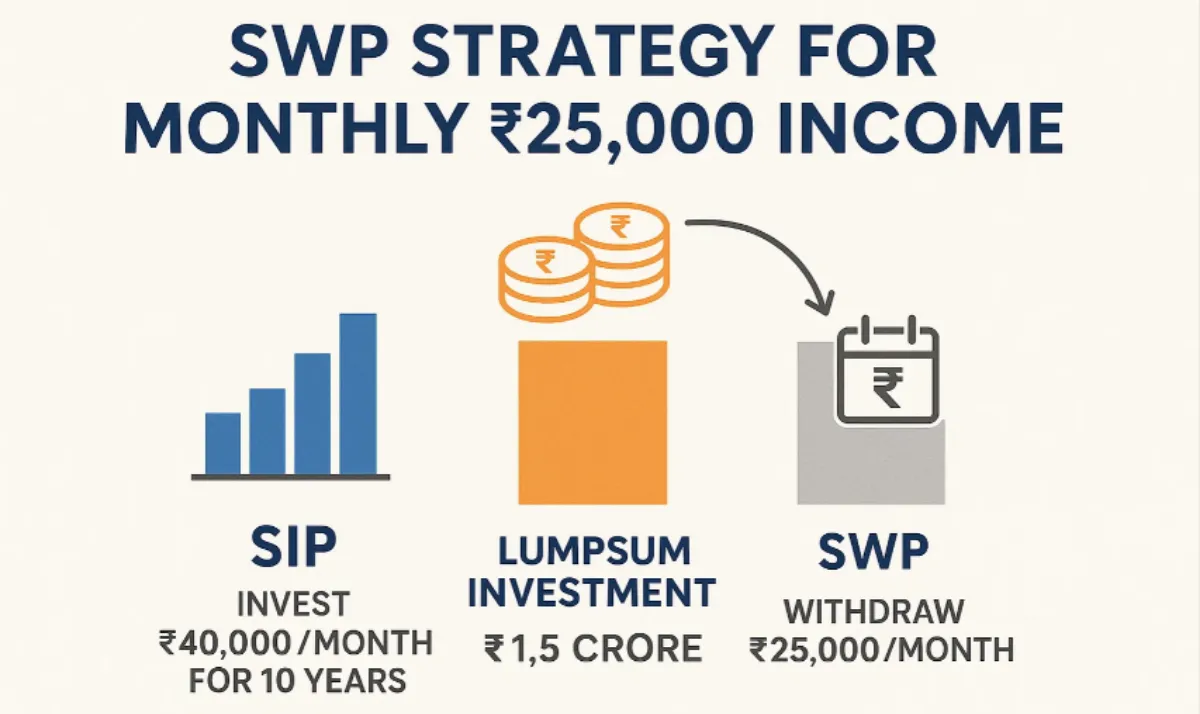
Think of it as the opposite of SIP (Systematic Investment Plan).
- In SIP, you invest regularly into a fund.
- In SWP, you withdraw regularly from your fund.
It’s like setting up a personal monthly salary from your mutual fund corpus.
So, instead of redeeming your entire investment at once, you withdraw only what you need — letting the rest of your money continue to grow through compounding.
How Does SWP Work in Real Life?
Let’s understand with a simple example:
| Scenario | Details |
|---|---|
| Investment Corpus | ₹30 lakh |
| Fund Type | Balanced Advantage Fund |
| Expected Annual Return | 10% |
| SWP Amount | ₹25,000 per month |
| Annual Withdrawal | ₹3 lakh |
| Net Growth (approx.) | ₹30 lakh × (10% – 3%) = ₹2.1 lakh growth yearly |
So even after withdrawing ₹3 lakh annually, your remaining corpus continues to grow due to the 10% annual return.
This balance between income generation and capital preservation is what makes SWP so powerful for investors — especially retirees or those seeking passive income.
How Much Corpus Do You Need for ₹25,000 Monthly SWP?
The most common question investors ask is:
“How much should I invest to earn ₹25,000 per month through SWP?”
Let’s calculate using realistic assumptions.
Scenario 1: Moderate 8% Return Fund
| Monthly SWP Goal | Expected Annual Return | Safe Withdrawal Rate (6%) | Required Corpus |
|---|---|---|---|
| ₹25,000/month | 8% | 6% | ₹50 lakh |
In this scenario, if you invest ₹50 lakh, you can comfortably withdraw ₹25,000 every month for several years, assuming the fund grows around 8% annually.
Also Read: ₹11,480 Crore Created by Top Performing SWP Mutual Funds
Scenario 2: Aggressive 10% Return Fund
| Monthly SWP Goal | Expected Annual Return | Safe Withdrawal Rate (8%) | Required Corpus |
|---|---|---|---|
| ₹25,000/month | 10% | 8% | ₹37.5 lakh |
Here, with a slightly higher return expectation (10%), you need around ₹37.5 lakh corpus to generate the same ₹25,000 monthly income.
Scenario 3: Conservative 6% Return Fund
| Monthly SWP Goal | Expected Annual Return | Safe Withdrawal Rate (5%) | Required Corpus |
|---|---|---|---|
| ₹25,000/month | 6% | 5% | ₹60 lakh |
If you prefer safer funds like debt or hybrid funds, you’ll need ₹60 lakh to generate ₹25,000 monthly with minimum risk.

The “4%–6% Rule” for Sustainable SWP Income
Experts often suggest a 4%–6% annual withdrawal rate for SWPs.
Here’s what that means:
- If your corpus earns around 8–10% yearly, withdrawing 4%–6% per year helps preserve your principal for long-term use.
- For example, with ₹50 lakh corpus, withdrawing ₹2–3 lakh per year (₹16,000–₹25,000/month) is safe and sustainable.
In short:
Withdraw too little = you underutilize your money.
Withdraw too much = you risk exhausting your corpus early.
Balance is the key.
Why SWP Is Better Than Bank FD or Monthly Income Schemes
Let’s compare SWP with traditional income options:
| Feature | SWP (Mutual Funds) | Bank FD | Post Office MIS |
|---|---|---|---|
| Return Potential | 8–12% (equity-oriented) | 6–7% | 6.6% |
| Tax Efficiency | Capital Gains Tax (lower) | Interest taxed as income | Interest taxed as income |
| Liquidity | High | Moderate | Limited |
| Flexibility | Fully customizable | Fixed term | Fixed term |
| Inflation Protection | Yes (if equity-based) | No | No |
Verdict: SWP offers better post-tax returns, flexibility, and inflation protection, making it ideal for long-term monthly income planning.
How to Set Up an SWP for ₹25,000/Month
Follow these 5 simple steps:
Step 1: Choose the Right Mutual Fund
Prefer funds with consistent returns, moderate volatility, and low expense ratios.
Top categories include:
- Balanced Advantage Funds
- Conservative Hybrid Funds
- Equity Savings Funds
- Short-duration Debt Funds (for low risk)
Step 2: Calculate Required Corpus
Use the 6% rule:
Corpus = (Desired Monthly Income × 12) ÷ 0.06
Corpus = (₹25,000 × 12) ÷ 0.06 = ₹50 lakh approx.
Step 3: Start SWP After 1-Year Holding
Avoid starting withdrawals immediately after investment.
Let your corpus grow for at least 12 months before activating SWP.
Step 4: Set SWP Frequency
Choose monthly payouts to mimic a salary-like income.
Step 5: Review Performance Every 6–12 Months
Adjust withdrawal amounts if market returns change significantly.
Best SWP-Friendly Mutual Funds (as of 2025)
| Category | Fund Name | 5-Year CAGR | Risk Level | Best For |
|---|---|---|---|---|
| Balanced Advantage | HDFC Balanced Advantage Fund | 12.3% | Moderate | Long-term SWP |
| Conservative Hybrid | ICICI Pru Regular Savings Fund | 8.9% | Low | Retirees |
| Equity Savings | Kotak Equity Savings Fund | 9.5% | Moderate | Regular Income |
| Debt Fund | Axis Short Term Fund | 7.2% | Low | Conservative investors |
| Dynamic Asset Allocation | Edelweiss Balanced Advantage Fund | 11.8% | Moderate | Growth + Income |
(Data Source: AMFI, Value Research, 2025)
Expert Insights: How to Maximize Your SWP Returns
1. Choose Growth Option, Not Dividend
Always select the Growth option in mutual funds — SWP will withdraw from your capital gains, not depend on fund house declarations.
2. Diversify Your Portfolio
Split your corpus:
- 60% in hybrid or balanced funds
- 40% in short-duration debt funds
This ensures steady growth plus stability.
3. Avoid Starting SWP in Bear Markets
If markets are falling, delay SWP activation by a few months to protect your corpus.
4. Reinvest Surplus Income
If you don’t need all ₹25,000 monthly, reinvest part of it in low-risk funds to maintain compounding.
Also Read: SWP mutual fund plans for ₹1 crore investment
Taxation of SWP Withdrawals (Simple Explanation)
Unlike bank interest, SWP withdrawals are not fully taxed.
Only the gains portion of each withdrawal is taxable.
For Example:
You invested ₹10 lakh in a balanced fund.
After a year, your investment grows to ₹11 lakh.
You withdraw ₹1 lakh through SWP.
Here’s how it works:
- ₹90,909 = principal (no tax)
- ₹9,091 = gain (taxable)
So, you pay tax only on ₹9,091, not the entire ₹1 lakh.
Tax Rates (as of FY 2025–26):
| Fund Type | Holding Period | Tax Rate |
|---|---|---|
| Equity-Oriented | < 1 year | 15% (STCG) |
| Equity-Oriented | > 1 year | 10% (LTCG above ₹1 lakh) |
| Debt-Oriented | < 3 years | As per income slab |
| Debt-Oriented | > 3 years | 20% with indexation |
Tip: Prefer hybrid or equity savings funds for better post-tax income.
SWP vs Dividend Option — Which Is Better?
| Aspect | SWP (Growth Option) | Dividend Option |
|---|---|---|
| Flexibility | You choose withdrawal amount | Fund decides payout |
| Taxation | Only capital gains taxed | Dividend taxed at your slab |
| Corpus Control | Full control | Limited |
| Reliability | Guaranteed withdrawal | Uncertain payout frequency |
Verdict: SWP (Growth Option) is more flexible and tax-efficient.
Real-Life Example: ₹50 Lakh Corpus SWP Plan
Let’s simulate a real investor case:
| Details | Values |
|---|---|
| Initial Corpus | ₹50,00,000 |
| Fund Type | Balanced Advantage Fund |
| Expected Return | 9% per annum |
| Monthly Withdrawal | ₹25,000 |
| Tenure | 10 years |
After 10 years:
- Total withdrawal = ₹30 lakh
- Corpus value (approx.) = ₹58–60 lakh
You received ₹25,000/month for 10 years and still retained most of your principal.
Table: SWP Monthly Income for Different Corpus Levels
| Corpus Amount | Expected Return (8%) | Safe SWP/Month |
|---|---|---|
| ₹20 lakh | Moderate | ₹10,000 |
| ₹30 lakh | Moderate | ₹15,000 |
| ₹40 lakh | Moderate | ₹20,000 |
| ₹50 lakh | Moderate | ₹25,000 |
| ₹60 lakh | Moderate | ₹30,000 |
(Assuming 6% annual withdrawal rate)
Common Mistakes to Avoid in SWP
- Starting SWP immediately after investment
- Choosing 100% equity fund for income generation
- Ignoring tax implications
- Not reviewing performance annually
- Withdrawing higher than 8% annually (unsustainable)
“A well-planned SWP strategy ensures steady income, tax efficiency, and longevity of your portfolio. Treat it like a personal pension, not an ATM.”
— Raghav Choudhary, Certified Financial Planner (CFP)
Tools to Calculate Your SWP
You can use:
- Groww SWP Calculator
- ET Money SWP Planner
- SBI Mutual Fund SWP Tool
These help estimate how much corpus is needed for your desired monthly income.
Summary: Key Takeaways
| Aspect | Key Insight |
|---|---|
| Target Income | ₹25,000/month |
| Ideal Corpus | ₹37–50 lakh |
| Safe Withdrawal Rate | 4%–6% annually |
| Best Fund Type | Balanced Advantage / Hybrid |
| Tax Advantage | Only on gains, not full amount |
| Goal | Steady, inflation-beating income |
Conclusion: Make Your Money Work Like a Monthly Salary
SWP isn’t just a withdrawal plan — it’s a financial lifestyle strategy.
It gives you the freedom to enjoy your money without killing the compounding effect of mutual funds.
Whether you’re planning retirement, aiming for part-time work, or simply want steady ₹25,000/month passive income, the SWP route makes it possible — smartly and sustainably.
Start small, diversify, review regularly, and let your money work for you, month after month.
CTA
Want to explore which mutual funds can generate ₹25,000 monthly income for you?
Visit SmartBlog91.com for in-depth fund comparisons, SWP calculators, and expert guides designed for Indian investors.
